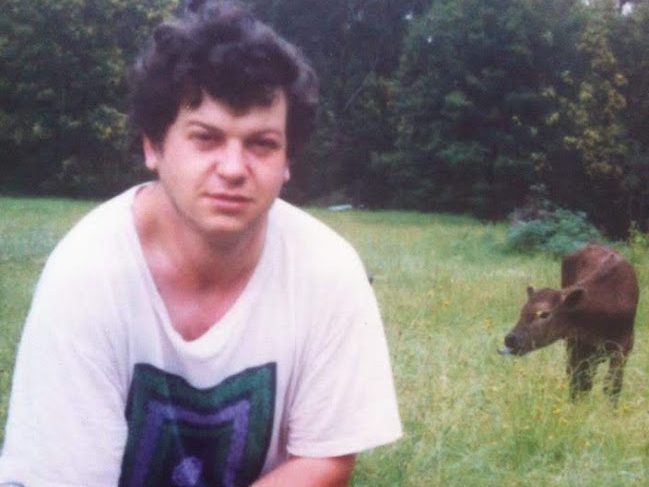
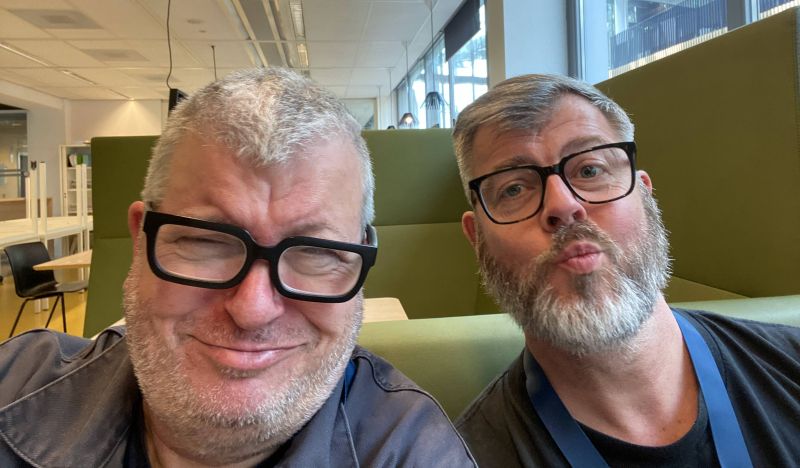
Karl and I have been fellow accessibility travellers for many years. We worked together at TPGi in the 2010’s. Although we don’t always agree I have immense respect for Karl and his contributions to accessibility. I even like him, in a Jim and Wilson kinda way.
Transcript
Steve:
Well, hello, Karl Groves, thank you for being on the fireside chat, I haven't talked to you, when was the last time I saw you, was that, that was at CSUN last year.

Karl:
Was it or was it, because you didn't come to the, did you come to the Accessibility Club in, you went to the one in Amsterdam, I went to the one in Amsterdam, yeah, I saw you there.

Steve:
I've got some nice pictures of you and I. Good, yeah, I'll share them, but at a suitable point with you. Yeah, so I haven't seen you for an age, but we have worked for the same companies, worked for, you know, different companies, but, you know, we've always had a similar, can I say that we have a similar view when it comes to accessibility and how it can be done right and the importance of the mechanics of accessibility, I think, in particular.

Yeah, so, yeah, so I've always enjoyed your work, your output. The only thing I would say, Karl, is that I find some of your articles, because you write them in, sometimes in a marketing style, and I've never really been, like, you know, you read, I don't like, I'm not saying this is you now, but I don't like articles where from, you know, from other companies that, that start off with, you know, a kernel of truth and then just turn into a reason.

Karl:
Sales pitch.

Steve:
Yeah, sales pitch.

Karl:
Yeah.

Steve:
I mean, I've never done it and I don't want to do it. I mean, if you're going to convey, not, again, I'm not talking about you, but if what is to convey is to give information, you know, and I think that's vital to our industry and vital to our communities, be able to share the techniques that make stuff more accessible. Yeah, that's what I do.

Karl:
Avoid that. So I've tried to avoid that, but call me out on it if I, if I don't. I mean, I always do.

I always do have a little byline in there that says, hey, if you need help with this stuff, give me a shout. But I try to avoid doing it, you know, because I, because I actually follow your lead a lot with that, because for years you've been doing, I don't know, a brief note on X and it's just, just sort of a brain dump, right? And it's a brain dump on a specific topic and you sort of put it out there and then you're done.

And I've kind of been following that sort of same, that's my approach to talks and that's my approach to writing is basically like the sales pitch is Karl Groves knows what the hell he's talking about. We should reach out to him for, you know what I mean? So, so it's always been that kind of thing where it's, where it's been, you know, I want to, I want to share a bunch of knowledge and then, and then people might be like.

Steve:
Maybe I just haven't realized, I've just been turned off by you and I haven't bothered to look at the things. Sorry. Yeah, but do it, call me out, man.

I will revisit. Yeah, I will revisit, but I, yeah, as again, it's, what I was pointing out was a general thing that, you know, there was some, some of the accessibility companies tend to write these things that are just, you know, market. And I'm sure that things have got a lot worse since people started using AI to write their shit.

I, I know that, that you have a, well, from what I understand, or from what I've seen is that you have a more optimistic view than others about accessibility and AI. Yeah. Can you elucidate a bit on that?

Karl:
Yeah, I mean, well, there is the, the whole overall idea of AI itself and, and whether that's a good thing or a bad thing for the world, that's, it's a different discussion. When it was, when it comes to accessibility, I think that, I think that we are at a point where you can get a lot of efficiency out of it. In other words, it's a bit, it's a, my feeling on AI is very similar to my feeling on automatic testing, if you think about it, which is that it's a tool that if it, that if it's well placed in what you're doing, if you're using it intelligently, it's awesome.

And that, that just comes from, and that's just my perspective on digital accessibility, you know, in terms of what we do for a living. Yeah. If we're talking about AI and other accessibility related stuff, you can't deny how amazing AI is now and will be in the future in terms of bridging the gaps of, you know, if you were, if you remember, I mean, first, for instance, I'm looking at the automatic captions that we have now, because, because I'm older, my hearing is not as great as it used to be.

And especially people with, with accents. I turn this on when someone has an accent. And if you've been using this for any length of time, you realize that it's gone from complete garbage to pretty awesome.

You know what I mean? And same thing goes for image recognition, right? Like AI recognition used to be total crap, and now it's pretty darn good.

So I think we're getting to a point where it's a extremely useful tool.

Steve:
I'm not denying that it's, that it's useful, but I don't, what I am not convinced of yet is it's useful for doing automated testing of accessibility. I haven't seen anything as yet. Like I understand the utility of things like, well, even for captioning, I mean, I've been making use of several third party online, you know, I've been paying, paying good money to, to use these things.

I found one now, which is Turbo something. What's it called? TurboScribe, which is better than, than what was before.

But it still does some, you know, like I, I was, I still have to go through and read every line and make sure, which I just did. I mean, I'm sure there's some things that were in there. I just did with Matt's talk, which I just released today.

But the, yeah, it comes up with, yeah, like I gave an example, I tweeted out, tweeted, tooted, whatever the word is. Socialized a mistake that I found in, in the, the captioning that I was, that I was doing and instead of HTMLZ, which I understand is a, is an old acronym, it said Haitian Mosley, which is sort of interesting because I don't know if you're aware of Edward, was it Oswald Mosley or Edward? He was a fascist politician from, from the early days.

He's like a, you know, sort of like proto-Nigel Farage from the UK. And he talked about the rivers of blood being, you know, the running through the streets of the UK. So anyway, it was sort of triggered me a little bit when I saw the "Haitian Mosley".

Karl:
But also, Hey guys, it's just a, it's a tool, like it's, it's not going to replace a skill, just like an automatic testing tool. It's not going to be, it's at least not for years now. I'm not going to replace anything.

It's not, and, and I have seen, I actually have seen companies that have used, like ChatGPT for whatever reason to do, to do audits and they're horrible, right? And so, so to the extent that you're using something intelligently, that you know what you're doing and then you're going to get in, you're going to be involved in ensuring its quality, then, then sure. But not a chance.

You know, somebody said, if somebody says to me that they're, they're doing AI audits, I'm like, yeah, that's garbage. And that should be run fast. You know.

Steve:
Have you, I don't know, but we know that, that our compadres at Deque have been investing heavily in, in AI and, and Axe AI and et cetera. And they made that wild claim, which, which was rightly called out that it was going to be a hundred percent, you know, testing, which, yeah.

Karl:
You know, you gotta, for those, I mean, that's the other thing is like a large language model like Claude or, or ChatGPT or whatever, like that's not doing, that's not going to do anything. Useful testing. But something like what Deque is doing, they're not going to get to a hundred percent with it, but they are actually training a model.

Right. And they're taking, they're taking failure information. They're taking the input that you, that the user puts into it.

And they're using it to train a model that's going to continuously feed. And at that point it does become, it's a data problem. Right.

And so what, what they're trying to solve by crowdsourcing this is the same thing that like, like the, that is happening with CAPTCHAs, like for CAPTCHAs for a very long time, where we're like, find the bike on the street, find the crosswalk, find the buses, right. They're using that to train vision models for automatic driving cars. Right.

And you see right now, you still see instances where automatic self-driving cars from Waymo are still getting tripped up. You know what I mean? Like, and so now we have, now you can understand the scale of what, what we're looking at in terms of automatic testing is that Deque has no chance in hell of ever getting the same amount of data that CAPTCHAs are.

Yeah. For self-driving cars. I mean, it's a different problem space where a self-driving car has like no room for error.

Like that's a public safety issue. Whereas Deque's got a, they got a much smaller burden of the accuracy, but that's kind of what's happening is they're using that to scale, to scale this data problem. That's, it's really, really hard.

And that kind of thing does have promise in the future, but are they going to get to a hundred percent? Not a chance. I mean, look at, look at automatic captioning.

And as you were just talking about automatic captioning, what is that? 80%? Yeah.

Steve:
I'd say, yeah. I'd say, I mean, it's helpful. The reason why I hadn't been using it, I was just, well, I was just using the YouTube and then, and then pulling them down.

But then somebody came along and said to me, oh, it will be helpful if you had the speaker names.

Karl:
Yeah.

Steve:
So that was difficult. That adds another layer of complexity to it. And also another layer of possible failures.

But with this, it sounds like I'm, I think that for 10% off, you could use turbo, whatever it is. Right. No, no.

I mean, but that's what I started. And I found that is actually, because what I want and what we all want is things that are going to increase our productivity and do the shit that we don't want to do.

Karl:
Yeah.

Steve:
Unfortunately, that most of the time we still have to do the shit because it requires our judgment and expertise and understanding.

Karl:
And it's not going, and it's really not going to bridge the expertise gap too much. You know what I mean? In other words, I believe AI-based testing and stuff like that is going to be an efficiency boost for somebody like you and me, but it's not going to make someone who doesn't know as much as us as good as us.

Steve:
Yeah.

Karl:
You know what I mean?

Steve:
Yeah. Yeah. Well, I mean, it's still, yeah.

That's the thing I always find is that in order to judge the veracity of any statement made by AI, you need to have the experience and understanding of the subject matter. And if you have that, then you don't really need the AI to do it in the first place. But it's an interesting, I mean, don't get me wrong.

I use AI not a huge amount, but I mean, I've used it to develop, you know, sort of proofs concepts for internal processes, you know, to like the processes that we use. So, but essentially just building, you know, I get it to build Python scripts for me that I can't do because I'm shit at coding, always have been, always will be. Unlike yourself and, you know, others that are, that I know like Pat and Joe Lamy, man, even, and Ian, and, you know, they know how to code.

I don't, I can code, but, you know, nothing beyond.

Karl:
Not like them.

Steve:
Yeah. Not like them, not the most basic, but so it's helpful in that way, but it ends up, it always makes a shitty thing, but at least it does make a thing that I can say to others, this is what I want. You know, this is what I want to achieve.

So anyway, let's go to the Rogues Gallery, Karl, because it's 20 minutes in and we haven't even looked at the gallery yet. So let me share my screen. That was, oh, that's sorry, free advertisement for TurboSquid all the time, but it's not.

Hold on now. There we go. Okay.

We've got the Rogues Gallery and I change it up for each person. So I've got a number of people I think that you may know or not know, blah, blah, blah. So who's top left?

Karl:
Top left?

Steve:
Yeah, top, the very, here.

Karl:
The face is David Swallow.

Steve:
Yes. Yeah. The body is Joe Humbert.

Um, he's weird. I made this series of shirts. And this is for, for, uh, whatever, 4.7 Focus Visible. And they show you that I sell demon. Dave's obviously not a demon. Um, but that's just to show an example of, uh, of Focus, um, being visible.

Okay. Yeah. The show that I sell demon, because when I was at TPG, we used to have, uh, you used to have the daily meetings or, you know, and so there used to be loads of people there.

Um, people such as Swallow or whoever, uh, but it was usually someone I knew who didn't turn their camera on. I used to shout, show yourself demon. So it was, yeah, that was the Swallow.

All right. So going. Yeah.

I mean, uh, I actually, Dave's coming to, to visit, uh, my, uh, manor next Friday.

Karl:
Oh yeah.

Steve:
So yeah. Yeah. He's going to stay the night and then he's doing a park run, but I, I'm going to state the browser next weekend, which I'm looking forward to.

And, um, Adrian is flying in international jet setter that he is. So Adrian, so who's this, uh, chat Dylan barrel.

Karl:
Yeah.

Steve:
Yeah. It's funny enough because I've heard people we've called referred to him as Dylan and Darrell and Dwayne. Yeah.

Dwayne barrel. I mean, I, I never know. obviously it is Dylan.

So it's obviously someone, you know, someone you, have you ever worked directly with Dylan?

Karl:
Yeah. I worked with him at DQ long, long, long, long time ago.

Steve:
And I'm sure you formed a strong and everlasting bond.

Karl:
Yes. Yes. One that persists to this day.

Steve:
And who's next? Who's this handsome chap?

Karl:
That is Patrick Lauke. And I think I was there when that picture was taken.

Steve:
No, I don't think you were. This was actually when we, uh, on our trip to Dunnington.

Karl:
Oh, okay. I thought that was when we were in Ireland.

Steve:
No, no, no. It's ageless. I mean, he just, yeah.

Karl:
He just continuously has that hat on, I guess.

Steve:
Yeah. Yeah. That's it.

You know, I have the, uh, the honor and the pleasure of working closely with Pat and also being his manager, but, um, I, um, I, he is now facilitating the WCAG backlog 2.2 taskforce, which is a subgroup of the Accessibility Guidelines Working Group at W3C. And what they're doing is, updating the thousands of documents that, you know, the non-normative WCAG 2.2 documents, the techniques, the failures, et cetera. All of those the understanding docs.

And I'm just continually impressed by the, I think it's important work because even though, you know, we, we, we are moving to three at some point, it's the, the boots on the ground, as far as the guidelines are concerned, its 2.2 at the moment, plus, you know, the, the regional variations that are brought in, you know, the EAA, et cetera, et cetera. So I think it's vital work. He's like, you know, some of this documentation, and he had stuff like examples of applets in it.

I mean, he fucking used, you know, and it, and it talks about XHTML. So anyway, so he's doing great work.

Karl:
And, um, I have, I've been a Patrick Lauke fan forever. So when I first, when I first became a web developer, um, I was, I would post on, uh, Usenet newsgroups, which a lot of people watching this have no clue what the hell those things are anyway. But Usenet newsgroups were like, before bulletin boards were a big thing and all that, and before mailing lists were, were a big thing.

And so Patrick, uh, who else? Um, uh, David Dorward, um, lots of people were, were on these Usenet newsgroups and knew a lot more about this stuff than I did. And, uh, and I learned a ton from him and I, and the other thing I learned, and the other thing that I took away from my interactions with, like with people like Patrick and David Dorward and those guys was just to think about accessibility in the first place.

Cause I had no idea, you know, I was posting, I was posting on these things as a guy who was writing websites, not somebody who gave a crap about accessibility. I didn't know about it. Um, and so you could say that Pat, Patrick and David Dorward and other people whose names I'm forgetting right now, cause it was 20 something.

Yeah. Me on this accessibility journey.

Steve:
Yeah. Well, I mean, I remember that, uh, when I first, developed the Web Accessing Toolbar, uh, when I was at Vision Australia, like 2004 and I was in Australia and I, I, uh, spoke to Pat because he at the time was,  had a Firefox, extension that, supported, uh, LongDesc. So.

Karl:
Okay.

Steve:
yeah, that was, that was back in the, in the day. And so I remember talking to him about developing, a Firefox version of the WAT. Uh, I can't remember what happened or water under the bridge, but yeah, so I, I get to work close with him.

He's also a big friend of mine and we spend, uh, you know, we meet up, um, on a fairly, uh, a regular cadence, but yeah, a couple of every couple of months or every six months at least. Okay. Um, and he knows his shit, which is always something that I appreciate and respect an individual talking to people that know their shit.

Who's next?

Karl:
Uh, Sharon Rush.

Steve:
Sharon Rush. I'm sure this is someone you're familiar with.

Karl:
Yeah, absolutely. Sharon runs  Knowbility, uh, nonprofit. they run a conference every year called accessU, which I've done for the past 10, 11 years or something like that.

Steve:
Oh, I have never been. It's cool.

Karl:
It's cool. And it's a great excuse to get awesome barbecue in, in Austin as well while you're there.

Steve:
Um, I'm sure it'll be, I'm sure it'd be a great, uh, conference and other people. I think that he's been in et cetera, but unfortunately, um, yeah, stateside travel is not on my agenda for the moment.

Karl:
Yeah.

Steve:
Which, which brings us along to, uh, this last person.

Karl:
God, that's such a great picture.

Steve:
That's here. Yeah. I really took this natural.

This was, um, well, the picture is because it's sort of like a in order to get it into the, the site. Oh, so it looks a bit longer and it looks a bit elongated, but you know who it is.

Karl:
Yeah. It's Paciello. Our old law.

Steve:
Yeah. Mike Paciello. And, uh, like I'll speak to Michael chatting to him the other day and he, um, well, he was saying that he's going to CSUN this year, but it was likely going to be his last, which is a shame because I would have really liked to have been there.

I mean, as I talked to someone about it, um, but, uh, I was just surprised. I've been surprised at the, at the vitriol or the, the negativity that people have, uh, viewed Mike, uh, with since we started working for audioeye.

Karl:
Well, I, you know, I'm not surprised. Um, I mean, I, I'm not saying I feel the same way. Um, I have, I have mixed feelings about him and I, and I don't think that it's fair to judge a whole person by anything other than their whole actions.

Right. So in other words, I have serious, deep, negative feelings about his change to moving to audio. I, um, and that's something that I've discussed with him as well, but I don't, but I don't think that that diminishes who he is and the respect he deserves for exactly.

Steve:
So, I mean, I, I understand because I have, you know, uh, a close personal friendship with him and he has done, I wouldn't be where I am today without Mike. That's the, without Mike, without, Debs and without Charlie being supportive of me through many years.

Karl:
Right. Same for me, really. I mean, Mike was extremely, he was, so before, before I had, before I joined TPG, Mike and I had long conversations about two things.

One was, I was concerned about personality clashes. Um, Yeah, I, frankly, I was concerned about me and you having personality clashes because we both have pretty strong opinions and strong personalities. And the second thing I was concerned about is I had already started working on,  Tenon.

Tenon at the time. And I was like, you know, I want to continue working on this. I don't want you to have any, uh, ownership over it, unless you want to work out some sort of deal, you know, et cetera, et cetera.

and he was cool and he was awesome and he was supportive. So like you, he was very supportive of me. He was supportive after I left.

He was supportive through the whole time period of, uh, acquisitions. Because there was more, more people wanting to acquire Tenon than, than just Level Access at the time. And there was, you know, all that.

And Mike was amazing. So, so do I, so do I have bad feelings about the AudioEye thing? Absolutely.

They sued me. You know what I mean?

Steve:
Like they, they sued you as well, did they? I didn't realize.

Karl:
Yeah, they sued me. My, my lawyer, uh, encouraged me not to take any of that stuff public. Unlike, unlike what they sued me before they sued Adrian.

Right. They, their lawsuit got tossed. They're a bunch of jackasses.

 but, you know, so I, I have hard feelings about that, but I don't have hard feelings about Mike as a whole. You know what I mean?

Steve:
Good. Because,  yeah, I did. I, I mean, it just, I, I think that he went with, he went to work with him because he thought he could make a positive difference.

Um, also he needed healthcare, which we, for the reality, like, you know, I mean, we all had worked shitty jobs in the past because we needed, you know, to live the reality of it.

Karl:
Well, and like you said, Mike, Mike always wants to do things like that. Like he always wants to, uh, be the bridge builder and this, you know, so no, you know, like I said, I don't like that he, he's, you know, that he's something I would do myself, but I don't hold it against him.

Steve:
And I would never, turn, turn my back on him because of it.

Karl:
Right.

Steve:
He hasn't killed somebody, you know, he doesn't, he's not a pedo. I mean, you know, well, hopefully, so yeah. So, so that's Mike.

I mean, Mike's going to come on and chat to me at some point. So I'll look forward to that. Uh, who is the next person?

Do you know this guy?

Karl:
I do. Yeah. I've known Mark for a long time.

Yeah. Well, actually Mark's been, I mean, he's been involved in, in, uh, accessibility for a long time. Mark Hauenschild, I think is my German pronunciation sucks.

So, uh, if Mark watches this and I've butchered his name, I completely apologize. Now, did you take that one at the accessibility club in?

Steve:
Yes. Yes.

Karl:
Yes. Mark's a great guy. Super, super nice.

Steve:
Yeah, really nice guy. And I thought that because I'm sure these be involved in the other accessibility clubs as well that are being held. Hey, I'm talking about accessibility clubs as one in, in Wurzburg.

Yeah. I'm doing, Pat was threatening to, to, to go because his dad lives in Wurzburg.

Karl:
Who's that? Who's gone?

Steve:
Patrick was awesome. So, uh, encouraging because, uh, I think it'd be good to, um, you know, give a good talk, whatever you have the opportunity or just attend. So anyway, yeah.

So Mark, Mark, is it Mark or Marcus? Mark. Mark.

Yeah. I met the Mark. Well, I've known Mark and we met when the accessibility club, which I, I quite enjoyed that event, very low key, but it was, uh, it was good.

Who is the person next to Mark?

Karl:
William Gregory.

Steve:
Yes. I thought you might recognize him despite the fact that I've only got half his head.

Karl:
I need that t-shirt man. Sorry? I need that t-shirt.

Steve:
Well, yeah, I'll send you one. You can, I can, uh, as part of your, um, gift package, your honorary coming home, uh, fireside chat, you get a free item. So if you want me to send you one of those shirts, what color, size, et cetera, you tell me and I'll do it.

Karl:
I love it. I love that shirt. Yeah.

Steve:
Um, yeah. So Billy Gregory, you and Billy, uh, had a, long and tumultuous affair.

Karl:
I love it. Yeah. I wouldn't say it's tumultuous.

Steve:
Oh, well I said tumultuous because it sounds like, you know, it sounds exciting.  so it is, uh, well, you'll know, you and Billy are known by some for the, like for the, Viking, the lumberjack, uh, series that must, which is that, that is from that t-shirt is, is, um, that was years ago though, wasn't it?

Karl:
It was like a long time ago. Yeah.

Steve:
Yeah. And I know you've resurrected it on occasion,any plans to, get together again.

Karl:
We've been talking about it. Um, but it never materializes. And especially since we, you know, we don't, it was great when it was a TPG because we also did all the training for TPG.

So we would always be around each other and so we could always do it. But now there's no, there's no opportunities for us to do any of that stuff because, you know, we'd have to, we'd have to pay on our own dime to go be with each other and all that sort of stuff. And we got other stuff to do.

So I think it's effectively dead, although I've been trying to get him to come with me to some of the,  some of the stuff like the accessibility club, for instance, where we could do talks together and stuff. Cause I think it was always good when we did talks together, like the videos were fun, but doing the talk together was, was even better.

Steve:
Well, did you, I, well, I saw, uh, Billy talk at,  CSUN last year, 2044. Was it 2025? I can't remember.

He turned up at CSUN, I think it was this year or that last year. And, yeah,  I think that the two of you are better together. Well, not that I've heard, to be honest, I haven't seen you talk.

I mean, I'm, I'm sure that you're, you're a good, uh, um, teacher and talker, but I, yeah, I, I look forward to having the opportunity, but I honestly, I don't tend to see many people talk because they usually go to my room during conferences.

Karl:
Yeah, you do. You hide in your room.

Steve:
Yeah, that's another matter. Um, I, I just get overwhelmed very easily, but, uh, yeah, I mean, what you should think about is, is doing, is doing some getting together with Billy at a11yTO,  this year. Because, uh, as I said to Billy, like I enjoy A11yTO, I enjoyed it last year, but I just thought it was a bit lackluster.

Need some, need some oomph.

Karl:
Yeah.

Steve:
And, you know, I mean, it's like anything, you have good news and bad news. But I also think that it was a combination of, of the new venue, which was a good venue, but I don't, there's, there's not really the spaces there to sort of hang out.

Karl:
Right.

Steve:
It feels like, you know, you're in a corridor the whole time. But anyway, but I'm sure that, uh, I mean, I do, I desire to go to AccessUTO in October this year, and hopefully I will. Um, I've, I've stopped, uh, I was haranguing, uh, Bill, I even put a presentation, you know, idea in, but, uh, they didn't like it.

But I'm not bothered with that. I mean, I, I don't like most of my own ideas anyway. Uh, but yeah, Billy, Billy's a, yeah, Billy's a mountain.

Um, who is the person next to Billy?

Karl:
Lucy Greco.

Steve:
Yeah., Lucy Greco is someone, another person I've known for years. Everybody I've known for years.

That's the problem. It's just getting old. I'm getting old.

Uh, Lucy, where, where does she work currently? I can't.

Karl:
Well, so wasn't she, I think she retired. I think so. But she was at UC Berkeley for a while.

Steve:
Yes, that's right. She does some, I've got to catch up with her because I'd like to interview her because she does some,  videos for, about, consumer products, like things, which, which sounds very useful, yeah, she's just an interesting, person who I like.

 and next to her. Charlie Pike. Yeah.

Oh, I knew you'd know. I hadn't put him on before because I didn't think, because Chuck, Chuck, well, did you know that Charlie is a published author?

Karl:
I did not.

Steve:
Yeah. He, um, he's, uh, he published one book called Jacob's Ladder. I think it's, uh, young adult science fiction.

Um, and he's got a second book on, on the way. Really? Yeah.

That's pretty awesome. Yeah. Yeah.

I've got, yeah, I'll, I'll send you a pic of that. I'll send you a link to the two. What I'll do is I'll put the link to the book in the, uh, the article that I published with this.

So then, you know, you and others can, uh, can have a look. Um, but Charlie, you know, Charlie was, again, he's one of the owners of TPG along with Mike and Debs, and he was an awesome boss and, uh, just a nice guy. I really like Charlie.

Karl:
I like Charlie. We, me, him and Billy got, got quite inebriated in Dublin.

Steve:
Oh, really?

Karl:
Everybody had already left when TPG had that thing in, uh, in, in Dublin. Uh, we stayed at the castle bar upstairs for a lot longer time than everybody else. And then we got,  we were going to walk to the hotel and then we got one of those guys who's got the bikes, you know?

We made that poor guy go halfway across Dublin. And I don't know if, I don't know if Charlie was as drunk as Billy and I were, but I was glad that I didn't have to walk that distance.

Steve:
Well, Charlie always seems drunk, even when he's not. So he's always got that smile on his face. He's a happy guy.

Like he's sort of, uh, and he's one of the people I do miss working with him. Uh, he's still at TPG. I don't know how, but he's managed to hang on.

Karl:
He must have some sort of special arrangement.

Steve:
Well, yeah. I don't just think that, uh, that he's not on, doesn't have a high enough profile. They just forget basically.

Oh yeah. But, uh, talking of people that,  did work at TPG, but no longer work there. Do you know who the next person is?

Karl:
James Edwards.

Steve:
James Edwards. Yes. And James.

Yeah. I've got a lot of time for James because he knows his shit and he shares his knowledge.

Karl:
He was, so he was my first hire at Tenon.

Steve:
Yeah.

Karl:
When Tenon, uh, when Tenon, when I left TPG, to start Tenon full time. And I started getting, I started, Tenon was successful on accident. If anybody asked me about how we got successful, it was completely on accident because I had so much work.

As soon as I left, it was, it was really bizarre and I needed additional help. And James, uh, James applied and joined on and stayed up until, you know, pretty much the very end and was amazing at ensuring extremely high quality deliverables.

Steve:
Yeah.

Karl:
And I mean, he was awesome. He was hands down between him and Marco, who was, uh, who was a developer of Tenon to the best, two of the best people I feel like, uh, really, really helped create an awesome company.

Steve:
Well, yeah. James has had a long history. I remember when I first started out in the early 2000s and I was writing my first article, co-writing it with Gez to go on Juicy Studio.

And Jez was saying, and I wasn't fully aware of James, but he was like around that same time, he was writing a lot of stuff about accessibility for Smashing Mag, I would like to say. Yeah.

Karl:
Yeah.

Steve:
Yeah. And, and, uh, Gez was saying, we've got to get this out before, before James, well, BrotherCake, which is before Brother Cake, uh, you know, gloms onto it. But no, no, you know, yeah.

Fair play to James. He is a great guy and a great mind. And one of the, sorry, I've got the windows in my office, like I live in a what is known as a listed building.

And, and which means that you can't make certain changes to it. One of the changes is it's got these things called crittle windows, which are very thin the metal frames. That's what they are.

But I've got these huge windows and, uh, so you can, when cars go past my window, even though I'm two floors up, it sounds like I'm in a sitting on the road.  anyway.

Karl:
Now you're very quiet by the way.

Steve:
Am I?

Karl:
Yeah.

Steve:
Oh, let me turn up. Is that better?

Karl:
Yeah.

Steve:
Yeah. Good. Thanks for telling me.

Um, Pat was telling me, cause I, I got this new microphone and he was saying he was got me confused about whether I should be speaking in the top of it or speaking in the side of it. Like I have no idea. I just speak.

Uh, okay. Bottom, bottom left.

Karl:
Johnny James.

Steve:
Johnny James. Johnny is long-term,  friend and a compadre to TPG still working there and lives in Canada. love Johnny.

What can I say?

Karl:
Yeah. Johnny is just amazing. Really?

Uh, always an upbeat kind of guy, you know, he's always extremely upbeat and, uh, I don't think I've ever, I don't, I don't think I've ever seen him mad or sad or anything. He's always, you know.

Steve:
Yeah. He just rolls with the punches. I think that's why he does so well as a manager or whatever.

I've just noticed that, uh, Billy's little dog is in the picture. Yeah. Uh, yeah.

Yeah. And sadly I don't get to see Johnny as much as I'd like because obviously he's in Canada and I'm not.

Karl:
So I'm so surprised that you guys never stole him.

Steve:
Uh, what you mean? Um, Tetralogical?.

Karl:
Yeah.

Steve:
we don't steal anybody, but we only employ people that have the right to live and work in the UK.

Karl:
Okay.

Steve:
And that's not, that's not a, you know, uh, sort of decision that we may, it's just, it's just purely the logistics of employing people and costs, et cetera. We're only a tiny little company and, and, uh, we, you know, we pay very well, but we, but the cost, the additional costs of  healthcare and et cetera, so just make it,  right. Also, you know, the, yeah, we haven't, uh, we've got this, uh, what was I saying?

We have this, this idea that we're only going to be certain size, and we're nearing that size now. So we don't want to continually expand, you know, and become a behemoth because we, you I think you lose the, a lot of the things that make being a small company, good, you know, good thing, but anyway, but yeah, but I mean, yeah, I'd love to, love to be able to work with Johnny again, just not at TPG.

Uh, now we've got a double wide here with two people.

Karl:
Glenda Sims and John Metz.

Steve:
Yes. Like I hadn't seen the Metz for like, I remember that. Well, he worked with TPG with us for a while.

You were in yes. You definitely were in Brighton and he was in Brighton.

Karl:
Yeah.

Steve:
Along with Zoe, Michel Biel.

Karl:
Yeah.

Steve:
So he's, Michiel is their  dead name, but yes. And I hadn't seen him for like, well, I hadn't seen him since then, which was like 2016.

And then he turned up at CSUN. I think it was last year or the year before. He is always the same, much the same as he's, he's always been.

And I've always got time to chat with, with Glenda as well. She's full of, uh, interesting, insights into stuff, plus she wears a good plushie.

 which, which they seem to do it at CSUN for some reason. Uh, but, uh, if you've got any, uh, got any, um, interesting, uh, insights to either of those people.

Karl:
Well, Glenda, you know, uh, she's, uh, been around a really, really long time. She's always bubbly and happy and all that and all that sort of stuff. Um, you know, I love her.

She's pretty awesome. John, you know, like him, like you, I haven't seen him in a long time. Um, he, uh, I don't, I don't remember the circumstances, but he made dinner at my house one time that he used to, I don't know where he lives now, but he used to live like not too far away.

Oh, right. He lived in Virginia or something like that at the time. Came over to my house, hung out, uh, met the family, all that sort of stuff.

Made us dinner. Really, really nice guy.

Steve:
Um, yeah, he's a nice guy for a limited period. He's a great guy.

Karl:
PDF nerd. Yeah.

Steve:
Oh, that's right. Yes. I forgot about that.

Karl:
Yeah.

Steve:
Um, I did the last time he and I took a road trip to a, to a record store. Uh, well, we'll see some of the last, which was, which was quite fun. I didn't end up buying anything, but he got a couple of records for his wife.

I think,  next person.

Karl:
Natalie Tucker.

Steve:
Natalie Patrice Tucker. Yeah. I had a fireside chat with her last week.

I'm still post processing, but, um, that was, yeah, you can.

Karl:
I've only, I've only interacted with her socially.

Steve:
Well, yeah, I've only interacted with her socially. The last time was at CSUN in San Diego. So it was like 10 years ago of all, but it, uh, it had quite an impression on me.

It's, I don't know if you remember this guy, a guy called Jason Kiss.

Karl:
Yes.

Steve:
Yes. So he was active at the time and he was at CSUN. He was representing, he was the.

Karl:
That was a long time ago.

Steve:
Yeah. New Zealand government. And that's when I, I met up with, this was the San Diego I met up with Natalie and another guy called Tamas Bitsky or something.

Um, yeah, so we were just, uh, I'll tell you another person that I, which I hadn't seen for years, but I saw, I think it was last year was, um, what's his name is. He's got red hair. William, William Lawrence.

Karl:
Yeah. William Lawrence.

Steve:
I hadn't seen him. I thought he just dropped off the earth, but then he just, he appeared at CSUN. It was really nice to meet him.

I mean, that's why I like going to these because I just see people that I like and I want to talk to, and last but not least.

Karl:
I am going to, I, I'm going to feel terrible for this, but I forget this dude's name.

Steve:
Uh, well, I call him Belton. Um, but his name is Brian Elton.

Karl:
Yes.

Steve:
Yeah. Yeah. He's Canadian.

Um, he is the, uh, I think he still is the, the representative for, uh, TPG at W3C. He took over from me.  and he does stuff.

He's a nice guy. I was. He is.

Karl:
I mean, every time I, I saw, I know I've interacted with him at a11yTO, but I'm not sure about CSUN or not. But always great when I see him, uh, super, super nice guy.

Steve:
Right. Yeah, he is. He is.

Um, so yeah, so that is the Rogues Gallery. So you did pretty well, Karl. But I mean, you know, you've been, you, you're long in the tooth and you've got a long, long memory.

So, well, it's not as long in the tooth as I, but you know, you, you're there. So I'm going to stop sharing now. Are you going to come back or are you just going to stop?

Karl:
Oh, my damn camera does that all the time. For some reason, my camera just automatically decides on its own that it doesn't want to.

Steve:
That's absolutely fine. So I just got a few more questions for you. Just, you know, just stuff.

So as far as, um, Tenon's, so what, what's, what has happened to it? It's just gone.

Karl:
Gone. Gone.

Steve:
So what did they do? I mean, they bought it and then they threw it away.

Karl:
Yes. I have, I have a, I have a non-disparagement agreement with them. So I can't say anything bad.

Steve:
That's fine. I didn't want you to say anything bad. I just was just wondering what, what would happen to it?

Karl:
Yeah, there was, there was a plan. I can say this because it's not disparaging. There was a plan when they first, uh, bought Tenon.

Tim Springer wanted to sort of take on Deque head to head on the developer tooling side of things. And then,  not long after that, there was, there was the, acquisition or, I'm sorry, not acquisition, the merger with Essential Accessibility. And the big private equity partners had decided that they wanted a different strategy moving forward.

And so pretty much everything relating to Tenon type stuff, developer tooling type stuff was put on the back burner.

Steve:
And how do you feel about that?

Karl:
Uh, you know, I was really disappointed because, you know, one of the things like, so Tenon was the first that did all the developer stuff. You know, you don't talk about shift left in accessibility and not talk about Tenon. DQ did an amazing job of sort of flanking us because they had more money, right?

They had way more money than, than Tenon had. And they did a great job of like the developer ecosystem stuff and, and all that sort of thing. But, you know, when it comes to like, who had a, who had a node module first?

Tenon. Who had a command line interface first? Tenon.

Who could work with Selenium first? Tenon. Grunt.

Tenon. Gulp. Tenon.

WordPress. Tenon. You know, Tenon did all that stuff first.

And then through a lack of money and, and, and, and marketing power, Deque, you know, flanked us. So the amazing thing with what I had hoped was going to happen with level access was those resources were going to come to go on. And so I, cause I still very strongly belief in putting testing in the hands of developers.

You know, um, I, I think that's how you avoid problems. And, you know, really in a lot of cases as an accessibility consultant, our job, we're really problem merchants, right? We get paid to tell people about their problems and I would still rather help people avoid them.

So when that didn't happen at level access, I was, I was pretty disappointed. You know, I was, I was hoping for being able to continue to make the impact that I had, uh, with the additional resources of a company like level access.

Steve:
And how are they going in general? I mean, I have no idea.

Karl:
I don't either. Uh, you know, I, that was a very different environment and, and different, uh, just different situation, uh, in general anyway. But then after the private equity thing and all that sort of stuff, uh, I, I was too much in the dark in terms of overall strategy and all that sort of stuff.

Then, then, uh, in order to be able to comment on that, I mean, they're the biggest company, the biggest accessibility company out there.

Steve:
I like, in terms of sales or revenue, you mean?

Karl:
All of the above, pretty much every metric you can think of that headcount, sales, annual revenue, all that sort of stuff.

Steve:
Yeah, I had no idea.

Karl:
Um, but so, and, you know, they had, um, they had some, they had some rounds of layoffs or something like that, you know, after the, uh, essential merger and things like that, that are kind of, uh, you would expect at that size, you know, you get two companies together, you start realizing we have redundancies or, you know, we don't have the, uh, you know, we, we're not able to keep everybody busy, you know, whatever the case may be when you start doing that.

But then they seem to have survived beyond that relatively unscathed. Whereas both TPGI and, uh, Deque have had some relatively recent rounds of layoffs that.

Steve:
I wasn't aware of, maybe It was at Deque, but I didn't know it. I don't know anybody that, that was laid off from there.

Karl:
Yeah, they had a good number of, I think within the last year or so, something like that, they had a good number. Maybe I'm, maybe I'm compressing things. Maybe it was more than a year ago, but they had a pretty big round of layoffs.

Steve:
Yeah, it's, it's never, it's always hard. I mean, I, I, I've led a charmed life because I've never been laid off and I've never, you know, I've just stepped from one job to another, which is, which is always good. Now I'm sort of in my permanent home until I die, retire, yeah.

Whichever comes first. I mean, probably death. I think I'll just, I'll keep on working, you know.

I mean, I'm a part owner of a company, so I mean, that's a different situation. But at least I have, I don't have to worry about losing my job, which is something. Well, yes, I have to worry less.

Talking of a job. So what are you doing? Like, I know that you're doing Fixit and also Eventably.

Karl:
It's AFixt. AFixed. A-F-I-X-T.

Steve:
Yeah, AFixed. Sorry. And Eventably is correct, isn't it?

Karl:
Yeah.

Steve:
Tell us a little bit about both.

Karl:
So, so talk about Eventably first. Eventably is like a events management platform, a lot like an Eventbrite or Cvent or something like that. You know, that's not going as well as I'd hoped it would go.

Why? I'll say it's a marketing problem. Um, we did not do enough marketing.

We haven't done enough marketing. We're still not doing enough marketing. The product is done.

It's awesome. There are still some things I'd like to add to it. I mean, obviously, there's always like things you'd like to add to a product.

Steve:
What's the, is it subscription model or is it?

Karl:
No, we charge per ticket. So let's say you put on an event for every ticket you sell, we get a piece of it. Gotcha.

So, but, um, so that's, so it's, it's, it's awesome though. I'm, I mean, I'm, I am glad to have created something that creates a truly accessible alternative to platforms that are often very much not accessible.

Steve:
I got the feeling that you were a bit disappointed in the level of support that you got from the accessibility community.

Karl:
That's true. Yeah, it is true. I mean, because I've had, I mean, for years, for years, people have talked about, for instance, how inaccessible Cvent is, which is what, um, which is what CSUN uses.

Oh yeah. Other things, you know, I mean, you go to any conference and you hear people with disabilities talking about how, uh, buying the tickets sucked or, you know, whatever. And so I'm like, well, then I'll make it accessible.

You know what I mean? Like if these other companies aren't going to, uh, give a shit, then I'll do it. And then, like you say, you know, I don't get the level of support from the community that I'd hoped for.

And that, that's kind of a bummer, but you know, whatever.

Steve:
So do you have any customers that are using it currently?

Karl:
Uh-huh. Yeah. A couple of small, uh, a couple of small events here and there are using it right now.

Nothing, like I said, nothing to the amount of volume that I had sort of hoped for, but that's, you know, we don't, I don't have any investors. I don't have any marketing money.

Steve:
I don't have, you know, so that's kind of, you know, To be honest, I've never looked and looked at it. Um, but yeah, I'll, I'll, I have to have a look at it. But, uh, yeah, no, I just got that you, that you had a certain level of frustration about the lack of, uh, of good vibes happening.

Karl:
Yeah.

Steve:
But that's, you know, I mean, it's difficult, uh, Karl, cause you're such a, you know, you're a cunt basically, but you're a great guy, but you know, it's not that sorry. I just had to get the word in there.

Karl:
That could be it, man. It could be, I don't know.

Steve:
I don't think so. I think it's just, yeah. Getting the commercial potential for things to, to, uh, to happen.

Talking about commercial potential. Um, I'll ask, uh, your experience. Do you have any experience of, um, native accessibilty testing software?

There's lots of automation software out there. Have you tried it in yourself? Like eVinced that does it.

Um, DQ does it. Uh, my native stuff, like native mobile, you know, like iOS.

Karl:
I haven't, I have not done that yet. I mean, I've done, I've done the testing myself, but in terms of software that doesn't. No, I mean, I've always used like the, um, I've always used like the Xcode.

For, you know, um, anything that's, you know, sort of. Post compiled.

Steve:
Yeah, no, no, it's just, I've been in conversation with people at Abra. I don't know if you know.

Karl:
Yeah.

Steve:
Yeah. And I mean, because the resources they provide are really top notch. I really like them.

Also, I know somebody who's, yes, who's part of the, uh, mobile accessibilty task force and working on the, the, you know, way ahead to ICT stuff.

Karl:
So he knows your stuff, but extremely knowledgeable guy.

Steve:
Yeah. Yeah. I just like him a little bit because of that.

It's probably why I just like you is because you do knowledge.

Karl:
But so like about AFIXT, you know, we started, um, so when I, when I left level access, there was a lot of discussion around competing with them. Right. And of course my, my agreement with them was, you know, I have a, when they bought 10 and I have a pretty extensive non-compete worldwide, non-compete, you know, all this sort of stuff, which is over in September.

Ooh. Um, but, uh, but so I, so I, when I left, I, I said, you know, there's a big problem in the accessibility industry in general. And I sort of alluded to that before, which is that we are problem merchants, you know, somebody pays you to do an audit.

All you're giving them is a big list of problems. Congratulations. Everything's fucked.

You know what I mean?

Steve:
Well, to an extent, because we don't, we provide both problem and solution for everything.

Karl:
Yeah. But even, yes, you guys do a lot of other people do, but it's still problems, you know, like here, here's your shit and it's all messed up and, and we're sorry. Um, and what I wanted to do was I wanted to be the person to fix it.

Right. Um, and, and it was, you know, it was sort of started when I worked at TPG, uh, back in the day where we had a customer at TPG, a furniture store that had gotten sued for accessibility and they had like 12 months to fix it. And then they didn't.

And then all of a sudden like month 11 comes and they're like, oh shit, we, we, we got all this stuff we haven't fixed. And so TPG sent me down there and me and the guy who, uh, who was basically in charge of the website, we, we went into their, uh, their, um, conference room. We set up two computers, mine and his, and we banged out code and for a week and we fixed everything, everything that was in TPG's audit.

We fixed it. And I, I left, I left that. Even then I let that go, man, I would love to do this.

Like I would love to just do that, you know, just take a, take an audit and bang through everything and, and then be at the end of it and being we're done. We fixed it, all this stuff, because you know, as well as I do, and anybody watching this knows that if you deliver that audit to the customer and then they later come to you and want to re audit 90% of that same stuff is still there because they don't know how to do it. And because, because that's why we exist, right?

They don't know how to do it. They have other competing priorities, which is fine. They have other business things.

They have other stuff going, you know what I mean? And so, so that's why when I, when I went, when I, when I launched AFIX, I was like, I just want to fix people's stuff. Um, and it's been awesome.

You know, I mean, there's a couple of unfortunate sides to it, but it's been really, really fun. I mean, we have taken dozens of customers' websites and we do testing anyway. One of the early, one of the early mistakes I made was assuming that we didn't need to test like egotistically.

I was like, nah, fuck it. We'll just fix it all ourselves. Uh, we just get in there and start fixing.

We do have to test, but then we get that list of test results and then we just bang through it and the next thing you know, they leave and they're done. Like that website is fixed.

Steve:
Um, and that's the problem, right?

Karl:
Is that, is I try to tell the customer, look, this is, this is a snapshot. It's only going to be when we're done. And if you don't maintain it, you're going to have the problems again, you know?

And so that's kind of, that's kind of where we are right now. We've had some discussions internally about how, how to make sure, uh, they, they do maintain it, how to make sure that it, uh, that we keep, keep up on it, that they, you know, but, but too many of them still continue to treat it as a one and done thing. Cause it gets, it's always because of a lawsuit, you know, that's the problem is it's always because of a lawsuit and they just want the lawsuit to go away.

Steve:
Yeah.

Karl:
It's like all you've done is made this lawsuit go away.

Steve:
Hey, um, so something totally different, but your sleeve, is that new? That tattoo?

Karl:
This one?

Steve:
Yeah.

Karl:
Yeah. Well, new ish, I guess. So I had the previous one.

Steve:
Yeah. I remember it being, yeah.

Karl:
I had it lasered off. Yes. Whole thing lasered off and, um, well not completely, but, but probably about 90% of it lasered off other than some dark spots here and there and then redid it.

It looks good. You got to see it as beautiful. Hopefully I'm going to be the first person who strips on your, uh, on your thing.

Absolutely beautiful, man.

Steve:
Oh yeah. It is nice. Very nice.

What, what style is that?

Karl:
It's, uh, Japanese, uh, Irizumi.

Steve:
Ah, you know, you know, uh, what's his name? Dave O'Neill from TPG, the guy. Yeah.

He's got a full bodysuit.

Karl:
He's got a full bodysuit. Yeah.

Steve:
Well, I don't know if it's finished yet. I imagine it is, but he, like, I think he started it when he was 50 or something, but he had some, you know, Japanese tattoo maestro and he'd been working with him for years. And so, yeah, I mean, I saw, I saw a picture of his ass at one point.

Um, yeah, he's got, yeah, he's, he's got tattoos.

Karl:
I've been thinking about doing, uh, doing the back, doing the back piece for that.

Steve:
Oh, really?

Karl:
Which does, so it, it goes from your back all the way past your butt. Yeah. Even then, like, even if you don't do the bodysuit, you still, for some reason, do the butt.

Steve:
So, yeah. Interesting. I, I myself don't have tattoos.

I, um, I like watching Ink Master though, because that's as close as I got. But, uh, both my, my daughters to talk about getting tattoos. Well, my younger is, is too young.

Right. She's only, she'll be 17 soon. But my older daughter, when she turned 18, she was gonna get tattoos, but she's 20, she'll be 22 in November.

She still hasn't got any tattoos.

Karl:
She hasn't got none. Yeah.

Steve:
But I'll tell you what she is really enjoying is, um, darts. Well, I went out to Birmingham over the, the, over Christmas to, um, visit family. And, uh, I took my daughters with me and my daughter's girlfriend.

Um, and, uh, we were at the hotel. We're watching darts on the telly, like, you know, sort of world champion or something. And ever since then, she's, she's been well into it.

She's got a whole set up in her room.

Karl:
Oh, yeah.

Steve:
Yeah. With the lights and the, and the mat and all that sort of thing.

Karl:
But anyway, that's good. That's cheaper than tattoos.

Steve:
Well, yeah, yeah. I mean, you know, like I wouldn't, uh, say no, like, even though I don't desire to have a tattoo myself, but I think you've got to think very carefully when you get one. Um, I would say no, my, my younger daughter's loves, uh, piercing.

She's got loads of piercings now. Um, so, uh, I mean, I had a couple of piercings when I was a young chap, but that was in the past. Uh, so, um, any last words, Karl?

Karl:
I really enjoyed this. I was, I was, I was a little jealous. You hadn't asked me earlier.

So.

Steve:
Well, I always intended to ask you, but it's just that, you know, luckily enough, I know a lot of people that are interesting.

Karl:
Yeah. There's a lot of interesting people in accessibility.

Steve:
Yeah, yeah, definitely. A lot of characters. Um, so, uh, it looks like my, I look like a bobblehead on here now without, yeah, it's the effect of the, uh, the background anyway.

Karl, thank you very much. Uh, and hopefully I'll see you soon.

Karl:
Yeah. Well, you should go to the, the, the one in Berksburg too.

Steve:
Yeah, I was thinking about it, but when is it in what month is it?

Karl:
May.

Steve:
May, yeah. So cause my, we've got Tetralogical week, which is because we're a remote company. We, we're all meeting, um, in York for a couple of days.

And then the week after I'm going to Utrecht.

Karl:
Okay.

Steve:
About, um, the, I'm doing a presentation on that. Uh, which is, you may know this, uh, document about the, you know, web content evaluation methodology working on with, uh, oh, I've got to ask you that about that for a week. Um, before, um, I've been working on that with Hidde DeVries and a guy called Jerouen somebody.

I can't remember his second name. Well, no, his name's Jeroen, Jeroen. And I was like, I'm just hopeless with names.

Jeroen Hulscher, his name is, but they both work for the Dutch government.

Karl:
Okay.

Steve:
And,  they, apparently they made use of the, the WCAG EM 1.0. Um, so I'm just glad what the aim of the work was to just bring it into the fucking, you know, present day and the reality of, of the, of it being used for more than websites, you know, WCAG.

Karl:
Yeah.

Steve:
Yeah. So hopefully we've achieved that, but, uh, I have a look at our, our first public working job out for a wide review. Get your, uh, get your eyes on there and, uh, give us some feedback.

We appreciate it.

Karl:
Okay.

Steve:
I will. What I was going to ask you about is the nervous cough. Are you aware that you've got this?

It's not nervous. What is it?

Karl:
Cough variant asthma.

Steve:
Oh, really? Cause it's always a, uh, you know, like, um, you know, Kyle grows, you're speaking when he's.

Karl:
Yeah. So, uh, so basically I just have a subtle type of asthma where, you know, my, my windpipe starts closing and I can go and open it up or I have the full on call. But like, you know, it's weird because, uh, inhalers don't really seem to work or at least the ones that they give me, uh, don't really seem to work.

It's just, and then I'm done.

Steve:
Yeah.

Karl:
Cool. Yeah.

Steve:
That was just something, you know, since I was a kid. Yeah. I know.

I always remember. I also remember when I first, what was it? First time I met you, I don't know, but it was very early on.

It was in San Diego at CSUN and you were showing me your tattoos and I thought that you were a bloody white supremacist.

Karl:
Cause that's what tattoos mean.

Steve:
Well, yeah, that's, yeah. I mean, you know, until, until you were, you started to explain to me the various meanings of tattoos and nails, but yeah, you just look like a, cause you, you do have quite a headshake back then too. Yeah.

You do have quite a fierce look, look about your times. I mean, I wouldn't want to meet you on a dark street or something like that, a formidable character, but you are, you're a formidable character for minimal accessibility, um, pretty practitioner. Appreciate everything you do, Karl.

Always good to talk to you.

Karl:
Thank you.

Steve:
Yeah. Good luck. Well, I'll, uh, as I said, I'll, I'll, I'll start clouting out stuff for about eventually, hopefully it will help.

Karl:
Thank you.

Steve:
Thank you. Talk to you later.
Some stuff we talked about
- The Viking and the Lumberjack
- Jacobs Ladder by Charlie Pike
- James Edwards Articles on TPGi blog
- Eventably
- AFixt
- Karl’s personal site
- Jeroen Hulscher
- Cough variant asthma
City Slang – Take 9 – Sonic’s Rendezvous Band
Lyrics
Got some dirt in my hand, a part of the land
City slang communication
Know downtown on the streets, they measure the beat
To understand the situation
A taste on the tongue with no place to run
With all the chances to be taken
Screaming by the angel, she flies
My heart, it opens like a nation
I got nothing to kick at night
Gypsy laughin' but that's alright
Momma's cryin', sister thinkin'
Yeah, I know it's just a
C, c, c, c, c, c, c, c, c, c, city slang
See if I get trought, you know I'm blue
Time is ticking so get it in
I'm talking to babe, she's okay
Sailing through, "Who do you think I am?"
Time on the life, she's at night
Act like a Buddhist, think American
Things I see, they're coming for me
Then I wait, I'm alone again
When you feel that hell above you
Pack of weeds and don't be left out
And no reason to call any names
When you know it's just
C, c, c, c, c, c, c, c, c, c, city slang
See, it's alright time in your life
'Cause I'd be ready, babe, to take you
Measure it kind, a trasure to find
Don't ever let the civil shake you
You know all the law, there's no echo
This guy in front is gonna follow me
Outside it take but inside it break
C'mon baby, make a move on me
Keep on talkin those city dreams
Baby, well alright, you know what I mean
Detroit, Chicago now New York to LA
They all been talkin bout
C, c, c, c, c, c, c, c, c, c, city slang
City slang, city slang
Yeah, city slang
C, c, c, c, c, c, city slang, city slang
2 replies on “Karl stokes the Fireside”
[…] Video: Karl stokes the Fireside Steve Faulkner: Although we don’t always agree I have immense respect for Karl and his contributions to accessibility. […]
[…] Video: Karl stokes the Fireside Steve Faulkner: Although we don’t always agree I have immense respect for Karl and his contributions to accessibility. […]