
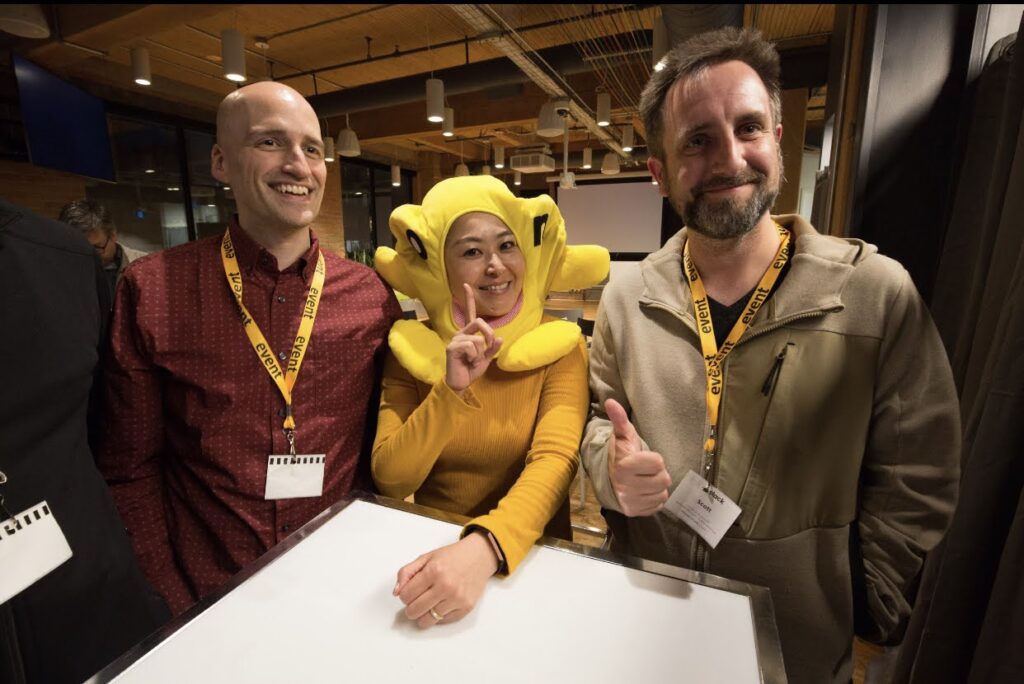
Scott and I have been friends and collaborators on web standards work for years. We used to work together at TPG, before he moved on to Microsoft.
Transcript
Steve:
Let's start. Well, hello Scott O'Hara. How are you, my friend?

Scott:
I'm peachy. And yourself? Are you?

Steve:
I'm feeling pretty good, actually. I've lost some weight. And as a result, I feel better within myself.

I got diagnosed with type 2 diabetes before Christmas. And so he said lose weight, which I've done.

Scott:
That's the time to be diagnosed, you know, like right when everyone's about to like get together for like Christmas and stuff and be like, hey, I know everyone's about to have some fun, but not you.

Steve:
You, yeah. Well, it was a couple of months before Christmas, but usually around Christmas time in England, they have these things called mince tarts or mince pies.

Scott:
I don't know if you know what they are, but I've seen the British baking show. I know all about culinary.

Steve:
Oh, OK. So, yeah, it's fruit mince and I used to love them. And they're high, you know, they've got shortcrust pastry in there.

They're they're quite calorific and have all the bad things in them. And usually I'll be like, you know, dozens of those over the Christmas period. I only had one.

Scott:
And they're all hand-delivered by Paul Hollywood, too.

Steve:
Again, my understanding. No, I actually like the sort of industrial production of standard Sainsbury's. Sainsbury's is a supermarket.

But anyway. So obviously you didn't have to cut anything back over Christmas. Did you have a good Christmas?

Scott:
Yeah, it was nice.

Steve:
What's what's Christmas like in your house?

Scott:
Oh, it's not in my house, first of all. So that's the.

Steve:
Well, that's always good.

Scott:
Yeah. No, my my my wife is from the Midwest. So we always.

Hold on a second.

Steve:
I'm just going to close the door.

Scott:
That makes sense. That's why we're doing this right now.

Steve:
Yeah.

Scott:
You can ask me a question, then you can just immediately leave as I start answering.

Steve:
It's my daughter's upstairs. Eloisa is upstairs.

Scott:
I just want you to ask. I want you to ask me questions. And then each time you do, I just want you to immediately leave.

Steve:
I'll do that. I'll just turn the camera off every time. OK, so you were saying that it was somewhere else.

Yeah, yeah.

Scott:
So my wife is from the Midwest and her family always does like this big, you know, get together over Christmas and stuff. So it's you know, it's nice.

Steve:
Oh, so you get to go.

Scott:
Yeah, we all go out there. You know, my sister-in-law and her family all go out there like all like, you know, my kids, her kids, they all get together and stuff. And it's you know, my kids all have birthdays around the same time, too.

So it all just is like this big, you know, Christmas slash family together slash birthday sort of.

Steve:
Oh, nice. Everything's wrapped up.

Scott:
Yeah, we just get it all done at once. And then the rest of the year, we're just like.

Steve:
So you said Midwest. Obviously, that's a term that is familiar to people that live in the States, but I've got no idea what where the Midwest is.

Scott:
Well, it's if you think about like going west.

Steve:
Yeah, it's like midway. So what was the.

Scott:
No, it's like, yeah, it's like smack dab in the middle of the United States.

Steve:
What's the state?

Scott:
I'm not saying.

Steve:
Huh? Oh, OK. That's fine.

Good call. But yeah, no. So I'm going to look for it now.

I'm going to make it my priority to find out where the fuck that place is in the Midwest. It's just yeah, it's as I say, I mean, I'm just I don't know. I don't I'm not very good with directions.

Well, I think I am OK with directions. But it's like, you know, I've lived in Kingston for 18 years now. But then when people say somewhere, you know, somewhere outside of Kingston, Ponteves, I live here.

And I thought, where the fuck is that? I don't know. It's only about 10 miles down the road.

But anyway, so you and I know each other. We've known each other for too long, probably a number of years now. Yeah.

So we used to work at TPG together. How long ago was that now?

Scott:
Well, I just hit five years at Microsoft, actually. So that long ago, it was 2021.

Steve:
And how long do you work at TPG for?

Scott:
I started there in 2018.

Steve:
Oh, OK. So it was like three years. It seemed longer.

Scott:
Yeah. Well, I do that to people.

Steve:
Yeah. Well, I mean, yeah. During that time, you and I became friends and.

Collaborators on a number of things, including the HTML AAM and the ARIA and HTML. Is it called that still? I can't remember.

Yeah, ARIA and HTML. And you essentially, I mean, I was rough riding over those specs for too long. And you came along and you actually made it more professional and and more accurate, I reckon.

Scott:
I mean, I feel then, you know, so, yeah, when I when I started working on this stuff, it was just after the you had just left the W3C HTML task force. I really I had stepped in.

To fill your spot, so I was working on the W3C version of the HTML spec.

Steve:
That's right. I forgot about that.

Scott:

Yeah. And then and then the WG and W3C finally came to an agreement and there's now there's only the one spec and and then. Uh, talking to Leonie, she was just like, well, hey, you still want to do this spec work.

Steve needs help with these with HTML, AAM. So yeah, I started bugging you about stuff.

Steve:
I definitely needed help. And and by that time I was. Burned out was maybe an over.

Overreach, but yeah, I just I wasn't doing much work. And you came in and you started to do work, which is great. The the the thing that I find, though, is that if you.

Edit a spec or, you know, substantial, do substantial development to a spec over time that you sort of start to think that it belongs to you, like, you know, you invest yourself in it. And it took me a while to disinvest myself. It wasn't actually that hard because I mean, I probably could have let it go earlier, but there was no one around that I trusted.

Until you came along and because I think that you and I have. Well, we don't always agree with things, and I think you have a very sharp technical understanding of accessibility, and that was important, I think, rather than some sort of, you know, woolly, you know, accessibility is great type thing. You actually are interested in the way stuff is implemented, and I think that's important.

Scott:
Yeah, I definitely I mean, I thought we complemented each other well on those because I definitely. I learned a lot. Kind of by trial by fire in some of those cases, too, like, you know, you coming on to do HTML, I had never worked on any like the platform mappings and stuff before, but yeah, this is just like, here you go, figure it out.

And that was, you know, that really gave me a lot of insight into, you know, kind of like how things actually worked. And it wasn't just like this, like, oh, the screen reader says, it's like, well, why did the screen reader say that?

Steve:
Yeah, well, that's why it's always been of interest.

Scott:
You see so many arguments with like people online being like, oh, well, maybe the screen reader should just update like that. Like, why do they behave that way? It's just like, well, half the time they behave that way is because the browser tells them to.

So, yeah, when I see certain people saying like, oh, the screen reader should update. I'm like, no, the browser should update. The reason it behaves that way is because of what y'all put in there.

Steve:
I mean, that's an important point that I've pushed for a long time is that, is that, you know, each part of the equation, you know, developers, users, and assistive tech app browsers all need to work together in order to get an, you know, an output that is meaningful. But, yeah, there's always been, you know, fighting against this notion that, well, screen reader doesn't does X because it's wrong. It should be fixed.

And it's, sometimes it is the case. Sometimes it's something else. And I enjoy, you know, and I'm sure you do enjoy, well, enjoy, work to, yeah, work to.

Scott:
See, this is the face of someone that enjoys things.

Steve:
Yeah, I can tell. I mean, yeah, you're such a happy, easygoing.

Scott:
Yeah, I'm a fucking delight.

Steve:
Happy-go-lucky fella. But, yeah, so, you know, filing bugs. So, I've always enjoyed doing that against the browsers and also against screen readers where possible, as you know.

But I met with Cynthia Shelley whilst in Amsterdam last week or so ago. And it was her and I that started work on what became the AAM. And I remember at the time, you know, talking about, well, not understanding it.

I mean, there was no, there was bits of documentation here, there and everywhere, but there was no documentation for how HTML is, you know, how the semantics of HTML would be implemented in Accessibility Tree. And I remember being told at the time by several people, influential people, that we didn't need the spec. It wasn't needed.

There's always, it was obviously just bullshit because I think that, you know, like the core AAM and the other AAMs that are coming down the pipe. I mean, it is important to have that documented the same way as everything else about the implementation of HTML is documented.

Scott:
I mean, I agree. I think it's kind of proven itself over time. I mean, you know, with even like some of the work that I've been doing more recently, you know, with the Open UI, you know, working group there, we came up with, you know, the proposal for the popover attributes and, you know, then like the command and command for attributes and the customizable select.

And, you know, we're going through and working on like menu, like a new pass at the menu element, but it won't be the menu element anymore because that thing has a sad story past, but like menu list and menu bar, like there's a lot of these things. And, you know, when working with these people who are all very, very intelligent, but how is this supposed to be mapped? You know, what is this supposed to be?

And it's been great to have like these conversations with them and then codify that stuff in the spec so that then the other implementers that aren't in the room can come and actually then weigh in on the decisions that were made and then implement them in those other browsers. Because without them, they would just be like, well, I guess it's supposed to work this way.

Steve:
Yeah. Talking about implementations, the details and summary elements, what's happened with the implementations there? Because I know when I initially, you know, defined or defined, I mean, it was just a lot of the work I did in the AAM was just looking at how it was implemented at the time and then, you know, writing that down.

But with the details and summary, I actually pushed the idea of the summary being a button, which is, I think, worked well in some instances, but it doesn't. Yeah. It's problematic because Apple, you know, have a specific disclosure element, just triangle or whatever.

They have a particular role that they already defined for that.

Scott:
Yeah. I mean, that's been kind of one of, it's been a really interesting one that I've complained about and also advocated for on and off over the years. I don't know where I fall on it anymore.

Steve:
What's actually happened, though?

Scott:
It's kind of just like, meh at this point, because it's a weird thing. Like in HTML, the summary is like semantically, you know, a caption for the details. And because of that, you know, it's not really considered a button, which is why you can have stuff inside of a summary that you can't put inside of a button per the HTML content model.

It's a little bit of like, you know, even like calling it like a caption or a label, like, to me, doesn't make a whole lot of sense because like those things you can't activate or focus on, and yet in this case you can. To me, in my perfect world, and I don't know if this will ever come to pass, what I would really like to have happen is us actually kind of get the best of both worlds. I mean, we can't do a whole lot to change it at this point just because it is like so out there now and we don't want to do anything that would break the web.

And yet also, I'm having a really hard time thinking about how it would break if we were to say, remove the button role from the summary element in and of itself, but instead made a button part in the Shadow DOM that, you know, would then be labeled with whatever text was next to it. Because you can label buttons, look it up.

Steve:
But the issue with that, part of the issue, because I remember we were discussing this, this on a ticket with Simon Peters, yeah, many years ago. But it was like, well, people wanted to add, you know, it was just like, as you say, a summary could contain another button, for example.

Scott:
Yeah, I had a fun issue that I found a while ago where if you put an input inside of a summary, and then you started typing in it, and you added spaces, it would just toggle the thing opening because the, yeah, the space key would bubble up. So we'd just constantly be opening and closing the associated content. I was like, this is what you wanted?

This, this?

Steve:
Well, that's a good reason not to do it. I mean, but what I found was what I had, I was trying to, what I was trying to do was, because I remember that they were trying to take, or the original idea I think Hixie had was that the, you know, the control for opening and closing would be the summary. But it would be, as you say, it would be like an additional thing within the shadow DOM.

But this, the issue still is, is that, is that if you do that, that resolves the problem of having, you know, other controls in there. But what it doesn't do is, is provide a clear expectation or clear path to, for an accessible name.

Scott:
Well, yeah. So, and this is, this is something that's a bit, getting back to our prior conversation of, you know, well, whose, whose, whose fault is this? You know, who's to do what?

Like, there's an argument to be made that, you know, with what I was saying, like you could put anything inside of the summary elements, and then that would be what labels the button parts. So then if you had, you know, whatever your label is, X, Y, Z, whatever you want in there, that would be all of its own label, which would then give the button the name of whatever this is, which is then like two nodes in the accessibility tree of like, you know, the content and then the other contents right after it. Yeah.

Screen readers arguably could come through and kind of like what some of them do with forms on the web now, where if something is associated with it, and you like are using like the virtual cursor to get through things, it will just kind of like bypass it. You'll just go right to the form instead of the label and then the form again.

Steve:
Yeah.

Scott:
You know, they could do that. So it would be two nodes in the accessibility tree, but it would be read as if it was still one, or if there was important stuff that needed to be called out, that could then be where the screen reader is like, ah, there's, there's other things in here. We need to make people sure that people are aware of it.

And then they could be still like, it would be redundancy, but it'd be redundancy for a reason. So that you could hear the full thing to toggle. And then if there was like a heading, or if there was an individual input in the summary, you know, label parts, then people could get to that individually as well.

But that's, it's all theoretical at this point.

Steve:
Yeah, I'm still not yet. I remember at the time that the, like, I must admit that the way I think about these things is extremely simplistically, but I was thinking, well, if there was something inside the shadow DOM, you know, if there was this built-in control that needed to be named, then you could have a label inside the summary that, that, that referenced the thing. But then you, you know, you can't reference it without, you know, but I was just thinking about some way to clearly say, this is the label for this control.

This, the rest of the stuff in the summary is, is not a label. Maybe a label for something else.

Scott:
Yeah, I mean, that's definitely a different way of going about it as well. I think it all just comes down to like, if anything is to be done about it at this point, it has to be, the only thing that can be done is just, the only thing that could possibly be done would be something that just wouldn't break the content for anybody else.

Steve:
So on Windows, it's still, it's still exposed as a button?

Scott:
Interestingly, not really. Although like, some screen readers will still announce it as a button. But summary element is actually one of the elements in all of HTMLAM that doesn't have, because there's no consistent role, and there's no like explicit ARIA role for summary, it's actually mapped as like a computer role of like HTML dash summary.

That's how it is in the spec. And that's kind of a signal that like, you know, every platform is kind of allowed to do their own thing. Like, yeah, it exposes it as like actual like summary, like it exposes it as a summary role.

Like you said, like, disclosure triangle is how it's exposed in some.

Steve:
But what are the intrinsic characteristics of the summary role? I mean, where does the interactive, you know, part of the interaction get, you know, the fact is, is the summary is that you click it or press on it to get it to open and close. How is that conveyed?

Scott:
I mean, it's kind of up to the screen readers to do that. And that's why, you know, some of them still do, even though it's not mapped that way, they will still expose it as a button, because that just makes sense. But, you know, some of the other ones where they are, they're more literal with the mapping and they will say summary, but they will still, you know, hook it up in a way where, you know, the expanded state can be, you know, exposed, that it's still, you know, an interactive elements.

Like those things can still be conveyed. I mean, as you know, I'm more saying this for anybody listening than you specifically, but like, you know, all the, like you can expose anything. Accessibility tree is just, you know, what have like the screen readers then decided to do with that.

So you can put any ARIA attribute on any HTML elements, but, you know, the browser and browsers may or may not actually expose that to the accessibility tree. And then it's up to the screen reader to do something with it. It's when the browsers don't expose the information that then the screen readers are SOL.

And that's what's more back to what we were talking about before. It's just like, well, if the browser doesn't expose it, then how can the screen reader be at fault for not exposing it?

Steve:
Yeah, yeah. Yeah, I mean, it's, I don't even want to think about it.

Scott:
Well, you shouldn't be talking about it.

Steve:
Yeah, I know. It just starts to do my head in. One of the other things that I talked with Brian Kardell recently, and he was talking about the heading offset attribute.

Yeah. And thoughts on that?

Scott:
I mean, it's the closest thing I think we're going to get to the heading outline. You know, I think that, you know, that was, I think that has potential to be a good one. You know, like, it's one of those things where I think that as long as people can like wrap their heads around it and they can understand where it's to be used, then it will be helpful.

It will be good for people to know that it won't modify any ARIA headings at all. So even more... Oh, really?

Steve:
Yeah. You really need to... If you've got an explicit role and level, then it won't mess with that.

Scott:
Yeah, because ARIA takes precedent over almost everything.

Steve:
That's interesting because then it really, given the direction of traffic where ARIA is being used more and more, which is not a good thing or a bad thing. I'm not, gosh, it's actually probably a bad thing. That unless they use the HTML headings, then they won't be able to use the offset or the offset.

Scott:
Yeah, it's really a... With a lot of some of the new features that are coming to HTML, it really is more of a, you should use the native features. You should stop using...

Steve:
Well, that's good.

Scott:
Yeah, I mean, I think there might be some that even would debate me on this, but I think for many basic cases of dialogues at this point too, there's no reason to be using ARIA. There's no reason to be rolling your own. I mean, for some of the...

Steve:
People just like to roll.

Scott:
Oh, yeah. But I mean, you know, it wheels...

Steve:
Now we've got AI to build our own custom stuff with. So, yeah. I mean, when Brian and I, to be honest, as I said to him, I hadn't looked at it.

I mean, because I was involved in the document outline crap for so long and once it got into some stable place in HTML, I was thinking, great, I can walk away now. And, you know, disinvest myself. And I suppose that's, you know, that's what I've done.

Disinvest myself. Like, I haven't been following as closely as that. So, I mean, I sort of knew there was this offset thing.

But essentially how it works is that you have it on a container element that contains headings. Can it contain other things as well?

Scott:
Yeah, yeah. Yeah, but it will only impact the headings. And then basically, yeah, you can adjust the heading levels based on, yeah, the heading offset, heading reset attributes.

So, if you want your headings to maintain, you know, what level you set them at, you hit the reset and they stay at what they're supposed to be. But then, yeah, you set the offset to be, you know, specific numbers and it will basically add or subtract.

Steve:
So, if it's a one, it'll say it's got a heading level offset of one. It'll, if it's one, it'll become two. If it's two, it'll become three.

Yeah, well, that's, yeah, I mean, it sounds reasonable. I never really understood, and I'm sure there's reasons why. And I understand why they want to be able to have that ability to set headings, you know, because that way, you can add anything to the DOM at any particular point.

And it's, you know, it'll have the right heading level. That's the idea. But I just wondered why they couldn't do it back in JavaScript or something.

You know, it just seemed over-engineering to me, but, you know.

Scott:
I mean, some would argue that doing things in JavaScript is over-engineering too, if they can get, you know, if you can get a more performant thing from the browser. Yeah, I mean, there's an argument to be made for, you know, a lot of this stuff is just like, well, why do we need any of this? You know, people are using custom elements.

People are, you know, using JavaScript. And I think that there is an interesting line that I haven't really found to be, like, very materialized for me yet. But, you know, sometimes when we are thinking up some of these, you know, new features, I'm like, well, is this something that the platform really needs?

Do we need to really hit, like, all the use cases? Or, like, are there going to, like, you know, you know, it's like the 80-20 rule. Talking with Aaron Leventhal, who was over on Chrome's accessibility for quite a while, he and I would talk about that quite a bit.

Of like, you know, what's the most important things that need to be done? Let's make sure those can get done. And then the stuff that's, you know, beyond that is just like, well, is that really what we need to get into this?

Steve:
So what do you think is important for the HTML, you know, for native HTML to continue to evolve and become more accessible?

Scott:
I think that just a, at this point, I think that, you know, for any new feature that is added to that, we just take a hard look at it and be like, what problem is it solving? And are we solving it for, you know, all users? I think that's one thing that people often forget about in accessibility is that it's not just about people using screen readers, but, you know, others as well.

Steve:
Oh, really? I never realized that. Yeah, it's kind of weird, isn't it?

It's just that, I don't know, I read LinkedIn, you know, I sort of go to LinkedIn quite often, or any of the social media sites. And then on occasion, you'll have somebody proclaim that accessibility isn't just around screen readers. And I know that, you know that, most people who work in the industry know that.

Scott:
You would think, you would think, like it feels silly for me to even be saying that. And yet, you know, like we were, you know, thinking about some new features for, you know, like a component that like, you know, would have like a use arrow key behavior instead of like using the tab key and stuff. And, you know, it comes down to like, well, what kind of component is this supposed to be?

Like what, like how would someone using, like that is used to just using the keyboard, how would they even know to switch up their navigation pattern to use arrow keys? And then like, you know, talking to some people like, well, doesn't the screen reader tell them that? I'm like, yeah, but what if the person's not using a screen reader?

How can they see it? How can they know that like, why am I not getting to this stuff? And, you know, at the same time, I also like to think that a lot of people can figure this stuff out.

So it's, you know, if you can't get to it with the tab key, then you use other keys. And eventually, you know, you can identify these things as long as they're styled the same. And that's where it becomes difficult because everyone styles something differently.

So then something that should be an understandable pattern becomes more difficult to understand because you're like, well, someone did this different. So how does it behave? I don't know.

That's really the difficult part about a lot of this, in my opinion, is that, you know, if everything was truly standardized and that it wasn't just like, you know, the code that was standardized, but also the visual aesthetic, then arguably things would be a lot easier. But because anyone can style anything to look like anything, then it just becomes a guessing game to some people of like, well, what is this? How is it supposed to behave?

Steve:
Well, I think that's part of the reason why people have created custom, their own rolled their own because they couldn't get it to look like they wanted to. But it does seem to be that the design aspects of the various controls are becoming more customizable.

Scott:
So which is, I think is a good thing.

Steve:
I mean, I remember in, I did this presentation in 2010 at Fronteers talking about the accessibility, like the new HTML5 controls and how basically at that time, I think that a lot of them were implemented in various, in Opera in particular, which the rendering engine, which was Presto. I can't remember. But anyway, that...

Scott:
Oh, blink now.

Steve:
Yeah, well, exactly. It died on the vine. But I just got, I've got this slide with pictures of it and everything just looks shit.

And so that's why people were using these things. But CSS to the rescue. But talking of CSS, tell us about what you know or your thoughts on the implementation of tab interfaces in CSS.

Scott:
Oh.

Steve:
Isn't there some move that, I think we were talking about this before, about the implementation of adding ARIA attributes to indicate, you know, to provide...

Scott:
Yeah, this is largely with the scroll markers in CSS. And that's a newer feature that was, I think it was last year's Google I-O that it was really kind of like pushed out to the, you know, announced as being, you know, intent to implement and then the people could try it out in Chrome browsers. But yeah, that is an interesting thing that there's been a lot of discussion on in the open UI and the ARIA working group of like, you know, exactly what to do there.

Because yeah, with some of the new stuff that's coming through CSS working group, there has been, you know, more of an idea of like, well, can we get CSS to do things that, you know, HTML can't. You know, can we, yeah, can we create tabs or carousels using CSS only and...

Steve:
I think it was carousels.

Scott:
Yeah, and inject, you know, these pseudo elements into the UI that then have implicit ARIA roles and then how do you name those things? Because that's very, you know, like it becomes a lot of like browser magic to have to do that because otherwise you basically have to name it using like CSS pseudo content. And that can be weird, but...

Steve:
What I don't understand though, and perhaps you may be able to explain it, is that why would we have to go down the route of implementing the addition of ARIA attributes? Why can't it just the particular element that they're injecting will have a set of, you know, a set of world states and properties that are explicitly defined not as ARIA attributes?

Scott:
Well, so maybe that's... So no, what I was saying is that they would be implicit ARIA attributes. And maybe that's like, we've been talking about it a lot more using that terminology lately where like all HTML elements or all HTML elements that have accessibility mappings, they kind of get referred to as having implicit ARIA mappings.

Steve:
Right.

Scott:
Because everything goes back to core AAM, which is ARIA. So that's what these things would be too, is that they would have implicit ARIA mappings. They would have implicit roles and states and properties.

But...

Steve:
So they wouldn't have physical...

Scott:
Yeah, you wouldn't have... And that's, again, both a... Depending on how you look at it, a pro and a con.

Because you wouldn't have to do anything outside of using CSS to get all these, you know, scroll markers, the necessary, you know, roles and states on them. But also if you wanted to use the CSS to build something that really didn't fit into one of the patterns that they had defined, then there's no way to change those roles or states or properties.

Steve:
So you can't inject into the shadow, like, yeah.

Scott:
You can't change those elements. And there's even some... There was some talk at some point, I'm honestly a little out of the loop on it, but there was some talk at some point about, like, how there also needed to be, like, a JavaScript API so that, you know, a developer would know, like, when one of these things was actually, like, clicked on or something.

You know, some component libraries, like, they need to be able to understand, like, what the state of this stuff is so that they can use it to communicate with other patterns, you know, in the component library or whatnot. And there was no real good way to do that. But I think that might've been solved, again.

Steve:
So in sort of, in general, though, I mean, what is your feeling about using CSS becoming more semantic? That's what we're talking about, isn't it?

Scott:
It's one of those things where, I mean, CSS always had some levels of semantics to it. And, you know, and you can't not admit that and then also be like, but display none. You know, like, it removes things from the tree, you know, visibility hidden, removes things from the tree, visibility visible, you can put it back in.

Steve:
Yeah.

Scott:
You know, they're, you know, like, lists and whether or not they're exposed as lists or even the list markers, you know, like there's really fundamentally no difference between an OL, a UL, and a menu element, but for the fact of what their markers are. And guess what? Those markers are defined in CSS.

Yeah, right. So it's, there are, my opinion, and only my opinion is that I would rather there be less in CSS than more. But I also understand that CSS is a lot easier to work with than in some cases, like there are no responsive roles, for instance.

You know, if you have a UI where on larger viewport sizes, you want it to be one type of component and on smaller viewport sizes, you want to be a different type of component. There's no good way to do that without some kind of like JavaScript or CSS hackery. You know, like I was even tooling around at one point of using like divs that contained, you know, like one div that contained another one, but on like the topmost div, it was like the role that I wanted it to be on like large screens.

And then on the inner role, it was the one that I didn't want, I only wanted to be on small screens and then using like CSS visibility hidden to hide the top one, but then show the bottom one and then flip it around based on the viewport size. So like I had to define both of those separately in the DOM though. And that was just sloppy.

I had a whole blog post I was going to write about. I never actually published it because I was like, this is dumb. Don't ever do this.

The fact that I'm even talking about it right now is just letting you all know that I'm dumb. That's a good idea. But otherwise, it's just JavaScript or it's like completely like ripping out the DOM and reputting it back in to get like the different components that you want or having them both in there and just simply switching off displaying none between the two.

Steve:
And that's sloppy too. There's no good way to do that. So is there use cases?


Scott:
Like I would be lying if I said there were none, but you know, it becomes like a conversation of like, you know, what is the best for the user? And you know, when we look around the internet and we see just how misused and misunderstood accessibility is, it's hard to like, again, there's some people that really know what they're doing. And then there's some people that really know what they're doing and care.

And then there's some people that really care, but they don't know what they're doing. And that can often be some of the most dangerous because they're trying to do a good thing, but they haven't really understood the space. They haven't talked to the users.

They don't really understand, you know, what might be technically possible. It's not necessarily technically good. So giving them bigger foot guns, it's like, I don't know, like people like their feet.

They don't like having bullet holes in their feet. Like I think that we can universally agree on that as a society that like bullet holes in the feet are a bad thing.

Steve:
Well, yeah, as long as they, but if they're in somebody else's feet, which is often the case, then it's not so bad for you, is it?

Scott:
Depends.

Steve:
Another thing that I've picked up on recently and I looked into a little bit is HTML and Canvas. Have you seen that?

Scott:
Yeah, yeah. They, there was a presentation on that to the ARIA working group, maybe about a month or two ago. Time's weird.

I don't know. But yeah, no, that's, it's kind of making good on a promise that I know long time ago, I talked about this with Mark Sadecki, who had worked on Canvas and trying to get the accessibility going on for it. And this seems to finally be making good on some of those ideas where you could basically, you know, write your HTML in the Canvas and indicate what you wanted, like the fallbacks to be.

So that you could then actually be exposed because otherwise, yeah, it's all just bitmap.

Steve:
I think it's more than just a fallback because you interact with the actual stuff in the DOM, in the subtree. And, you know, it passes that information to, like, you will see, so like if you focus on a button inside the HTML and Canvas, you actually, you know, in the DOM and focus on the button, but it also shows that the button has been focused in the Canvas, which is, I mean, I, you know, I had a look at it and I thought it was quite nice. The only questions I really had, which I couldn't answer for myself, or the immediate question was that, how would it, how would screen magnifiers deal with it?

Does it, you know, does the positioning, you know, is that information, because it's the same thing. I mean, HTML elements have a positioning information that's available to screen magnifiers. Does stuff in the, in that, you know, still have that representation of the visual display.

It's interesting.

Scott:
My biggest question about it when we were hearing the presentation on it was, you know, in a lot of cases of what, you know, might be referred to as Canvas, but it's not actually Canvas, you know, like an editable Canvas, you know, like some apps have where people can, you know, users can come along and just drag and drop things anywhere, and then they can reposition it anywhere. And my hope was that with this, like this could then be a tool for that. And that's basically reconfiguring of the DOM underneath the hood would be possible.

Steve:
Oh, if you drag something on the canvas, you mean?

Scott:
Yeah, and then like if you take, yeah, if you take like paragraph here and paragraph here, and then you flip them, that the DOM would actually flip. But that's, I mean, that's a very specific use case. But one that I could see being very useful with this, but I don't think, at least at the time they were presenting on it, that wasn't possible yet.

Hopefully it could be a feature in the future though, because I think that, you know, that's one of the things that I see happen a lot with these, again, like editable canvases, people can drag and drop their stuff anywhere, that unless you really know what you're doing, or the application has taken a lot of thought into making sure that the visual layouts and the programmatically are actually in sync, you can get some really weird reading sequences then.

Steve:
Yeah, the potential is there for that. I mean, I see the immediate use or a use case for this HTML in canvases, the creation of things like apps and things like that on mobile, for example, is that, you know, because you can control the, effectively you're showing people a picture, but then I was thinking, well, really the, you know, it's still a picture anyway, that it's still a graphical representation of the DOM, it's just, you know, through a different medium. I have thought that this was going to happen for years.

I mean, when Canvas was originally being, not implemented, but both implemented and defined by Hixie, I remember at the time that he was, and I think it said in the html spec at one time that basically that Canvas is just, you can't have interactive content in Canvas. That was the bottom line. he didn't want for user interfaces to be built in Canvas.

And I always thought, well, it's not so much what you want, it's what's going to happen.

Scott:
Yeah, and that's kind of, yeah.

Steve:
Yeah, I had a Google alerts out for HTML in Canvas for years. So it happened a lot slower than I thought it would, but eventually it's come around to that. So I'm interested to see, but I do have, I am optimistic about it because it's actually in the development of it, they have thought about the accessibility.

Scott:
I think that that's, yes. And I think it's actually worth calling that out because I know for a real long time, at least it seemed to feel like, accessibility really needed to kick and scream to get heard of at the table for some of these things. And I mean, I don't think everything's perfect yet.

And not just around accessibility, I'm sure you could talk about that for many different types of subtopics within a particular field. But for what it's worth, at least from what I've seen, and again, speaking primarily from the number of years now that I've been working with the Open UI folk is that accessibility has been there from the start. Yeah, it's good.

Yeah, much. I mean, maybe even to some of the chagrin of like some of those people, because I mean, when I started working in Open UI, they were talking about popover, but it was as the popup element. And I came in and basically blew that all up.

And I was just like, it's gotta be something else. It's gotta be an attribute. And it took a little while.

And a lot of people in that room were just like, what the fuck is this guy? You know, I didn't think that.

Steve:
Yeah, I'm sure they still think maybe that.

Scott:
Yeah, well, they should. I'm a garbage person. But yeah, you know, it worked out.

And I think that it's a testament to, you know, how much people do think about and care about accessibility now that they didn't just brush off, you know, the things that were being brought to them. Like they were like, okay, well, no, let's consider it. Like you're saying that this isn't a good idea.

Like what do we need to do?

Steve:
I think this sort of speaks to what I was talking about before is that having people that say that have expertise or understanding of the technical aspects for accessibility, it's useful to have those people such as yourself in the room in these discussions because I think a lot of the pushback was in the early days, at least in, you know, when I was young, when I was younger, a lot of the pushback was because you had basically non-technical people saying accessibility, you know, needed to be considered and, but not providing that technical insight into what it meant.

Scott:
Right.

Steve:
So, yeah.

Scott:
I mean, there's still some of that though. I mean, I don't want to get too into that, but there's absolutely still some of that in our industry right now too, where, you know, I don't know. I think it's, I think it's interesting.

There are some topics that, you know, you go into too, where, you know, just like some people really want certain features that will, you know, absolutely help out, like some people with disabilities, but they don't always realize that, like, sometimes those things will actually negatively affect somebody else with a different disability. And it's interesting. There's been a lot of, there's been slow movement, but it's looking promising.

That's all browsers, hopefully in the not too distant future, might all like treat, for instance, like elements that have like an overflow scroll. Those might all actually be scroll focusable. People might actually be able to get to all of those and like navigate them with a keyboard.

Oh, cool. But at the same time is as much as that's needed for someone that, you know, is using keyboard only. There's been plenty of chatter online about, you know, screen reader users who don't like that.

An element that's only in the focus order for scrolling is now in the focus order because it's an extra thing. They don't need it. Right.

So it's like, well, how do you solve that problem? You have to make somebody unhappy, unfortunately.

Steve:
Yeah, well, I've always enjoyed making people unhappy.

Scott:
Yeah, I mean, it's a good time.

Steve:
I've revealed the rogues gallery. It's funny because every time I say rogues, it always comes out as rows or roads in the, I get AI to, well, it says it's AI. I get a automated service to create the initial captioning.

And then I've got to go through, I spent hours and hours just reading, re-reading everything and trying to decipher what was said because half the time, you know, it doesn't. Yeah. It just comes up with odd things.

But anyway, I don't even know why I mentioned that.

Scott:
Hmm.

Steve:
Uh, yeah, sorry. That's, that's what happens. Uh, rogues gallery, top left.

Scott:
That's, that's Dr. Swallow.

Steve:
That's, you are the first person. It is Dr. Swallow. And it's, um, I think that was actually taken when recently at, oh, it's, it's a picture from Lloydy actually, cut down picture of Lloydy.

Scott:
But it looks like, like people are trying to grab his face.

Steve:
Yeah. It was just like, it's all hands.

Scott:
Yeah.

Steve:
Yeah.

Scott:
Was it an all hands meeting? It was just hands, like they're just being chucked at him.

Steve:
Yeah. That's it. Yeah.

And he loves it. Um, yeah. So David is one of the people that, uh, as you know, he's a close friend of mine.

Um, and, uh, I hope to have him on the, uh, fireside soon. We kept, uh, we kept trying to get, get it together, but it hasn't happened this year, but it's always, I've got always got him in my back pocket.

Scott:
Uh, I really liked working with David. He was, I wish that we get to talk more. Honestly, I'm real rubbish about actually reaching out to people, but yeah, I know.

Steve:
I know. Well, yeah, you know, the first couple of years, I just thought you were being, uh, you didn't like me. Um, but then I just realized, I just, no, that's, you know, I'm overreacting.

I mean, I, but he's next.

Scott:
I actually don't know. I don't know if it's the picture or.

Steve:
Yeah. Well, I sort of did. The problem with these pictures is that I do tend to distort them, but that is a guy called Homer Gaines.

You might.

Scott:
Oh yeah. No, I know Homer. Yeah.

I did not recognize him from that picture though.

Steve:
Yeah. That was the first time I met him. It was at A11YTO last year.

Scott:
I've only ever seen, uh, his profile picture. I don't know if we've ever actually met in person and if we have, then I'm sorry.

Steve:
What was the good? Yeah, I can't say that. Well, I'm hopeless like that.

Scott, don't worry. I mean, I've seen people like Wendy Reid. I was talking to Wendy Reid, um, a couple of weeks ago and, and I, the last time I remember seeing her was at TPAC in, in, uh, Seville.

And, and that was a couple of years ago, but I had, I talked to her at A11yTO, which was like six months ago or eight months ago. So anyway, uh, but yeah, but I met him there. I can't say we had a conversation.

He was presenting there. I did. I missed his presentation.

Um, the only presentation I actually saw, uh, of the, I enjoyed was, uh, Eric Bailey in the opposite corner. Next person.

Scott:
That is Henny Swan.

Steve:
No, no, no. It's the good witch.

Scott:
Oh, well, I'm going to say that the glasses threw me off there though.

Steve:
Yeah. And also she's sort of stretched out, but, uh, she's, she's a, a recent, um, a recent interviewee, uh, on the, uh, fireside and she's what sporting, her, uh, gift that I sent her. So yeah, she looks pretty cool.

I like that. That's on A one, one Y, uh, Glenda. I didn't realize, but she's the chief information accessibility officer at DQ, which sounds like a, yeah.

I just know that she's a good title. Don't know what she means, but I mean, Glenda has been around for, for yonks. She does a lot of good work.

Um, despite the fact that I don't, uh, particularly like the company, um, but that's just a purely, uh, you know, companies, people all go on my shit list, but my shit list has no real set. There's no real, uh, uh, reasoning behind it.

Scott:
It's just that your shit list is full of shit is what you're saying.

Steve:
Yeah. Yeah. Essentially, it's just gives me something to do.

I could just move people on and off. I mean, I can't say anybody here has been on my shit list. So, um, some of the wait in the wings perhaps, but not actually on the, on the, on the main shit list and that you haven't been on my shit list or either.

So you're lucky. Uh, next person you should, yeah. Yeah.

And, uh, again, that was from A11YTO because all I do is I'll just go and look at my old photos and see, I'll think, find people who you might have an idea of. Sarah does a lot of work in, just as she worked for Microsoft as well.

Scott:
Yeah. Yeah. She's over on the, uh, the Fluent UI, uh, component library.

Um, comes to a lot of the ARIA meetings and the open UI meetings too. She is. Oh, excellent.

I mean, I don't, there's, she does a lot and, uh, the, you know, the internet is a better place for the efforts that she has put into it. Honestly.

Steve:
Cool. I remember, um, I remember this was a couple of A11YTOs ago and we were sitting in the hotel chatting and, and Sarah was there. And, uh, she, uh, described myself and, uh, I think Adrian and a few others as, as like old school, like the, the, the, the next, like the, the, she and, and some others with the next generation.

And I felt a bit, well, I mean, I didn't, you know, I just, I just don't like to be called old essentially, which is why I am.

Scott:
So if I started calling you old Steve from now on, well, people call me uncle Steve, which is sort of the same. Okay.


Steve:
Old Steve. Yeah. Yeah.

I didn't mind that. I mean, it's just a, it's just a realistic view of why I am. Um, but I was like, uh, I suppose what the thinking that I was part of the past and not part of the current, you know, just sort of made me feel a bit.

Yeah.

Scott:
So you really, you're just, you were sad that you were.

Steve:
Yeah. Yeah. Wish I was younger.

Talking about young, do you know who is in the bottom corner? You worked with him, I think.

Scott:
Did I?

Steve:
Yeah, maybe he was there at TPG. I don't know how long for it. I remember he, his name is, he's a Canadian.

He's got a book written about him by his sister.

Scott:
Is that Ben?

Steve:
No, it's Mike.

Scott:
But again, you know, I don't, I don't know if we worked together. If we did, I'm a bad coworker.

Steve:
Yeah. Well, he was, he didn't do much work. No, that's, that's not true.

I think I can't even remember if I managed him or not. But, but anyway, I've continued. He left TPG, now lives in Portugal and is doing accessibility stuff in Europe.

And I remained good friends with him.

Scott:
Is the, is the picture right before you sent him some, a t-shirt?

Steve:
No, no. Um, I think that, that it was in response to like, I, I had a fight, like when I was going to Netherlands, I, I just sat on the toilet in, in the, uh.

Scott:
After a great start, the story?

Steve:
Yeah, I was sitting on the toilet, you know, in a, in the waiting area. And I looked up and I noticed it was, there was a mirror straight across from the toilet. So I just took a snap.

I didn't show anything, you know, but, um, but that his photo was the response to that. I didn't have my top off by the way. But obviously I'll sit on the toilet side of my trousers down, but you couldn't see anything.

I'll, I'll show you the picture.

Scott:
I can't wait.

Steve:
Yeah. Yeah. When I was in, uh, when I was in.

Scott:
I want the file name to be all toilet sieve.

Steve:
Yeah. Yeah. Okay.

Uh, I was in the Netherlands for a conference for the NCDT conference. And I met up with this person I've known for a long time called Rianne reinVeld.

Scott:
Oh yeah. Yeah.

Steve:
Yeah. Didn't she do WordPress stuff? Yes.

Yeah. She's largely, you know, well, she said she's retired now. She was asking me why I hadn't retired yet.

And I said, well, you know, I've got kids.

Scott:
Yeah. No. Same reason for me.

Steve:
Yeah. And I've got kids and I've got a fucking huge mortgage. I can't, I can't, you know, once I'm by the time of 70, I think I'll have it all paid off.

But, um, but anyway, she saw that pic. She literally, I'll show you a picture of that. Adrian sent me of him and Carl at CSUN because I didn't go to CSUN this year and I always liked to go to CSUN, but I didn't go because of.

I didn't feel safe going to America at this point. But, uh, inadvertently she saw that picture and she was horrified. Um, even though it did, and I attempted to like, I was trying to show it and say, look, you can't see anything.

She said, I don't want to see it. I felt, I felt bad. It's like, you know.

Scott:
Do you have that photo on one of your, uh, t-shirts, your HTML t-shirts?

Steve:
What? The photo of me on the toilet. Yeah.

No, no, I just, it's in my private collection. I share with other connoisseurs.

Scott:
You should just get a, uh, you should get a t-shirt of that and just like speck in it. Like that's all.

Steve:
Yeah, not a bad idea. Next up, there's a twofer.

Scott:
Yeah. We got Adrian and Bruce there.

Steve:
Yeah. That was a SOTB state of the browser last or in March. I think that was, I can't remember.

They happen so often these days. Um, and as we all know, Adrian is, is a well-known entity. Um, same as Bruce and both of them have been on the, uh, fireside.

So, um, for those who haven't listened to their, their, uh, interviews, they're there. Uh, next person.

Scott:
Is this Mike Smith?

Steve:
It is Mike Smith.

Scott:
I, I, I've only ever seen a photo of him before.

Steve:
So, um, exactly like that.

Scott:
But yeah, for whatever reason, I got that.

Steve:
It's not a particularly good photo. Cause he looks a bit sort of wizened, but I don't think he looks for a lot. I mean, he's getting older, like all of us, but I think it's like when I did the interview with him, the fireside chat, he, he, for some reason, he just wanted it all in.

Like he's, he's, um, he was black and white. It was in black and white.

Scott:
He was, so he's like the, the new, uh, Spider-Man show.

Steve:
Yeah. But, um, the, you may be able to see, cause what I'm trying to do now as well is, is to get, um, is to get sort of product placement from the HTMLZ store. And you'll see the, he asked me to make him some DEI harder stickers and that's one on his laptop.

Scott:
Yeah.

Steve:
Um, so again, Mike has, has been on interviewed. Um, and, uh, Mike has been a long term. I've known him for many, many years since 2008.

And he has been always helpful. It's been one of the most helpful people life and, uh, technically minded, but, and both technically minded and helpful, um, people that works at W3C. So, uh, and you know, Mike as well.

Scott:
Yeah. He's always, uh, I've always found him. I mean, we, we don't work a lot together.

I mean, in my work together, I mean like through GitHub issues and stuff, but anytime he ever says something where like, he like has a question or like he doesn't agree with something. It's always been like, oh, well you should, we should pay attention to this. What's going on.

So, uh, yeah, he's always.

Steve:
Yeah. So very thoughtful and yeah. And he has a considered view on things, which I find really helpful, but I mean, he helped me a lot during the HTML five days and getting stuff implemented and, and, you know, dealing with the, uh, with the, the culture and politics of, um, the whole thing.

So, uh, I owe a great debt to Mike and he's a nice guy too. Uh, lastly, but not leastly someone we both know.

Scott:
Yeah. Mr. Eric Bailey.

Steve:
Yeah.

Scott:
I was talking with him this morning, actually.

Steve:
Oh, were you? Yeah. I was talking to him.

I was reading an article by him that he, uh, on the GitHub blog about, uh, accessibility and AI and how they're implementing or using accessibility, uh, AI to, to, you know, I mean, you're, you're at Microsoft as well. How, how has that, um, how has the, the AI impinging upon or, or integrated into your work day?

Scott:
It is, it is integrated. It is a journey we are, we are doing, you know, our best, I think. Um, I don't know.

Yeah. I have a lot of things that I'm working on to, uh, try to both, uh, I'm more interested in by interested. I mean, like that's where like my, my focus is right now is I'm trying to make AI, uh, understand accessibility concepts a lot better.

Um, you know, there's, I don't think there's, there's any doubts that there are absolutely practical benefits of using AI as a tool, um, for people with disabilities. I think that there's a lot of products out there that show how it can be, uh, useful. Um, but where I think that there still is work and that's why we are working on it is, uh, to make, uh, like code remediation and, uh, creation, um, have a better, have better concepts of, uh, what is accessible versus what is not.

And that's, uh, that's, uh, an interesting thing to work on because, you know, with, with so much of the AI LLM stuff right now, it's, it's all based off from, you know, what has, um, you know, what's out there. What have people realized that like have been good patterns and stuff. And, um, for what we were saying before about, you know, how definitely accessibility seat at the table is more of an actual seat now.

And, and, um, you know, there's definitely been a lot of strides there is still just the internet is just riddled with inaccessible code. And, you know, if that's what you have your stuff based off from, if that's, you know, that's what it's been trained on, then of course it's going to keep on falling over its two left feet. But I don't know, I, it's an interesting problem.

And I think that, uh, you know, Eric and Sarah, I mean, I talked to both of them frequently about how we can try to make this better. And I think that we're all doing the best that we can.

Steve:
So how do you, how do you use it in your day to day?

Scott:
I mean, what's the, um, I, so I use it in two very different ways. One, uh, to actually make stuff and I've found decent success with that because I also know, like I, I've learned very early on. Did I lose you?

There you are.

Steve:
Hello. It's something happened.

Scott:
Yeah, no, I realized that. So this would be a good place to cut. What?

I said, this would be a good place to cut. Um, what are we, uh, yeah, I'll, I'll start answering the question now, I guess. Um, cause you, you had asked like how I use it, uh, and I was saying that I use it in two very different ways.

And one of them is, uh, you know, I use it to make stuff and I found that as long as you're very thoughtful in the way that you're prompting it and giving it very, you gotta be kidding me, Steve. He's adorable. Oh, he's not going to be on camera or even here.

I want to, that is my name. Now it's in progress again, so I'll come back on the camera now.

Steve:
Yeah. Excellent. Sorry about that.

Scott:
Try this again for a third time or is this basically, maybe this is Microsoft actually just being like, do not talk about this.

Steve:
Yeah. Well, they were obviously listening to the zoom and in real time. Yeah.

Censoring.

Scott:
Yeah, I know. So I'll, I'll try to answer again. Um, so again, I, I do it in two very different ways and like in one, in one way I'm, I'm writing a lot, uh, and, and tweaking instructions and, and documentation to try to teach the AI more about accessibility and code practices.

Um, and then, uh, uh, but I also end up making stuff with it as well. And I've found that as long as like, you're very methodical and, uh, very, um, detailed about what it is you want to make. Uh, you know, if you were to just say like, make me this, whatever, that's often, we'll just be like, if you were like, I needed to do X, Y, Z here, like, you know, the accessibility requirements, here's the UX that I want.

Here's like this, that, and the other thing. Like if you tell it everything that you want it to do, generally do it. I mean, it's, uh, yeah, it, it, it, it then just becomes like, well, how, you know, is this something that can be used outside of like demonstrated purposes?

You know, like a lot of the stuff that I do is for demonstrated purposes. Um, I know a lot of people, you know, also use it to help actually build like applications and stuff. And, um, to be fair, I, I, I'm not saying that it can't be done, but I think that there's even a lot more, um, thought and effort that needs to go into that because otherwise, uh, you know, I've seen examples of where you're like, oh, I want to make this new component for this page and it will, it will do it, but that doesn't mean it will necessarily work well with all the other components that have been made. Um, really has to understand the structure that it's in and that can be done, but it's, is a different type of work to make that work right. You know, you can do it all yourself and that will take X amount of time, or you can use AI to help you build it.

It might take a shorter amount of time, but then it's going to take longer to make sure that it really does what it needs to do. And then it's performant and accessible and this, that, and the other thing. So, um, I don't know, it's, it's the future.

So whether we like it or not, it's kind of like a, I would rather be on the side of trying to make it good than just, you know, put my hands up.

Steve:
Yeah. Yeah. No, no, I understand.

It's just such a, it's, it's a environment like, you know, the concept and the, the technology is, is, is very divisive though, because a lot of people are just, you know, don't like it, um, for various reasons. It's, it's very much aligned with, um, fascism as far as I can see, you know, it's, it's, well, it's aligned with, with capitalists, you know, capitalists who, who have no sense of, of society or the society that actually means people like you and I can, can, uh, you know, not just you and I, but other people that people that can live a reasonable life. I don't think they give a fuck about that.

Unfortunately, it's, I'm not talking about any particular company. I'm just talking about.

Scott:
No, no, no, no, no. And I, and I'm not right now either, but I think it's, it's a very interesting world that we live in right now where, you know, we can see where the future is going and the pros and cons of it. And I think that right now is the time where really people need to like, you know, it's one of those things where like, people are like, don't just come to me with problems, but come to me with solutions sort of thing.

And I'm not saying that everyone needs to have a solution for this, but I think it's one of those things where you can't just say that you don't like it. I think it's like, if you don't like it, then you also kind of need to like, have an idea of like, well, what could make it better? Because right now, like that's what, like it's being defined and you can either just be completely against it and, and that's your rights.

But if you want it to be better, then now's the time to say things. I mean, yeah.

Steve:
This, well, that's why I've engaged with it. That's why I use it to, because to, to find out what could be done. But unfortunately, I think that, that I, I need to, to get involved in, in more complex uses of it.

I mean, I use it, I mean, I found, found it really useful just for creating, it's, what I tend to do is I ask, I get it to create a script, a Python script that I could run locally. So, you know, just to do stuff with like, you know, files or whatever, or just to, to organize certain things. And I found it really useful that way.

And also it's made that I create one thing and then I only go back to the, to the LLM, the chatbot or whatever, if it's not working. So then if it's not working, I'll, I'll, I'll say, you know, this error comes up. And so, and it'll, it'll say, it invariably says, oh, that's, you know, it implies that it's your fault that the error is there when it, when often it's not, which I find really annoying.

Scott:
Oh, I, I will call it out for that shit. I'll be like.

Steve:
I call it out, but, but I didn't.

Scott:
You're a fucker, like you, you did this.

Steve:
Yeah. But the thing is, is, is that, you know, I don't want to over, I don't want to anthropomorphize because I really don't believe that it has intelligence. I don't believe it's, it's, you know, sentient in any way.

It's just what, what, what I've got to the point now where it's, I think it's just another software tool.

Scott:
I think that's the best way to think about it. And I wish that people would think about it is that it is a tool that's any tool can be useful and also any tool can be problematic if you use it in the wrong way. That's why there's a difference between a fucking hammer, a saw and a screwdriver.

Steve:
Yeah, true. But everybody, you know, everybody thinks, well, people tend to push the idea that it can be that, you know, it's the solution to all our problems. It's a hammer for everything and it ain't.

I mean, that's why I keep asking, you know, people show me, show me how it improves access fee, you know, it's all like automated access fee testing of, of things that we can't or that we don't already automate. How does it improve on, on say Axe or, or some other rule set? And I haven't really seen, well, I haven't seen any, any, any evidence to say, well, well now we can, you know, things that we had to do by hand before we can now do automatically.

Maybe you have because you're in a, you know, more sophisticated organization than me sitting here, you know.

Scott:
With your chairs on fire. Yeah.

Steve:
Yeah. Sort of.

Scott:
I mean, that's to be fair, you know, you actually could really level up your, you know, your working area. If you were to put out those flames behind you, it must be very hot.

Steve:
It's, it's extremely comfortable here.

Scott:
Really? Yeah.

Steve:
I'm protected by the.

Scott:
I like the AC on as cold as it can be. It's very much, very different for, for my wife and I, she, she wants it warm. I just want to be freezing.

Steve:
Yeah. Well, I'm the same.

Scott:
Also just, you know, works out for my cold dead heart. Oh, cold heart.

Steve:
That's the problem with you. You try to say that you've got a cold heart.

Scott:
There's only one?

Steve:
And you don't. You're, you're fucking soft, you mean. Anyway, that's okay.

That's, you know, that's what I like about you.

Scott:
No, there's, there's, there's to, to actually answer your question though, to not just make it deflected with jokes, which is what I like to do. Um, there, there are, I, I'm not going to get into it too much, but like there, there actually is some benefit that I've seen of where, you know, uh, very, very targeted. Uh, use of LLM on top of programmatic detections can bring in some context that wouldn't have otherwise been there.

You know, there's still a lot more work that needs to be done, but I've also seen a lot of gains within the last, you know, what year even that seemed impossible before. I mean, I think there was like maybe a blog post that I wrote like a year and a half, two years ago where, you know, I was basically like, it can't do anything. And I don't feel the same way anymore.

Um, although I will also say there's still so much more that needs to be improved on.

Steve:
I mean, I, I continue to tout that, um, article I wrote a year or so ago about the WCAG and, and what can be tested manually and what can be just, and I, I would love, you know, some of those things to be able to be improved or the, or, uh, resolved or, or test to be tested with, um, you know, it does have to be, but you know, making more stuff automatically testable by whatever route. Um, but I just hadn't seen it in action yet. And, and from what I've tried myself, I haven't really seen it, um, evident, but I know that there are others that are working on it that are much more sophisticated than my, uh, understanding, um, is, and that, yeah, it could be, but I'm still, look, when I see it, I'll be happy.

Scott:
Have you, uh, have you looked into, um, I've helped a little bit with this, but this is, um, Michael Fairchild has been doing the, um, eval. He is, uh, if, if I can throw out another, uh, name here, you should talk to him at some point. He is a delightful human and is incredibly intelligent and has been doing a lot of work to try to help, you know, make this more accessible here at Microsoft.

Steve:
No, Morgan Fairchild is an actor, a female actor. What's his name?

Scott:
Michael Fairchild. Michael Fairchild. He was, uh, you know, in, um, education before.

What's that? Did he used to work for DQ? Yeah, for a little bit.

And then, yeah, and then he came over to Microsoft maybe a year or two after I did.

Steve:
But, uh, and yeah, I know that he's been doing some sort of, uh, benchmarking. I haven't really looked at it yet. I need to, um, one of the things that I've done is, uh, I submitted an application for XSBTO on the subject of, um, AI and XSB testing.

And so chances are I won't get chosen because, um, I've got form. But, um, if I do, you know, like I want to work up a, uh, a, um, presentation about XSB testing and AI to, you know, to help sort of make it to help explore it. Because I think, you know, as you know, we're an XSB company and we're going to have customers that, that, well, we already do have customers that, that, uh, use, um, AI and want to integrate their, their workflow or whatever.

Uh, so. Okay. Sorry.

I just noticed all this. When I have a beard, I'd scratch myself and I'd just get scurf covering my under. But yeah, I'm falling apart, man.

I'm just an old man.

Scott:
I'm wearing a hat because I haven't had a haircut in a long time. Why are you wearing a hat? Because I haven't had a haircut in a long time and it's all getting old.

Steve:
Well, at least you still got hair. That's, that's something I can say as well. Still got hair.

Scott:
Yeah, we still got hair, but it's, uh, it is unkempt at this point.

Steve:
Yeah. Well, but you've got a nicer beard than I have. Mine just looks like it's sort of some sort of pubic sort of growth area, you know.

Yours actually looks like a beard. Anyway, uh, there are many things that I could still, um, uh, discuss with you, Scott, but we've been going for an hour and a half now. So approximately an hour and a half.

Yeah. Well, with, with the downtime, what, you know, but I will, uh, well, I'll, um, use my editing chops, which are minimal to, uh, to make it seem as though the downtime never happened. Uh, when, when am I going to see you next?

That's, that's all I want to know.

Scott:
That is a great question. I, uh, I don't get out much, honestly. Honestly, uh, truly like it was like before COVID I had started doing speaking gigs and stuff and then COVID hit and I was just like, you know what I like not going anywhere.

I mean, I would love to, you know, go to like accessibly Toronto again. Um, and you know, I'll, I'll, I'll try to, I think. Um, but it's, I dunno, I mean, I'm sure you can have similar, uh, you know, understanding of like, you know, like my kids are at the age right now where like, there's just a lot going on with them and constantly packed up.

And if it comes down to like, I can go away or I can stay here and see them do like one of their activities or just them, I'm always going to do that. Um, I'm always going to pick my kids over this other stuff. Um, I think that was actually one of the best things that happened in COVID is, is actually, I think I was putting too much of myself into work and it really kind of broke me down and made me realize like, stop it, you know?

And so like, I, I just, I prioritized outside of work. Um, you know, it's, you know, it's.

Steve:
I mean, it's good that you, you got it, you know, you work in a company and you feel, you know, that you can.

Scott:
Yeah.

Steve:
I mean, it's not every company, you know? So you haven't been token maxing then?

Scott:
Uh, not so much. No, but I mean, you know, I just mean that, you know, really over the last few years, if there was anybody that was actually, you know, paying attention to me online, you'll probably, probably notice that I'm, I'm barely online anymore. You know, I do a lot of stuff over, you know, in standards and, but I still, I actually do less than I did before.

And it's just because, you know, I'm, I'm working, I'm doing my job, I'm doing as much as I can outside of that. And then, uh, you know, when workday is done, I'm, I'm done too.

Steve:
That doesn't mean you can't come to an A11YTO and have a good time. No, I mean, of course. I mean, I, I perfectly understand if you, you're not going to be the last one.

Scott:
No, I actually do it because I can also make a, uh, I can make an excuse out of it to go see my sister. And that was up in Toronto because she's the, she's the smart one and she, she got up there.

Steve:
Yeah. Got out before, before Gilead. Um, Scott, it's a wonderful to see you as always.

And, uh, thank you for today. Remember to choose your, an item from HTMLZ and yeah, send me a pic if, if once you, once you get it, send me a pic of you wearing it. I like that.

I, yeah, it's one of my, well, what I do is I sit on the toilet in, in strange places and look at the pictures of people wearing those.

Scott:
That's exactly why I want you to have a photo of me so you can be like, oh, Scott.

Steve:
Yeah. Thanks, Scott. I appreciate it.

And we should talk more. We'll see about that. Yeah.

Fuck you, man. See you later, Scott. Take care.

Thanks. Bye.
Some stuff mentioned
- Scott O’Hara – Accessibility engineer, UX developer & designer
- Sarah Higley
- Eric Bailey
- content aware headings in HTML
- Open Web Advocacy
- ARIA in HTML
- HTML Accessibility API Mappings 1.0
- Open UI community group
Removables
Lyrics
"Removables"

Conscience binds you in chains
Trial by stone, hammer and nails
No-one made the holes but me
Misery mourns to be devoured

Killed God blood soiled unclean again
Killed God blood soiled skin dead again
Again, everywhere again

All removables, all transitory
All removables, passing always
All removables, all transitory
All removables, passing always

Never grown, preserved gently
A bronze moth dies easily
Unknown to others weak to me
Broken hands never ending

Aimless rut of my own perception
Numbly waiting for voices to tell me
For voices to tell me

All removables, all transitory
All removables, passing always
All removables, all transitory
All removables, passing always
All removables, all transitory
All removables, passing always