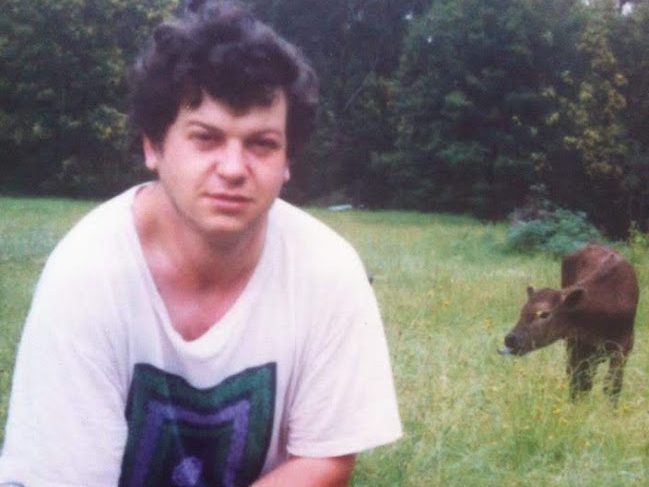
Dave Letorey
fuck facism
I apologise to Dave, as I have been slothlike in my preparing and publishing of his visit to the fireside. I do have reasons though… Anyways it was refreshing to prepare the captions with optimistic eyes and in the process enjoy Dave’s virtual company once again.
Transcript
Steve:
Well, welcome, Dave Letorey. How are you? I'm very well, yeah.

Good. I forgot to mention you, Dave, that as a esteemed guest, you get to choose an item from HMLZ, the merchant store which I run, which, you know, has multivarious web standards, politics-related things. So, hopefully, you'll find something you like there.

You just find it, send it to me, send me the details, and I'll send it out to you. But, of course, I'll also need your address. It's the way I get people to...

Dave:
This is how you collect people's data, is it?

Steve:
Yes, exactly. With permission, with permission, and then I'll sell it on to OpenAI or whatever.

So, Dave, tell us about your day job.

Dave:
My day job? So, my day job became...

I managed to be able to swap weeks for weekends. Yeah. What are you pointing at me?

Steve:
Oh, I was just going to say, I'm going to close the door, just like last time off. Now I'm just talking to myself. Yeah, that's what Scott was saying.

Now I'm back, I'm back. Sorry. Excellent.


Dave:
So, yeah, I've swapped the weeks for weekends. So, now I only work two-day weeks, which is pretty awesome.

Steve:
And how did you manage that?

Dave:
Because... Oh, so I run a conference, you know that. I run a conference called State of the Browser to come and speak, and he spoke about Firefox and DevTools, and that was pretty cool.

I also invited Ruth John to come speak, and she gave a talk about web audio. It's quite a topic that we have loads of times about web audio. And at the end of it, Chris asked Ruth to work on some stuff for MDN.

And eventually, she became the leader of MDN. And then a few years ago...

Steve:
So, MDN for those at home?
Dave:
Mozilla Developer Network. It is the Bible for web developers.

Steve:
It's where you go to find out what the CSS thing does, or what this weird JavaScript thing is, or what this ARIA role is, and all of those. I use W3Schools for all that.

Dave:
Yeah, of course you do.

Yeah. Yeah, I do not believe you.

Steve:
Well, have you seen my code lately?

Dave:
No, but yeah. So, MDN is a great resource, and we reference it in our deliverables quite often, because it's the source. It's next to the specs that specify what the thing is itself.

It's the best thing. I always like to go to the specs, but having a reliable, up-to-date explanation, further explanation of some of this stuff is... Well, it's...

The MDN stuff is really, really useful, because it is not just, this is how something works. It also links to the spec, so you can find that information out. Exactly, yeah.

What it also does is it has some data called browser compat data that says, this is available in these browsers. That is then used for many, many, many things. One of the things it's used for is a thing called Baseline, which Rachel Andrews has been working on.

And that says, you could use this in all browsers, because it's been there for 30 months at least, and those kind of things. So, it's a good way. But that BCD, or the browser compat data, is also used inside DevTools, in all of the major browsers.

So, you know that it's available in your browser, or it's not available in this browser, for example. And then it's also used for things like IDEs, such as VS Code. And as you're typing, it uses that browser compact data to say, are you sure you want to do this?

Because it's not supported in Safari, for example. Oh, that's nice. The stuff that MDN team do, and it's not just MDN, it's open web docs as well.

So, there was a whole kind of issue a few years ago, where Mozilla stopped paying people, and then that content nearly disappeared. And that would have been a nightmare. And open web docs was started.

So, there's a whole group of people that work and contribute towards MDN, that are not part of Mozilla. Is that all voluntary work? It's not.

They are funded by most of the major browsers. So, Microsoft and Chrome and others give money towards that. And anybody can do that.

You can go to GitHub and support open web docs, or you can also go to the other thing. What is it? It's Open Collective and support open web docs as well.

So, if you think the work that they're doing is good, you can give $5 or £10. Or what it is, a month to help support that.

Steve:
And so, you work on two days a week.
What do you actually do in your day-to-day?

Dave:
So, I work, I contract for Mozilla, and I make sure that all of the stuff that gets released in Firefox each month is properly documented and all of the data is correct. So, that's what I do.

Steve:
Sounds like a freaking hard work.

Dave:
It is hard work, but it's amazing fun. Yeah.

I absolutely love it. I get to work with some really, really cool people. On my first day of working there, it was sort of like, wow, I haven't seen you in ages.

I didn't do any work for the first day because I was just chatting to people I haven't spoken to for ages and ages and ages, which was really cool.

Steve:
And you mentioned Chris Mills. Is he still working there?


Dave:
Chris Mills is still working on MDN. He works for it via Google and via Mozilla. So, yes.

Steve:
So, he's actually, yeah. I just wondered because I couldn't remember where he was. So, he's actually still with MDN?

Dave:
Yes, he still contributes to MDN and he gets funded via Mozilla and via Google. Nice. Make sure that things are documented.

Steve:
Yeah. And how long have you been doing that for?

Dave:
Well, nearly four years, three and a half years.

Steve:
And what did you do before that?

Dave:
So, before that, I set up my own company in 2020 to do some work building websites and apps. And I worked for a group of kind of a company that helps solicitors with house buying processes.

And they wanted to automate everything. And it's one of the worst situations in my life. By day one, they said, okay, build it.

And I went, okay, give me a specification of what to build. And they said, oh, you know, we just want a form thing. And I went, this is not a specification.

I don't know your business. I don't know anything about house buying. Help me out here.

And yeah, they just said, yeah, just build a form that people fill in and it will give them answers. And they're sort of like, you need to give me more information. So, that was a long process.

And then eventually I met Ruth. And Ruth said, two days a week? And I went, yes.

And I get paid the same amount of money I was getting paid with the mad search solicitor thing.

Steve:
And so, what do you do for the rest of those five days?

Dave:
So, I organize an event and I help the community.

So, I do. Yeah,

Steve:
carry on. Tell us more.

Dave:
I help run a group called London Web Standards. Yeah. Where we started in 2007 and we had regular meetups because it was the early days of HTML5 and CSS3 and nobody knew anything about it.

Steve:
I think I actually did a talk at one of the London Web Standards many years ago.

Dave:
Yeah, many years ago. So, next year is 20 years of London Web Standards.

Steve:
Wow. Yeah, that's good. Because it went quiet for a while.

Dave:
Yeah, the last time we had a meetup, you were there. It was last May. We've got a meetup coming in September.

I'm just trying to organize the correct people to come and talk.

Steve:
Oh, brilliant.
So, there'll be a meetup and then it'll be every two months. Yeah. Oh, nice.

So, you do the regular cadence. But the state of the browser, the conference you help or you organize or help organize and lead, that is just once a year, isn't it?

Dave:
It is just once a year, yeah.

Steve:
Yeah, you did two last year because...

Dave:
Well, we didn't. We did one in the September of 2025.

One in September 24 and then one in February.

Steve:
Yeah, so I remember them being close together. Yeah, yeah.

Going to both. And so, it's gone back to once a year again. When is it?

Dave:
It's early 2027. Yeah, it's March the 6th. The reason we moved it is because there's too many conferences in autumn.

Steve:
Yes. And standing on people's toes and competing for the same audience.
No, no, it's a good idea.
Yeah. A good idea. It's definitely a positive reaction from the punters, isn't it?
Because you've almost sold all of the tickets already.

Dave:
Yeah, it's blowing my mind because we've got like, I think, less than 30 tickets left.

Steve:
Out of how many?

Dave:
Out of 200. Oh, right. And we haven't even announced any speakers yet.

Yeah. I feel like Glastonbury, you know? It's like a lucky deal.

Sell all of your tickets before you announce the speakers. And then, see what happens.

Steve:
So, have you got speakers lined up?

Dave:
Oh, yeah, we've got all of our speakers lined up. Right. And I'm not telling you, Steve.

Steve:
Oh, no, no. I wouldn't expect you to. No.

When is that news going to be trickling in? Probably after the summer. Right.

Dave:
Because tickets are on sale at the moment until the end of July. And then we stop. And we stop until FFConf.

Right. Because there is a conference in Bristol called WebDevConf. And there is FFConf.
And we don't want to step on our toes.

Steve:
So, you don't want to take people away from buying tickets for those. But you go and attend most of these things yourself?

Dave:
I do, yeah. Yeah. I was at Pixel Pioneers just last week.

Steve:
And how was that?

Dave:
It was a lot of fun. Oliver is such a nice guy.

He asked me to help him with setting up the captions and things like that. So, that was really nice. And it's just the community.

That's why I go to these things. Because of the community.

Steve:
So, it's the same reason why I don't go to things.

Because to avoid people. No, no. Not true.

I love state of the browser because you just have really good people there. And a real variety. And it's really well organized.

I mean, I can't sing enough praises for you and the team, Dave. Because you do a wonderful job. I appreciate that.

I always... It's one of the few conferences where I sit through most of the talks. These long, you know, two or three-day conferences, I tend to sort of like lose the will to live after a couple of hours, I think.

And just retire to my room. But yeah, I really enjoy them. And also, what I like about state of the browser is the bacon rolls you have.

Who can go past that? And sitting in that sort of terrarium type place, it's just a cool place to hang out. The Barbican is an amazing venue.

Yeah. Well, I'd never seen it until I'd come to stay at the browser. Yeah.

I'd heard of it, but I'd never really... You know, you see it sometimes because it's brutalist sort of architecture style of the stuff. You see it on telly, but you don't...

Yeah. I always feel, are you originally from London? No.

No?

Dave:
No.

Steve:
Where are you from originally?

Dave:
I'm from a place called Scunthorpe.

Steve:
Oh, I've heard of Scunthorpe.

Dave:
Yeah, it's always on the news because the Tories kept killing it, you know?

Steve:
So where is it located exactly? Sorry, I'm not very good with geography.

Dave:
Do you know where Manchester is? I know where Manchester is. Right, so Manchester is on the west side of the country.

Scunthorpe's the same place, but left on the east. So it's which... Near Hull.

Oh, okay. Yeah, it's right in between Hull and Lincoln. Oh, okay.

Steve:
So is it... So what shire is that?

Dave:
Well, so when I was born, it was in Lincolnshire.

A year later, it was south Umberside, and now it's north Lincolnshire again. So it keeps moving, even though it hasn't moved.

Steve:
But you've made London your home for many a year.

Dave:
Yeah, I moved here like 2005.

Steve:
Which part of London? You don't have to say specifically.

Dave:
I live in proper east London, where the docks used to be.

Steve:
Oh, yes, yes. Yeah, yeah, yeah.

Yeah. I live in Kingston-upon-Thames, where the first Saxon kings of England were crowned.

Dave:
Yeah, my uncle used to live in Kingston.

And around Surbiton Way, around there. Yeah, it's a nice spot. I'd like to say...

I don't know, all the telephone boxes fall over in that place.

Steve:
Yeah, yeah. That's the famous...

The famous... Arbor. Yeah, of...

Full of artists and artwork. So let me just crank up the... This is where everything goes awry.

Let me just crank up the rogues gallery, and I will... I've got to find it. You'd think I would have everything...

Ah, there we go. Daves Fireside.

Dave:
Oh.
Is this a PowerPoint presentation then?

Steve:
No, no, it's just... It started off as a PowerPoint presentation.

I started off using a PowerPoint, but then I... In the early days, but that was too much for me. So I've just got...

I create the rogues gallery and then just take a static image because it's just... It works better. For my limited sensibilities and control.

Hold on. Now. Share.

Okay, we're getting there. You see, it's something that should take about 30 seconds. it takes...

Oh. Okay. So...

Some of these are taken at my event. Yes. Yeah.

So, top left. Do you know who this person is?

Dave:
I don't think I do, actually.

Steve:
Doesn't anybody ever watch anything? It's always the same person. This is Dr. Swallow.

Dave:
Dr. Swallow, ah. Yeah,

Steve:
Dr. David Swallow. Yeah. The well-known anxiety accessibility UX person who works in... Who I worked with for many years and continues to work at TPG.

Dave:
Now...
Is this David of York?

Steve:
Yes, that's David of York. Right.

Dave:
I've never met him.

Steve:
Well, you should. You should also have him on state of the browser.

Dave:
Yeah, we've got a list, mate. That list is long.

Steve:
He's the only person I know with a PhD in web accessibility.

There you go. But the reason why I've got that particular photo is because he's standing next to the Coronation Stone in Kingston, which is where the first kings of England were crowned. On that very stone.

Well, either that or they had their heads cut off. So that's Dr. Swallow. Do you know who this next person is?

Dave:
Is that Donald Trump? No. He's not really orange enough.

No. That must be Patrick. Yes, that's Patrick.

Steve:
He's got a copy of WCAG 2 in his hand. He's laying down the law for WCAG 2. Right, OK.

Dave:
Yeah. Isn't that Section 508 where they live? No.

Steve:
So, you know, yeah, I mean, Patrick does a lot of work for WCAG 2 backlog. He works with other people involved that basically make those documents usable and not seem like they were written in the 2000s, which a lot of them were. Next up.

Dave:
Next up. Well, that's Sarah. Very, very good friend of mine.

She just sent me a load of anti-Nazi stickers in the post, which is awesome. I love anti-Nazi stuff.

Steve:
She's—well, you might—well, there's a couple of—I've got a couple of anti-Nazi shirts on HTMLZ, which you might enjoy.

Yeah, so I saw her. She presented at the last SOTB. Not this year.

The year before. In 25. Yeah.

That's what I mean. Yeah, that's right. 25.

Yeah. That was very—she was talking about the old web. Or, you know, sort of— Yeah, yeah.

She was talking about accessibility and how people who don't build websites could learn about accessibility. And, yeah, and the old web being the web where it was built by people rather than companies. Yeah, or machines.

So, that's correct. And so this—you've got to know who that is.

Dave:
Of course I do.

That's a fellow London Web Standards organiser, Jim. Is that why he's there or he's hanging around? Yeah, well, me and Jim started helping out at London Web Standards in 2009 together.

Steve:
So, yeah, I've known Jim for a long, long time. Yeah, Jim, I mean, I've known you for a long time as well and is a character that I really appreciate. Yeah.
Interesting guy. Bottom left? Bottom left.
There are two people in this one. I know. So, you get a twofer.

Dave:
One's Cassie. Yeah. And the other one's Andy.

Yeah. This hat that I'm wearing, Cassie had it made especially for me. What's it say on the top?

It says, time to learn tech. Nice. So there was a—she did a podcast with Jake many years ago when Jake worked at Google.

Steve:
Yep.

Dave:
And in the comments afterwards, somebody put, I don't want all of this chit-chat. I come here to learn tech. So Cassie had some hats made and put them on the internet to sell to raise money for for bar camp.

Not bar camp. Some bar, some code teaching place. Code club.

Yeah, down in Bright. And they were all black. And I said, I'd buy one of these hats if it was in red.

But she just made a red one, especially for me. So that's nice. I've got all the time in the world for Cassie.

We often go for dog walks, even though I haven't got a dog. And we walk around the towns. Yeah.

Cool. Andy, I expect he was a Pixel Pioneers? He wasn't, no.

Wasn't it? No. Yeah.

But yeah, I've known Andy for a long time. I had to phone him up on his holiday once, because our friend Jake phoned up two days before State of the Browser and said, I've got COVID. I'm not coming.

So I phoned Andy, knowing that he was coming to State of the Browser on his holiday. And I could hear his wife in the background going, no. Yeah.

But he came and he gave a talk at State of the Browser. And that was the second time he's spoken at State of the Browser. Yeah.

And ever since then, we've always had a backup speaker. It's a good idea. I can't cope with Jake pulling out again.

Yeah. He was there last year, wasn't he? He was, yeah.

Well, that photo is from this year, because Cassie's in it. Gotcha. And the next person?

That's Keith. Yeah. Yeah.

Now, somebody told me his second name was Kirkle. But I asked him, it wasn't. Yeah.

Dave:
Keith Circle.

Steve:
Yeah. Yeah. I always thought it was Keith Circle until I was there.

Yeah. But then, yeah. But basically, I was taken for a ride by some jokers who said his name was Kirkle.

Dave:
Oh, yeah.

Steve:
Well, if you read it, it might read as Kirkle. Yeah. Yeah.

He actually lives quite close to me. He lives in Surbton, I think.

Dave:
He does, yeah.

Steve:
Yeah, I've bumped into him a few times. He lives in South West London-ish area. That's what we say, rather than give out his address.

Dave:
Oh, yeah. Well, I don't know if he lives in Surbiton, but he lives somewhere in South West London, like myself. He likes his cocktails.

Steve:
Oh, does he?

Dave:
A number of times that we've gone and drunk cocktails together. He's doing a lot of work. Like, he works for Google.

No, he works for Mozilla now. I wish there was a... Yeah.

Keep moving around. I was chatting to him earlier. He did...

No, no. So Keith got hired by Mozilla because in his spare time, he would just implement browser features.

Steve:
Oh, really?

Dave:
And there was one, he implemented the Command 4, which allowed popovers to work just automatically with a HTML attribute. But he implemented it in all of the browsers, so it got fixed instantly as a hobby.

Steve:
Wow, as a hobby?

Dave:
Yeah, yeah. And Mozilla hired him off the back of that because he used to work at GitHub. That's where he used to work.

Steve:
Well, I'm glad. I'm glad that they've taken him on. I mean, there's so many people do so much free labor, really, for the web.

Dave:
Yeah.

Steve:
It is commendable, but at the same time, people have got to get paid. So I'm glad to hear that he's getting a few bucks for it. Keith does good work.
And in the background, there's Mark as well. Do you know Mark? I don't know.

Dave:
Mark who? Mark Thiel. He runs beyond Telerand.


Steve:
Yes, I do know of him because I think, was he at State of the Browser last year? That photo is from State of the Browser last year. Ah, yeah.

And oh, is that the guy on the left to me? Yeah, the white T-shirt. Ah, yeah, yeah.

I took a photo of him taking a photo of somebody as well. At the back of the room where I like to hang out. And lastly, but not leastly, you can see, do you know either of these people?


Dave:
Their faces ring bells, but... Yeah, that's fine. That's an American photo, that one.

Steve:
Yeah. One on the left is Dennis Lembrey, who works at GitHub, but previously worked at Deque and many other places. He's been around forever.

I did a fireside with him recently, which is yet to be released. And yeah, it's just someone I've known. That was at CSUN.

Or no, maybe it was at TPAC. No, it was at CSUN. Next to him is an old friend, Scott O'Hara.

Dave:
Ah, yeah, I have met Scott. I met him at Performance Now. Yeah, maybe last year.

Yeah, he works at Microsoft. He used to work at TPG. I used to work together.

He's the editor of the HTML AAM, which is the implementation stuff and also ARIA in HTML. He also builds some amazing web components. Yeah, I mean, yeah, he's a cool guy.

And I talked to him about AI because at Microsoft, they go on hell for leather for AI.

Dave:
Yeah.

Steve:
Is AI part of the workflow of MDN?

Dave:
Yes and no.

Steve:
So how is it used?

Dave:
I don't know. It's not part of my world. I know that we've had a number of pull requests that have been submitted, and we've had to question them.

Steve:
Right. Yeah, it's not my... I only do a tiny little bit.


Dave:
So you're talking to the wrong person about MDN and AI. So yeah.

Steve:
Well, let's widen it.

You must have some opinions about AI. You say it's not your world. Is it something...

What's your opinion? Do you see any utility? Do you see what dangers?

Do you see what positives? So the thing that people are talking about when they talk about AI is not what I imagine AI to be. It is what has come from ChatGPT being released a few years ago.

Dave:
Yeah.

And it is generative AI. This is creating some content. Whereas the AI has been around for years and years and years and years and years, and it only became a thing in the news recently when ChatGPT 3 came out.

And the things that it's done, like here's 10 million photos, tell me which ones of them may have cancer, for example. That's amazing. And that's a really good use for AI.

It's a task that humans just would not be able to do.

Steve:
Yeah.

Dave:
You can't go through that many images in yourself. So things like that, I think, are amazing. It's not something that this late in my career that I'm actually going to get into, because, yeah, I don't need to.

Well, if you need to. I would rather that water and power is prioritised for humans than data centres.

Steve:
Why do you hate superintelligence?

Dave:
I Don't hate superintelligence. I hate the way that it's being talked about and the way that it's being thrust upon people. And then there was a couple of weeks ago when one of them started to charge the real price for their tokens.

It was like, oh, yeah, well, we can't afford this anymore. And none of these things are actually making any money. Yeah.

Just being, and if you go back, it is the buzzword of the moment. And if you go back a few years ago, everybody was talking about NFTs. You must have NFTs.

Artists have got to use these. It's a way of getting. And now they're gone.

Steve:
And crypto and Bitcoin and all of those. Yeah, I hear these arguments, but it's a different construct, isn't it? I mean, it does different things.

It actually can do stuff. It's like, you know, you can churn out crappy code, whereas NFTs, you know.

Dave:
So over the weekend, it was announced that Ford have rehired loads of engineers because they replaced them with AI.

And then people's cars have started falling to pieces and not working properly because the tests were not considered and stuff like that. So hopefully they rehired them with a bigger wage than they originally had. Yeah, well, that's good.

Steve:
That's good. Yeah, I mean, I do think there will always be a, well, my thoughts are, is that A, it's not intelligent. B, it's not super.

It's a tool. It's a software tool that can be used, you know, alongside many. And it has certain applications, but it's not a panacea for every issue that we have or every problem, you know, that we could solve.

Dave:
So just understanding how to use it in that sense. I mean, I'm not, yeah. It's also, I went to a conference last year in Bristol, WebDevConf, and Remy was talking.

And at the end of the day, we went to go get some food and we sat in this restaurant. And it was this Chinese restaurant. The food was really good, but they had these TV screens and it was generative AI jazz.

And my God, it was fucking shit. Yes. Yeah.

So there are times when we can use these things for creative stuff. Really? Yeah.

And it's like whenever you see an image that's been created with some AI tool, their hands don't work. They've got more fingers than they need to. Well, you can just see.

I can spot you on LinkedIn all the time. I just really wonder why they think it's great to be able to use these over, you know, overpopulated images as text, basically. And it just looks cheap.

Well, there is that. And the other thing they've done is they've stolen everybody's content.

Steve:
Yeah.

Dave:
And if I did that, if I went and stole your content or some content from a famous author, copyright would apply to me. But yeah. Yeah.

So how does that work? Yeah, well, it's just, you know, it's the law. Well, the biggest problem I have with it is power and water.

Steve:
Yeah.

Dave:
Because people in Kent have got no water anymore because they've run out of reservoirs and Thames water or southeast water have just let it all piss out into the ground. And people in Kent have got no water. So and they've got data centers there.

So who prioritizes that? Is the data more important than the people? Well, Jeff Bezos would say yes.

Steve:
Of course. Yeah. Yeah.

But he's a cunt.

Dave:
So, you know. The other one is the thing that came out today is there's a place called Tejo.

Apple made an operating system after this.

Steve:
Yeah, yeah.

Dave:
And 90% of the power is being diverted to the data center. So there's like 50,000 people live there and they might have to find a new source of data of power. Really?

Yeah. So, yeah, it's. So.

The lesson there is avoid having your place named. And then you've got the fucking buffoon who allows children's pictures to be nudified. Oh, fuck.

So, fuck that cunt. Excuse my language, but.

Steve:
Yeah, yeah.

Dave:
Yeah. Yeah. So, yeah, it's got uses.

But the things that people are using it for are wrong. Yeah. Yeah.

Yeah, no, no, I agree. I mean, it's just such an ethical dilemma. I was going to ask you, what do you think?

Like, you know, I don't know if you've seen it yet, but Burnham made a speech today about changing the politics. Did you? I did see that.

Yeah. Yeah. So the thing that he said that resonated with me massively was that he said, we're going to build lots and lots of council housing.

Yeah. Which I think that is very, very key. And there needs to change the rules about being able to sell your council house as well and be able to buy your council house, because that's what Thatcher did in 1983.

And loads of people bought their house. Yeah. Less money than it was worth and then couldn't afford to keep it.

So they sold them to landlords and then landlords of this housing stock. And none of it was rebuilt. Yeah.

So, yeah. I mean, you know, there's a lot of negativity from the right wing press about him. But I mean, I just feel more positive.

He's more labour than... I'm hopeful.

Steve:
Yes.
That's this. There's optimism in the air. So let's just wait and see what happens.

Dave:
But yeah, something had to change. That's for sure. Oh, well, yeah.

At least West Streeting is not going to be him. Yeah. So because that would...

I know where he lives and I would just go to his house and shout at him. Yeah.

Steve:
Talking of shouting, well, talking of stalking, I went to see the Sleaford Mods, which is one of my all-time favourite bands.

And you happened to be there, which was a few days after State of the Browser, I believe. And you thought I was following you. Well, yeah.

Dave:
Well, I've been to probably about 40 to 50 Sleaford Mods gigs since 2016. That's the first time I saw them. Yeah.

I've always liked them. I'm always there. So you're the one stalking me.

I've been to all of their London gigs since 2016.

Steve:
And how do you feel about the current output versus their older output?


I quite like the new album.

Dave:
I thought it was amazing. Gwendoline Christie coming up on stage and then singing that song. Because she came on on track two.

And then throughout the rest of the gig, she just kept coming on stage and having a bit of a dance. I thought it was brilliant. And they've also done a song with one of my favourite bands at the moment called Big Special.

Oh, right. Yeah. What's the song called?

I can't remember. Oh, I'll look it up. Yeah.

Big Special. I'm loving them at the moment.

Steve:
When I write the article, I always put a song at the end.

So I'll have to find a good sleaford mods song. But you're actually into dance music and stuff, are you?

Dave:
I'm into all music as long as it's not generative.

But yeah. If you look at my wall behind me, you can see I've got lots of kneecap stuff. I won't see kneecaps, sadly.

Steve:
Why not?

Dave:
Yeah, they're really, really good. Really good.

They're getting better all the time as well. So kneecap are massive in my life. Public service broadcasting are massive in my life.

I've got two gigs of theirs coming up.

Steve:
Who's that? Public service?
Never heard of them.

Dave:
Public service broadcasting. Yeah, yeah. They're really interesting.

Steve:
I get most of my newish music from my daughters, because they're young and they force me to listen to stuff. I've got to do a lot of drill and the English sort of rapping sort of stuff.

So I quite enjoy that. Deno and people like that. Steel banglez.


Dave:
Well, so the other day, I went and I got this hat. Look at this.


Do you know what this is?

Steve:
Ah, Devo, yes. Yes.

Dave:
So I saw Devo a couple of weeks ago, a week last Saturday.

How was that? So it was, I went because I got an email saying 30 pound tickets. So they were absolutely amazing.

And the support acts were absolutely fantastic as well. It was Lena Lovitch.

Steve:
Oh, really?

Dave:
Yeah. And Rosellos. So they were amazing.

And then the headliners were the B-52s. And they were shit. Yeah.

Absolutely shit. But Devo absolutely rocked it. They were brilliant.


Steve:
Is it still the original members of Devo? Yeah.

Yeah. Yeah. I mean, I've loved Devo since I was young.

Dave:
Yeah, yeah. They were excellent. Yeah.

Probably enough, when I was speaking to Dennis Lembree last week, he went to see Devo. He went on a holiday, like he's from America, he went on a holiday somewhere, Phoenix or something. And it ended up where they were staying Devo was playing across the road.

Absolutely. So, yeah, he said they were great. Anyway, so what else?

So you've got these five days a week. How much time do you spend on the development and production of each of the state of the browsers?


I spend quite a bit of time on it.

I spend time talking to people, trying to find new speakers and things like that for future years. And then there's web standards as well. So I do quite a lot of work on it.

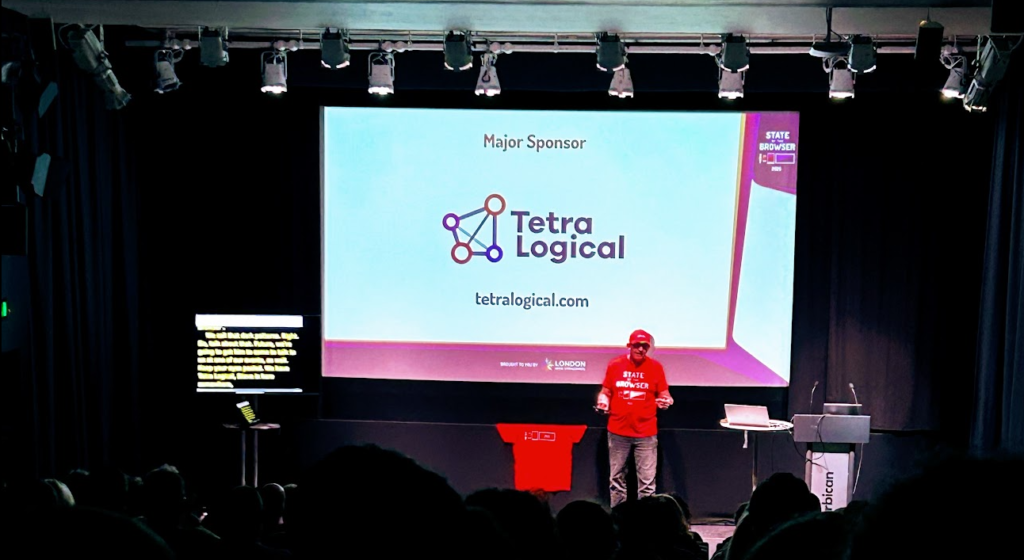
There's a lot of publicity to do and make sure that things are in line and finding new sponsors. We get TetraLogical every year, which is amazing.

Steve:
Yes, we're big, big supporters of state of the browser.

We, well, big supporters. We support state of the browser. We support full frontal, pixel pioneers, most of the local.

And what we do try to do is not, well, we've got a limited amount of sponsorship money, but we always try to put that into more generalised conferences rather than just accessibility conferences.

Dave:
Yeah, so accessibility is absolutely key to what we do. But we always have a talk about accessibility because it's very, very important, even though the audience that we've got already know about accessibility, but we have videos that go out into the world and leak.

So that's really cool. And what we also do is we make sure that the other speakers think about accessibility with their talks as well. So if they're talking about anchor positioning like Brahms did this year, how does that affect accessibility?

What happens with these things? So we try to get that into every single talk because it's good. But you need to think about these things.

Steve:
Yeah, yeah, definitely. Oliver Lindbergh. No, not Oliver Lindbergh.

Who's the guy that does the fonts? His name's Oliver. Ah, that's Oliver Schoendoffer.

Yeah, yes. Is it this guy? Yes, yeah, I really enjoyed, again, it was probably in December, but I really enjoyed his talk that he did at State of the Browser.

Dave:
Yeah.

Steve:
Because it's not necessarily something I'd particularly sit through, but he's just, he's very, makes it interesting. It's like when Stuart Langridge gave a talk a couple of years ago,

Dave:
you were there. Yes.

These were not talks, they were performances. Yes. And there's a big difference between a talk and a performance.

A performance, yeah. Yeah. And Oliver definitely was a performer.

Steve:
Yeah.

Dave:
Yeah. He even sat down in the audience and talked to Ariel about accessibility. Yeah.

Steve:
Yeah, it was amazing. No, no, it's good. I mean, what it says to me is that it's worthwhile going to State of the Browser because you get really good quality speakers.

Dave:
Oh, yeah, we've got amazing speakers for this year. So we've got some speakers that we've been trying to get hold of for years and years and years.

Steve:
Oh, I'll have to think about that then.

Dave:
Yeah, but you don't know what's in my brain, mate. No, no, but I, yeah.

Steve:
I mean, have you got somebody talking about accessibility that knows their stuff?

Dave:
Yep, yes.

Steve:
Yeah. Oh, good.

Well, that's always a good start. Yeah, and we've got a backup speaker talking about accessibility as well, just in case. Yeah.

Did I, I can't remember. Did I see that Adrian's going to, well, I'm not, he's attending this year, I believe, again. Yeah, he's bought a ticket for next year.

Yeah, for next year. Yeah, same as me.

Dave:
Yeah, I know, and you're a sponsor.

Steve:
I didn't need to. Well, no, because we give them to, you know, other people within the company first that want to go or, you know. Yeah.

And also, yeah, it's just easier that way. Yeah. I mean, you need the money.

I did notice that the price had gone up from last year, from 50 to 80, but still.

Dave:
No, it didn't. No.

Didn't it? No, no. The price was the same, but you're talking about the year before.

Steve:
Oh, there you go, yeah. You see, my memory is so shit. You're stuck in the 70s, mate.

Yeah, well, I'm approaching the 70s, that's for sure. Oh, OK, OK. So, yes, that was the same price as last year.

I just didn't notice. That's fine. I didn't, I'm not complaining.

I just thought, oh, yeah, OK.

Dave:
Yeah, well, if you can't afford it, we give tickets away to people who can't afford it. We partner with Greenwich Uni, which is the only uni in the country that has got a course dedicated to web development.

All of the rest of them have modules on web development, but this is the only course in the country that is just web development. So, we give all of our students a ticket. We just, all of them.

Oh, that's nice. Yeah. Does, um, do they have guest speakers at the university?

Yeah, they do, yeah. Yeah, cool. Excellent, excellent.

Steve:
What else can we talk about? See, the problem is I get to this point where my brain's not working, especially on a Monday, but it's been, it's been particularly hot and tedious. So, yeah, I mean, I don't know about you, but, but I live in a, you know, old block of flats and it's up the top.
And so, we're reaching 35, 40 degrees when it's hotter.

Dave:
Yeah, that's why your sofa's on fire then. Yeah, yeah, exactly.

Steve:
Yeah. Well, yeah, maybe I should, maybe I should make it by the poolside or something. Yeah.

Dave:
Yeah, that'd be nice.

Steve:
So, do you have any future plans for SOTB as in, you know, doing different or, or expanding or anything like that?

Dave:
So, something's got to happen in 2028 because the Barbican's being refitted. Oh.

And we're not going to have the venue. So, we need to find a venue or somewhere to, to host it. Yeah.

Steve:
That's a, that's a shame because it's such a great venue.

Dave:
I'm not, I'm not sure.

It'll be back the year after, 2029, we'll be, we'll be back there. But we've got a year where we've got to find a new venue. And, yeah, there's thoughts on what we're going to do about that one.

Yeah. The Barbican are really good with us because we've been going there for quite a few years. And because we do it on a Saturday when they don't have loads of corporate clients, because corporate clients only want to do it during the week, it's a lot cheaper for us.

Yep. Yeah. So, yeah.

Well, fingers crossed for that. I mean, it'll be fine. We'll find somewhere.

Steve:
Yeah. I'll be at your poolside, but yeah. Why?

Yeah. Why not? Um, okay, Dave, I'm going to let you go because I'm tired.

And, uh, but it's been wonderful to chat to you. Any parting words before? Um, yeah.

Dave:
Fuck fascism.

Steve:
Yes. Well, that's something we can all agree upon.

Fuck fascism. What was I going to say? Remember to have a look at HTMLZ, I'll send you the details.

Anyway. Uh, thanks for taking the time, Dave.

Dave:
Oh, don't be daft.

Steve:
Keep it up, my friend. You do, you know, I'm in awe. You do, you have, you know, you obviously do great web standards work in between doing one of the, you know, the prize, conferences.


Dave:
The thing I can say is don't buy tickets for our event. Buy them for web dev conf and for FF conf.

Steve:
Where is web dev conf?

It's in Bristol. Oh, it's in Bristol. The longest running conference in the UK.

Steve:
What was the conference that, that it was the last year of recently? Oh, that was all day. Hey.

Dave:
Yeah. Yeah. That was in Leeds.

That's a shame. Yeah. Well, it is, but there's a new one coming next year and it's called viewport and it's run by Mike Hall who gave a talk about performance this year at state of the browser.

Yeah. And that's going to happen in Liverpool around the time of all day Hey.


Steve:
Oh, brilliant. Yeah. Liverpool's a great city.

I've never been. Oh, well, yeah. There you go.

Dave:
We should go together.

Steve:
Yeah. Well, it's a date, my friend.

It's a date. I mean, I've been up north, but I've never been to Liverpool. Oh, yeah.

It's a great city. To Preston and Manchester to visit Patrick. Yeah.

And all my family come from Birmingham originally. So.

Dave:
I thought you are Australian.

Steve:
I am an Australian. My parents emigrated in 58 before I was born.
But I'm the only Aussie.
10 pound poms then. Yes. Yeah.

Fantastic. Probably when we came, like I was born in 64. We came back to the UK because my mum's dad was.

Sorry, my dad's mum was ill and died. She was old, but we came back on an ocean liner. Fantastic.

So because when we left Australia in 1968, it was cheaper to go by boat than it was by aircraft. But when we went back in 74, it was cheaper to go by plane. So, yeah, I can't remember anything about it.

Apart from a bad dream I had while on the boat. But everybody tells me it was a wonderful, wonderful time. Yeah.

OK, Dave. Sorry, I'm just rabbiting on now.

Dave:
Oh, don't be daft.

Steve:
Look after yourself and I'll talk to you soon and see you SOTB. All right. Yeah.

Dave:
One thing. If you send me anything next week, I'm not going to be here because I'm going on holiday. So that's fine.

Look, I won't respond to you.

Steve:
Yeah, it takes you a couple of weeks to. You know, haven't you recently been on holiday?

Dave:
Is that all you do is go on holidays? Well, I've got five days off a week. So, yeah.

Yeah. It's my friend's 60th birthday and there's like 30 of us going to Turkey.

Steve:
Oh, brilliant.

Dave:
60th birthday. Yeah. So, yeah.

Steve:
Well, it usually takes me about two weeks to process everything. So I'll send it to you and it'll sit there because I've got a couple of others to process. No worries.

Cool. All right. Cheers, Dave.

And please do send me links to various things that you would like to include in the article because, yeah, I have a list of stuff we've talked about and I can't remember everything. So, yeah. I'll send you a list of links of interesting stuff.

Enjoy yourself in Turkey and I'll see you soon. Cool. Bye.

Take it easy, mate. See ya.
Some stuff mentioned
- State of the Browser Conference 2027
- MDN docs
- Evil Jim O’Donnell
- Oliver Schöndorfer
- London Web Standards
- Pixel Pioneers conference
- FFConf
Tied up in Nottz
Lyrics
The smell of piss is so strong
It smells like decent bacon
Kevin's getting footloose on the overspill
Under the piss-station
Two pints destroyer on the cobbled floors
No amount of whatever is gonna chirp the chip up
It's "The Final Countdown, " by fuckin' Journey
I woke up with shit in my sock outside the Polish off-licence
"They don't mind" said the arsehole to the legs
You got to be cruel to be kind, shit bank
Save it up like Norbert Colon
Release the stench of shit grub like a giant toilet kraken
The lonely life that is touring
I got an armful of decent tunes, mate
But it's all so fuckin' boring
Tied up in Nottz, with a Z, you cunt
Black t-shirts and state toss
Nobby's Nuts, the rule of rough cuts
A to Z of nothing gets all the shiz
We are real, we are looking 20p in the 10p mix
Crab eyes, another lonely little DJ with no fuckin' life
Weetabix, England, fuckin' shredded wheat, Kelloggs cunts
On bleak shiz, hard cock, the green light don't stop
The shit homegrown dealers of Berlin begging for lolly
And it's beautiful how the privileged still let 'em in
Tied up in Nottz, Shit!
And then the dealer's tipped up
Tied up in Nottz, Shit!
And then the dealer's tipped up
Tied up in Nottz, Shit!
And then the dealer's tipped up
Tied up in Nottz, Shit!
And then the dealer's tipped up
... Big up the riots!
3 replies on “DAVE visits the fire”
[…] DAVE visits the fire […]
[…] Video: DAVE visits the fire Steve Faulkner: I apologise to Dave [Letorey], as I have been slothlike in my preparing and publishing of his visit to the fireside. […]
[…] Video: DAVE visits the fire Steve Faulkner: I apologise to Dave [Letorey], as I have been slothlike in my preparing and publishing of his visit to the fireside. […]