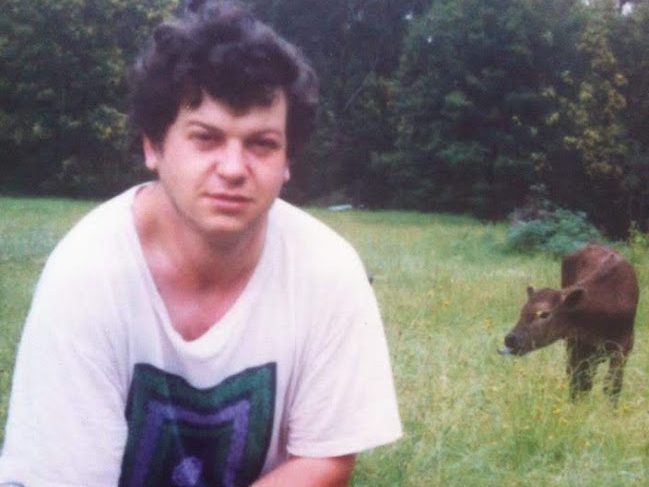
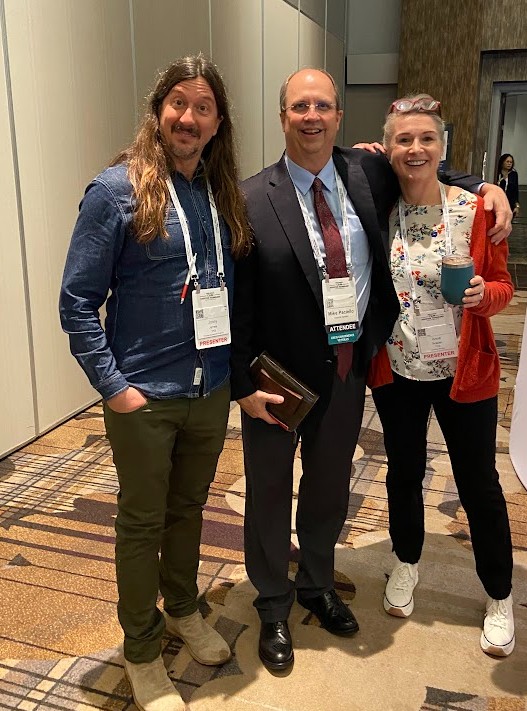
Of the many people I have worked with, alongside and for in my time doing accessibility, I can say with certainty that Mike Paciello (along with Debra Rapsis & Charlie Pike) have supported me the most. I would not be where I am today without the support and guidance they have provided.
This does not mean Mike and I agree on everything, but we are mature and trust each other enough to keep an open dialog on matters of disagreement.
Transcript
Steve:
Hello, Mike Paciello.

Mike:
Steve Faulkner. So good to see you, my friend.

Steve:
Yeah, it's always good to see you, as always. So today we're just going to have a chat about what you're doing, where you see things are going in the industry, where it's a positive for people with disabilities and where it may not be a positive for people with disabilities. Well, I'll start by saying I don't know about you, but I think you have a similar view, but that accessibility for me is about making things or helping others to make things, make digital sort of like user interfaces more accessible to people with disabilities.

Mike:
Yeah, well, you and I are on the same page there, except for one thing, and I've been saying this for many, many, many, many years, decades now, literally. I don't think that we can separate accessibility from usability. You've got to have the two of them, and because something is accessible doesn't necessarily mean that the interface is usable, or conversely, just because you've got some UX Don Norman, Jacob Nielsen types behind saying, hey, this is usable and the user experience is good, doesn't mean it's usable to people with disabilities, and I think fundamentally we have to keep beating that message into everywhere, the world.

Steve:
Yeah, yeah, yeah, definitely. I mean, I agree with that, but as you say, the accessibility, usability, they're like sort of siblings, aren't they? They're sort of intertwined, but as far as the accessibility, conformance is concerned or not, it's very much about people with disabilities.

I'm not trying to make the web and applications accessible to all, because that's the job of the people that actually develop the stuff, and that's the mainstream. Right. It's more about the people on the edges, the people in the cheap seats, so to speak, that need that support.

Mike:
Agreed, totally agree.

Steve:
It's – I understand why people will say, you know, it helped lay the curb cut, helps everyone, helps, and that's great, you know, it helps mothers and with babies and things like that, but it's still, you know, I'm not out there to try to make life easier for other people. I'm out there to try to make life a bit easier for people with disabilities.

Mike:
And when you say that, are you – because I know I have a challenge, because I think people, some people misinterpret my, I don't know, my career, my life, my life intent, so to speak, but do you find that some people will come to you and ask you about the built environment and, like you said, the curb cuts and how do we, you know, what do we need to do to make elevators and bathrooms and buildings more accessible? I get people that come in and ask me those questions. My brother is a building inspector, and he is an expert in that area, in making buildings and streets and, you know, what have you, the built environment, the brick and mortar environment accessible.

I'm not. I know it. I understand what it is, because the principles are still the same, right?

But when it comes to where my heart lies and where my, you know, my experience, so to speak, is, it's in the digital world, and that's where I'm really focusing on accessibility.

Steve:
Well, yeah, I very much agree with that, but also that I have, you know, some expertise or I know some things about particular aspects of accessibility, very much the technical, you know, how it's implemented in browsers and how it works with the technology. If somebody comes to me and asks me something that I don't know, I don't pretend to know what I don't know.

Mike:
Right.

Steve:
You know? Yeah. And I think that in some ways that I've had the luxury of working in environments where I've always just worked with a great multidisciplinary team of people that have, you know, have the experience and understanding and skills to be able to answer those questions.

And so I'll refer them to somebody else. I mean, one of my favorite things to say is that I'm not an expert, but I know some people who are.

Mike:
Exactly. Yep, I hear you. I think I fall into the same category, especially the last 30 years.

Most of my experience has been more from, you know, a business development standpoint, and you hire folks or work with folks around you. I mean, TPG was the essence of that, right?

Steve:
Well, that's why I wanted to ask you to delve into that a little bit, because one of the things that, you know, you and Charlie and Debs were the best bosses I've ever had. Now, I'm a boss. I try to remember the lessons that I learned from you, and in particular you, because you were sort of like the, how would I put it?

You were sort of like the guiding light of the company in regards to accessibility. And what I did note is that you always seemed to gather, like you seemed to have an eye out for people with talent and people that had the right stuff to work in accessibility. But you did that, but then you didn't try to impose your views upon them.

You know, this is the way you must do it. Somebody like me, for example, you guys just let me, you know, do what I do.

Mike:
Yeah.

Steve:
And I very much appreciated that.

Mike:
That was, you know, very, very early on, and maybe some people don't know this, but my original company was actually WebAble. And, you know, long story short, the initial parts of WebAble as a business started just with me as being the expert and some other people doing the business part of it. And then we got during, this is during the .com boom area, right, early 90s when I was in it. And I got approached by a major investor, a very, very large investment firm. They brought me in, and they brought in the guy who was functioning at that time as the president of WebAble.com, right?

Steve:
Yeah.

Mike:
And long story short, they pushed him out, or they actually had meetings with me separately and said, look, this guy's not the guy you want. What you need are people around you that understand law, understand accounting, understand business development, understand all the things that make up a business. You're the centerpiece because you're the face of this company.

So we'll build it around you, but you need to understand, and this was my first real lesson in business, and that is their advice to me was surround yourself with the experts. Let them, listen to them, let them work your business. They'll create it, and you'll be successful.

And I always used that as a fundamental principle. That's how I ended up with Deb doing all of our finance and accounting, right, and bringing her in as a partner. That's how we ended up with Charlie, and really Charlie's brother, Richard, in the background, who was really a true entrepreneur, and that's how we ended up with you, right?

And then we just started filling all the gaps with the – my goal was to build a company with the best experts in the world, not in the U.S., not in Canada, not in North America, in the world. And I felt like at its highest point, at its apex, we did. We did.

We definitely did. We had the best in the world. I can't think of one or – I can't think – we had a couple of situations where it didn't quite work out with an individual, but that was very, very few and far between.

Steve:
Yeah, and I know, but also what I found is that you and all of you, the executive team at TPG, tried their best to help people get over any impediments, any barriers they had. You didn't just throw people on the scrapheap because, oh, you know, you work with them. And that was important to me as well.

Yeah. I mean, I don't know if you recall, but I remember the day that you told us that the company was being sold. Yeah.

And I understand the reasons why, but I cried, like, for the rest of the day. I mean, really, really, because what we had – and we still have to an extent – what we had was really important to me, and that group of people was really important to me.

Mike:
Yeah. Let me tell you something. You cried that day, but I cried for a month leading up to it.

It was really, really hard. A lot of people know it was my – Kim was dying, and I had to. I had to.

And I'm glad. As hard as that was, it was the right decision at the right time. It was the best decision because it gave me nearly two years from that time – two and a half years, actually – to be able to stay and take care of her full time, and that's what I did.

That's all I did for that two and a half years. I did little things on the outside to stay involved, but my whole life was dedicated to her, helping her through. And when she passed, that was tough too, but I was glad that I did what I did.

Steve:
Yeah, well, you made the right decision for your family. I mean, and that's one of my guiding principles as well. I think that is the same with this company, Tetralogical, that I'm a partner of, is that we always put people before – you know, the people that we work with, we say, look after yourself, look after your family.

Mike:
Yeah, we always did that. How many times did we talk about that? Exactly.

You know, in our group meetings, team meetings, on one-on-one meetings, we always say family first. Take care of your family. And the other thing I thought that we did a really good job doing, and really this was with Charlie and Deb and myself, we were kind of like the tribunal of the company, always talking to one another, is what can we do to help so-and-so?

They're really struggling. They're going through a difficult time. We don't have to make a big deal about it, but what can we do?

And all three of us were on, always, always on the same page, always. Yeah.

Steve:
I mean, I was thinking back, and I don't think that you ever made huge amounts of money, but you always made sure that we got to CSUN or wherever. And it was, you know, we always had those meet-ups as well. Yeah.

It was a really important part of the company, cohesion, and just, you know, being able to look at somebody, at the people you work with remotely, just be able to look at them and have a beer with them or have a coffee and just talk.

Mike:
Yeah, yeah.

Steve:
It was really important.

Mike:
Those were important, yeah.

Steve:
It was a really positive part.

Mike:
And we had some good times. We had some fun times. There are experiences that took place.

I'll never forget.

Steve:
You know it. I know it.

Mike:
I mean, you and I had more than a couple of interactions, some things, and they're tucked away as memories that I'll never forget. And I've said this to others. I've said this, you know, to my sons and whatnot.

Two of the three of them are obviously in our business as well. So I love that legacy. I'm very proud of Shane and Kyle and what they've done.

But I will tell you, the 16 years of TPG at the level when I was there was by far and away the greatest professional experience I've ever had in my life since then and before then. I've had great experiences. I've been very, very lucky, which is probably the best word to use for that.

Very, very lucky, very, very fortunate with a lot of things that have happened in my career even today. But nothing, nothing will replace those 16 years of TPG. Nothing.

Just won't.

Steve:
Yeah, well, it's been a major time. I was there a bit longer than you because I continued on. Yeah.

And I still enjoy myself because there was a lot. At the time I was there, for the most part, we did a lot of the same people and then slowly over time that people left or people found different positions or whatever. And it's like, I mean, there's still some people there that I really feel.

Mike:
Yeah. David's still there, right?

Steve:
Yeah.

Mike:
Matt's there. I guess Justin's no longer there. No.

I just talked to him about it at CSUN. Hans is still there.

Steve:
Yeah. I was talking to Hans yesterday. He's coming over to Europe in June.

Yeah. Hopefully we'll be able to meet up with him because, yeah, Hans and I started on the same day. Yeah.

Mike:
Yeah. Yeah.

Steve:
He put up with me for seventeen years. So, I mean, I can't say nothing.

Mike:
What a team. What a team. Really.

You can go through. It's a who's who of accessibility. I can't think of anyone on the team.

Cedric is probably the least known.

Steve:
Yeah. Right?

Mike:
And he was instrumental. Yeah.

Steve:
I was really happy when I heard that Cedric got a position working. Is it Temesis?

Mike:
Is that where he is? I think I did hear something. I didn't know who it was.

Yeah, he's at Temesis.

Steve:
Because we used to use some of the, yeah. I can't remember the main guy's name.

Mike:
Actually, we played with it a little bit. We did a little work with them.

Steve:
We had their help desk.

Mike:
Yeah, that's right. That's what it was, yeah.

Steve:
Which was a major millstone around there. But they're nice people.

Mike:
Yeah.

Steve:
But he's there. And what I'm really pleased to see is that he is continuing. He's built a new version of the color contrast analyzer.

Oh, he did? I didn't know that either. Great.

Yeah, I mean, there's a public repo.

Mike:
I'll have to go back and look at it, yeah.

Steve:
Yeah.

Mike:
But he's probably of all the entire team, and yet he came with Charlie. So, you know, there was me, then Charlie, and Cedric, and then you, and then Hans, right? I mean, Deb was there with you as well.

And Gez. Gez was there. And Gez, oh, that's right.

And Gez, too.

Steve:
Gez started a few months before me because I wanted to move to the UK, and he wanted to get some. I said, well, have a look at this guy, Gez. Because Gez was the bee's knees when it came to accessibility stuff.

He still is, but he's one of those people that doesn't put himself out publicly as I do now, and he still do.

Mike:
But he is brilliant.

Steve:
Yeah. I mean, and that's why he works. Well, I work closely with him because I don't actually manage Gez, but I look after the assessments.

Mike:
Okay.

Steve:
At Tetralogical, and so I work closely with Pat and with Gez and with the whole, I do a lot of QA. So, yeah, it's still in some ways, as you know, quite a few of the people I used to work with under you and Debs and Charlie.

Mike:
Yeah. Yeah.

Steve:
Yeah. It's awesome. Yeah.

I mean, we've taken those people on because they're very good.

Mike:
Yeah.

Steve:
And they're in it for the right reasons. That's an important thing.

Mike:
It's all about their hearts. It's all about their hearts. These are, and I mean every single person that worked at TPG, it was all about their hearts.

They were fully dedicated. They're fully invested. They're very empathic towards individuals with disabilities, and that's something I'm very grateful for.

Every single person. Yeah. Even Karl and Adrian.

Steve:
Even Karl and Adrian. Yeah. Well, as you know, I've spoken to both Karl and Adrian.

Yeah. On the fireside recently. And I saw Karl, like, you know, I bump into Karl at conferences or whatever, like see somebody and actually go.

But I've got a lovely picture I'll show you later, because I had serious fomo about not being at CSUN this year.

Mike:
Yeah.

Steve:
And I contacted Adrian and said, you know, send me pics. And the first one he sent was a selfie of him with Karl standing next to him, you know, flipping the bird.

Mike:
It's perfect. Yeah, that's the prize. That's the prize.

But I mean, that's, you know, look, those guys are great guys who really know their stuff. I love and miss them both. I run into them.

I bump into them. I saw them both at CSUN. And, yeah, they're good guys.

And, of course, you know, Karl, the girls, I love the girls. We have known them since I still have. Karl's girls made some crayon pictures, drawings for me, that I had hanging up at my office all those years.

So, you know, yeah, they're all good. They're all good. Hey, we're all in it for the same reason, by and large.

And how we, you know, what we do now is not, doesn't take away from anything that we're committed to as a profession.

Steve:
Yeah. What I'll do is I'll get on to the fireside now because.

Mike:
Okay.

Steve:
That's, you know, it's just.

Mike:
Yeah, go for it.

Steve:
Okay. So you should be able to see now. Can you see?

Yeah, I can. I can see.

Mike:
Yeah. Who's the first person? Oh, yeah.

Yeah. That's David. That's Swallow.

Yeah. Yeah. I remember.

I remember David. I remember he was delivering a paper at a conference. Boy, I think it might've been when we're staying, when we're at Henny's in Bristol or something.

Or York. Oh, it was at York. University of York.

Right. Helen Petrie was there. David created a great paper there.

I can't remember who came up to me and said, hey, we need to get Swallow. He's in there. It might've been David Sloan.

So, yep. I got him.

Steve:
Love him. Good guy. He did a PhD.

He's a doctor, of course. Doc Swallow, we call him.

Mike:
Yeah.

Steve:
And he did his PhD on web accessibility.

Mike:
Yeah.

Steve:
He knows his stuff, but also he's a very close friend of mine. I love him a hundred bits.

Mike:
Yeah. Yeah.

Steve:
So, yeah. And I'm happy to say that I will be seeing him in York, because TetraLogical, we're having a face-to-face in York next month. And we usually have a social, and he'll be mine.

But also, I'm pleased to say that one of the people that I work with, a guy called Joe Lemyman, who's a young guy, who did his Master's at York University, University of York, or whatever it's called. Yeah. And he's great.

Because one of the things that we've been able to do with Tetralogical is employ younger people that are newish to the industry. Because obviously, I'm as old as, well, not as old as you, but I'm old enough. And so it's not something that I'm going to continue to do.

I would like to think that once I stop making sense, I will stop. Really, I'll stop when I'll be able to get my two daughters through their education. Through college?

Yeah, through university. I have to say that Clara, my oldest, she will be finishing her degree. And she's graduating in July.

Mike:
That's awesome. Congratulations. Tell her I said congratulations.

Hey, Steve, I just want to let you know you cut out for about five seconds just a couple of minutes ago, so I didn't quite capture what it was that you said. I don't know why that came in there. Oh, Otter, I keep trying to de-install it.

Yeah, it just came in. Can you just exit them out? Yes.

Yeah, just kill it. Yeah. There you go.

Okay, good. Yeah, sorry. I've had a couple of deaf folks and whatnot in there that needed it for one of the other panels that I'm working on.

Steve:
Yeah. Well, of course, part of what I did before I published the video is do all the captioning. And provide a text transcript as well as the captions.

So hopefully, you know, the good thing is, from my side, is that there's not a lot of audio description. There needs to be, you know, in general, the discussion, we're talking about their own story now, we've got these people. So, but we are actually talking about them, so I don't need to actually add extra information.

Awesome.

Mike:
Next?

Steve:
Next.

Mike:
Next would be Charles Pike.

Steve:
Charlie.

Mike:
Charlie Pike, yeah.

Steve:
Yes.

Mike:
One of my first real partners. Deb was there, Deb had already started with me doing some, she did a lot of the books. But in terms of technology, Charlie and I were working with each other.

I think he actually reached out to me first. I can't recall. But very, very early on, we found some great synergy together.

He was doing some projects at NYU. Yep. And I think that's how we got started there.

But yeah, great, great friend to this day. He and his brother Richard are two very dear, dear friends and were very instrumental in making TPG the success that it was. The best thing I loved about Charlie, he has a little bit more of a laid back, less intense than I am.

Steve:
Yeah.

Mike:
And so he was great. But there were a couple of times when he got a little ornery.

Steve:
Oh, really?

Mike:
Yeah, yeah, yeah.

Steve:
I've never seen Charlie ornery. Yeah, yeah.

Mike:
Over certain subjects, there were a couple of things that, maybe ornery is not the right word. Maybe just firm, firm resolve. No, no, no, no.

We've got to do it this way and for this reason. But I always appreciated his advice. And again, like I said earlier, I surrounded myself at TPG with the best of the best, and it started with Charlie and Deb.

Steve:
I'm not saying that you surround yourself with really good people, good, nice people. People that, you know, like, yeah, I've got nothing but praise for Charlie. I can't think of anything negative to say about him.

But except he was my line manager or whatever at some point. And when I manage people, I think about the way he managed me. And I always describe his management style as homeopathic.

You know, it was sort of like almost non-existent. But he's still at Vispero now.

Mike:
Yeah, he's still there, right, along with Hans and a couple of other people. But it's down to like, I don't know, six to eight that were originally there with us. I don't even know if it's that much.

Steve:
Yeah, they got rid of Denis. Who was he?

Mike:
Yeah, I saw Denis at CSUN. I saw him at CSUN. Yeah, he's doing well.

Yeah, a few folks have left.

Steve:
Yeah. What's the other guy, Brown?

Mike:
Brown, Brown, Brown, Brown. Oh, Travis? Are you thinking about Travis?

Steve:
Yeah.

Mike:
Travis is actually working at AudioEye now. Oh. Yeah, yeah.

That came up, I don't know, last fall? Last fall, I think. Oh, that's good.

Steve:
I'm glad that he's got work, you know, because he's got a family. And also he's got, you know, other challenges. So I'm really glad that he's found a place.

Mike:
Yeah, yeah, he's doing good. I think he's enjoying it. I know that the folks there really like him.

And yeah, and he knows his stuff. Travis brings into this company what this company is dying for, and that is experience, really good, solid experience across the accessibility industry. And he's got that.

You know, before he came to us at TPG, he was at Deque. So he's got a lot of years into this.

Steve:
Like Matt Feldman. Yeah. I don't know what Matt's up to now, but he got the bullet as well.

Mike:
Yeah, yeah. I talked to Matt too just before we brought on Travis. And I think Matt has gone in a different direction because he's more, I'm not sure if he ended up with a nonprofit, but he was kind of looking in that area.

Steve:
He is. Oh, yeah. Well, whatever work he gets, I'm pleased.

But yeah, but Charlie, I mean, like you, like Debs, that I've known, you know, I feel like I've known you for a large part of my life, and I knew Charlie, and Charlie was always a positive effect. Thank you. Always had a positive effect.

I remember going to, his family went off to Greece or something one year, and when my daughters were young, and we went and stayed in his house. We had a family vacation in his house.

Mike:
Oh, cool.

Steve:
And it was lovely. I mean, you know, where he lives in County Wicklow, it's just a lovely place. But the scenery around there is incredible.

Mike:
He has a knack. He and Berget have a knack. I'm not sure if it's a combination of both of them, but every time Charlie would, we would go somewhere, like you remember we would go and have meetings in Florence, and we went to Budapest together.

He has this incredible knack of finding great places to stay, you know, and I remember being so envious of him when we were in Florence, and I was in a hotel with Sarah and Henny, you know, it was downtown, and he had this beautiful place out overlooking, what's the river there, that we had to go across there? I forget the name of the river there. But it was just awesome.

It was absolutely awesome, and he got it at half the cost for what we were paying for our rooms at a stupid hotel.

Steve:
Great guy.

Mike:
He's a world traveler.

Steve:
He is a great guy. The next person?

Mike:
Shadi, yeah. Shadi, yeah. I know Shadi well.

I have a meeting with Shadi I think later this week in the Amazon team.

Steve:
Oh, excellent. He's going to appear on the fireside at some point in the next month or two.

Mike:
Shadi is a great guy and really, really understands and knows the standards business. If there's one thing I don't like about him, and I'll say this, and he can come back and tell me, he's too loyal to the organizations that he works with.

Steve:
Yeah.

Mike:
His loyalty outweighs his, I think sometimes, his affinity for what he's really good at. That is understanding what people with disabilities, users with disabilities need for accessibility.

Steve:
Right. I mean, I know I've dealt with him mostly through the W3C. Yeah.

And it continues because he's still an active participant in the W3C.

Mike:
Yep.

Steve:
And same as Andrew Kirkpatrick and others and Greg Van Huyden. Yeah. So there's plenty of people with a lot of experience that continue to be involved.

Mike:
Yeah. Yeah. Good guy.

Good friend. Good colleague.

Steve:
Yeah.

Mike:
He's definitely someone you want to have on your team, for sure.

Steve:
Oh, yeah. Definitely. You don't want him as an enemy.

Mike:
Yeah. Yeah.

Steve:
So last on the top row, we've got Kate, Kate on top, Leonie, and Debs. Yeah. I saw it go like, you know, because I'm going through all the pictures.

Mike:
Yeah. Thank you for making this easy for me. It wasn't too hard.

Of everybody there, there's only one person I'm still trying to figure out right now. But other than that, this makes it pretty. Because I saw, what was it?

I think I saw the ones you put up for Adrian, and I think I only knew, I don't even think I knew half of the ones that were up there, and I'm not sure why. Or I would recognize faces, but I couldn't remember names. But at least here I can.

Steve:
I've had people on here, on the Rogues Gallery, and I can't remember their name. Yeah. So don't worry.

It's really just, you know, to get conversations going.

Mike:
But, you know, here's, and you know how we were at TPG with our families and our kids. We were all raising kids. We all were raising kids.

And so Kate, when Kate, and Deb's got three daughters, Victoria, Kate, and oh, boy, I can't remember the name of the third one. She'll probably get me for this. They would come into the office.

When they were seven, eight, nine years old, right? And Kate now has two sons of her own and married. And, you know, Deb is a happy grandma.

Steve:
Yeah. Yeah. I mean, obviously I still keep in touch with Deb.

Mike:
Yeah.

Steve:
I had an email conversation with her just to recently say hi. Because she's like, she never fails to send me or send a lovely Christmas postcard to us, you know, with her family on it. And she's always writing, you know, things, telling us what's going on.

And it's always, I mean, I really miss having the opportunity to spend time with her.

Mike:
Yeah.

Steve:
But who knows? You know, who knows what the future holds? But, yeah, what I was going to say is I just go through and look at I've got hundreds and hundreds of photos.

Mike:
I'm sure.

Steve:
Yeah. I make a point of taking photos when I go to conferences or whatever, because it helps me to remember things. And, like, I saw this photo.

This was actually, I think, when we were in Orlando. I don't think you were there then. No, I don't think so.

Yeah, but that was from Orlando. It's just such a lovely, you know, picture of the three of them.

Mike:
Yeah.

Steve:
Obviously smiling and happy. Yeah. Well, yeah.

Mike:
Kate was our first real HR person. Yep, she did a great job. She was wonderful to work with.

And I know she cared about the entire team.

Steve:
She did. She was great. I loved working with Kate.

And she was very much like a mother. She was very nurturing, very caring.

Mike:
Exactly. Yeah. Yeah, Deb.

I know Gez, he'll say Deb. You know, Deb's got her name from Gez.

Steve:
Oh, really?

Mike:
Yeah. You did not know that?

Steve:
No, but it's still cool. I always call her Debs.

Mike:
Yeah, that's from Gez. Gez thought her name was Debs instead of Deb. I can't remember how long it was.

It was years before somehow he realized that it was Deb. I can't remember how that came about. But, yeah, that's how we started calling her Debs.

I've always had a hard time doing it because I just have always known. Deb and I go back. A lot of people don't know this.

Deb and I worked at Digital Equipment Corporation back in the early 80s together. And that's how we came together. So there's a little bit of a story.

I'm not sure how many of the, even the old team knew that. So we go back almost my full career. I am pretty sure Deb was working in accounting at Digital and had started right around the same time that I had started DEC in 1982.

Steve:
Right.

Mike:
81. 81.

Steve:
Sorry. Just to go back to Shadi again. Yeah.

Because he was obviously worked a long time within the web accessibility initiative. And I wanted to get you to give us a bit of background to how the Web Accessibility Initiative was formed at W3C. And I know that you were involved at least initially.

Mike:
Yeah. Yep. Right up until right through WCAG 1.

I was there. So it was really kind of interesting. At the time the web was out, Tim had released it to the world.

And then Joe Harden's team at the University of Urbana-Champaign, University of Illinois at Urbana-Champaign, which of course you know that's where John Gunderson was for many years, released the Mosaic browser. And that basically is what brought the GUI to the web. And so folks like Greg Vander Heiden over at Trace, Larry Goldberg at NCCAM, and myself, George Kirscher, a few others, you know, we were really working on the accessibility of documentation, electronic docs.

And somehow we got pulled into this. I can't remember what was the tip off. But at any rate, we all went to the second World Wide Web conference, which was held in Chicago.

And we had a meeting with Daniel Dadier and with Jim Miller, who were their part of the W3C team. Tim was not in the original meeting. Tim did come on later on.

But long story short, we started talking about accessibility. And basically between NCCAM and Trace and a few other things that George and I were doing for ICAD, which was another organization, we put together what really was the fruit of WCAG 1. So that gives you that notion, that draft.

Then I'm working as a volunteer at MIT, which just was, okay, let me start pulling together people of an interest in web accessibility. So I did that as a volunteer. And then I got pinged by Jim Miller.

I can't remember if Daniel was on that first call, but he definitely was in every call after that.

Steve:
Sorry, Jim Miller is not a name that I'm familiar with.

Mike:
Jim, yeah, you've got to go back. Jim Miller goes back with Dave Raggett and Hakon Lee. Those names go back there.

Joe Harden, Tim Berners-Lee, these are some of the original folks that were at WCAG 1 were there. These are folks that I knew at the very early beginning. And Jim had one of the domains that he was in charge of.

And I can't remember what the domain at the W3C was at that particular time. But he was there. And Jim also, I think he may have worked at digital equipment at one time.

And so there was that. We had that relationship going. So anyway, we're creating this little consortia, just volunteer consortia.

And one day Jim says to me, hey, Mike, Tim, I think it was just him at the time, but probably others were with him, had been meeting with President Clinton, Vice President Gore, some of the folks at the National Science Foundation and the Department of Education. And long story short, the White House, the U.S. White House wanted to put together something that was rooted and sourced and hosted at the W3C around web accessibility for people with disabilities. And so they came to me and said, hey, you want to work with us?

You want to help us put this thing together? Excuse me. So I said, sure.

Ironically, the department at digital equipment that I was working for, which was network solutions, Ethernet and things along those lines, I was a UX engineer at that time, was sold to Computer Associates. And Computer Associates really didn't have me working on anything. So I had this six-month window.

And basically what it came down to was Tim said, excuse me, go create a business plan and create this entity. Let me take a drink. Trying to combine two stories at the same time.

Go create this project within the W3C that deals with web accessibility. So Jim, Danielle, myself, we get some other help from a couple of other folks like Dave Raggett, especially at the HTML level, and some of the browser folks. Chris Wilson was still at NCSA at that time.

And actually so was, believe it or not, so was, what's his name, that founded Netscape.

Steve:
Oh, yeah, I know who you're talking about.

Mike:
You know who I'm talking about? Yeah, it's funny. Anyway, these were all kids in college at that time.

Yeah. But they worked with us, and we did some good work. So we created this thing called the Web Access Project, WAP.

That's what it was. And I said, so Danielle and I spent, I think, a day or two. And I said, look, we can't call this the WAP or Web.

This is because we were planning on launching this whole thing in 97. So I worked on all the work. We put all the business plan together.

Got it all vetted by the W3C, by their executive councils and whatnot. Tim bought into it. We got funding from MIT, from Department of Ed and National Science Foundation, and from TIDE in Europe.

So three years of funding built into this thing. And the timing couldn't have been better because it was right around the next major release of HTML, which was, I think, 3.1, maybe 3.2 at that particular time. So all of these things are going on at the same time.

So I'll tell you two stories, try to get through this real quickly. One was Danielle and I said, we've got to come up with another name. So I spent one night, literally one whole night, it was 3 or 4 o'clock in the morning, and it came to me.

WAI, W-A-I, Web Accessibility Initiative. So I read it by him. I said, look, we can use this.

This will be great. We can do this for marketing. When we launch this, there'll be all kinds of ways that we can use it.

And that's how we settled on that name. Jim agreed to it. Tim liked it.

And so that's how Web Accessibility Initiative came about. The challenge was at that time, Netscape, and I don't mind calling these guys out, and their rep did not want accessibility to be embedded into the HTML specification that was about to be released. It was that problem.

And the other problem was the U.S. government wanted to announce this, because this is 1996 and an election year, and they wanted to turn it into a platform for them. And we all agreed, Tim, Jim, myself, this is not a national thing. This is international.

We're not going to release this this year. So whatever we do, we're going to do in 1997. So that was another big thing, that big decision that came out of it.

So the launch would have been and was at Santa Clara, Stanford, hosted by Stanford, in April of 97. And the HTML specification was the next big thing. How do we get accessibility acknowledged and get buy-in from Netscape?

So I had established a relationship with the White House, with Tom Kalil, who was, I think he was at the time the assistant director of science and technology at the White House under Vice President Gore. In a conversation I had with Tom, because I was also in the middle, I just started writing my book, Tom said, anytime you ever need anything, you ever want to have a meeting here at the White House, let me know. I'll get us in.

So Netscape is funding the spec. I say, hey, I bet if we call a meeting of all the people who are in support of accessibility and spec at the White House, suddenly Netscape will buy in. And I put out an invitation.

I said, you have to commit to supporting accessibility and the HTML specification, or you can't come. It's plain and simple. You can't come.

They were the first ones to respond. The first ones to respond. So we got that through.

We launched the Web Accessibility Initiative in April. Long story short, I was at that time the executive director of the Urey Brinsky Insight Foundation, another great story to talk about. And eventually we went and we hired an executive director, and that was Judy Brewer.

So there you go. That's a very quick version of how that all came about.

Steve:
So was it Brendan Eich you were talking about that was in Netscape, or was?

Mike:
Say that again?

Steve:
I was thinking that it may have been Brendan Eich.

Mike:
No, no, no. Who was the founder of Netscape? He's a big entrepreneur.

He's got his own venture capital firm. Geez, named right at the tip of my tongue. No, not Clark.

Mark, yeah, it was Anderson. Anderson was one of the original developers at NCSA, along with Chris Wilson and I think Tim Koskoff, who eventually went to Spyglass. So all three of those guys were college students, post-grad, I think, when I was there, and we were talking about accessibility then under Joseph Harden.

That's all I remember.

Steve:
So that's how. Is the history of the WAI, the formation of the WAI, is it documented somewhere?

Mike:
There is, yes, there is. And Daniel is the one that put it up there. So I've read the whole thing, and it's exactly as he describes it.

He says a couple of things, he thinks this or that, and it was more or less that way. I have a link.

Steve:
One of the things I do is when I publish the chat, I put some references and things in for people.

Mike:
I'll send you the link. It is definitely up there. It's on the W3C site.

Steve:
Excellent.

Mike:
And so Shadi and Judy came. I don't remember how soon after Judy was hired as the executive director, but Shadi came in not too long after that. So that would have been maybe 97, 98-ish.

Steve:
Yeah, she was there for a long time.

Mike:
Yeah, yeah. Yeah.

Steve:
So as well as being involved in the early days or being involved in the formation of WAI, you also, one of the other things that I remember that you were involved in was your chairing of the Section 508 refresh.

Mike:
Yep, that's right. I was on the, excuse me, there were actually three versions of Section 508. The first version hardly anyone knows because it was almost all hardware.

I think it was associated with the Computer Accommodations Act. Then there was Section 508, the first version, in which Jim Thatcher and Larry Skadden were the chairs. And I worked under Larry Skadden.

Jim was working on some of the other technical things. I worked on documentation in that first committee. And then the refresh committee came about, and the Access Board approached myself and our good friend and colleague who's since passed away, one of my best friends ever, Jim Tobias.

And we were both co-chairs.

Steve:
I didn't know Jim had passed.

Mike:
It was shortly after COVID, so maybe 2021. I remember Karen Pallis-Strauss and I were, it might have been even 2022, we were both at the M&A conference and she came up to me and she said, I just heard that Jim Tobias passed away. And I said, I personally have been trying to call him and contact him and got no response.

And so I have heard rumors of, you know, that it may have been Alzheimer's and things like that. I don't know exactly how, but he did pass away. Yeah, what a great, Jim Thatcher and Jim Tobias are maybe two of the greatest minds, literally.

People who, not only I can say I'm just very, very proud and humbled to have worked with, but these are two of the greatest, greatest minds ever in terms of accessibility, ever.

Steve:
Yeah, I think the people up here, Jim Thatcher's been gone for a while now, but during the early days, Jim was one of those people that, you know, he was a leading light. But I also have read stuff about how he developed stuff. He worked at IBM, didn't he?

Mike:
He worked for Bell Labs. Thatcher worked for IBM. Jim worked for Bell Labs.

Yeah. And he was in research and development and telecommunications. That's how he got, you know, knew Larry Goldberg and Carol Bell Strauss so well and all the folks at that level.

And he's just brilliant, just a brilliant engineer. Absolutely brilliant. I will tell you briefly if you have a second, one of the interesting things about he and I, when we were approached by the access board, David Capozzi and Larry Rolfe, who was the executive director of the access board at that time, we were shocked.

Both of us, we're just two little guys. TPG was barely, you know, up and around and doing anything. In fact, I think I actually am in there under WebAble.

If you look at, if you look back on it and Jim was, Jim was still at Bell Labs, but I think he had gone off and started his own inclusive technologies. Yeah, his own business. And they called us and we went down and they said, we want you guys because, you know, you're well-respected.

We believe that you'll be able to keep everyone else in order. And there were going to be a lot of significant players. And so Jim and I agreed that he would be kind of the lead and I would be the backup.

Long story short, a lot of big corporations and organizations did not like Jim. They did not want him there. And they gave him such a hard time through the first couple of meetings, a real hard time and to the point where he's going to quit.

And I said, no way. You are the technical brains of this operation. So I'll lead the meetings because I'm good at, you know, leading organization, getting people, you know, to talk and keep things in order.

You do all the technical stuff and then we'll work together. So we switched roles and it worked like a peach. We're great.

And when people needed to be told, sit down and be quiet and I won't name names, but there were a few of our colleagues and friends that were there, well-respected colleagues that I had to say, I had to pull them off. I'd say, you're talking too much. You're not really listening and your ideas may be good, but they're not great.

So listen to everybody else.

Steve:
That's one of the things that I'm, I mean, I've been involved in the Accessibility Guidelines Working Group meetings that are largely about WCAG 3 now.

Mike:
Yeah.

Steve:
And I tend to say very little because I haven't been involved, like I took myself out of the standards work for a while after, you know, I had a bit of burnout after doing HTML5 and all of that. But I have been getting more involved again. But I sit there and I listen a lot because I think that's the best way to actually, you know, have informed opinions about things.

And if I've got something to say, I will say it. But what I find is there's a number of people that take up all the air in the room, you know, take up all the oxygen, not naming names.

Mike:
Some people just like to hear their voice.

Steve:
Yeah, but there's some people that would do better just to listen a bit more than actually, because also there's loads of people. It's a well-attended, you know, the weekly meetings are well-attended, but you don't hear from a lot of the people. Yeah.

You know, because they can't get a word in edge ways in the best time. But I will say, I mean, the current chair is Alistair Campbell, who was, well, he still works at Nomensa, but now it's been bought by another company. It's called Game.

You know, he was one of the founders of Nomensa.

Mike:
Right. Where Leonie came from.

Steve:
Yeah. Right, when she came to TPG, yeah. Rachel Bradbury.

Yeah. There's a co-chair guy called Adam, but it's a bloody hard job. That's all I can say.

Trying to move things forward, especially with, you know, like the scope of WCAG 3 is vast, just like the scope of WCAG 2 was. But, you know, trying to rewrite or change the whole concept, the whole conceptual structure of the guidelines is a mammoth task. And trying to, you know, herd the people into actually, I couldn't do it.

Because, I mean, a lot of the time I just get my mouth shut because I'd be telling people to fuck off. Sorry, to put it bluntly.

Mike:
Yeah, yeah, yeah.

Steve:
So I just say nothing. I find that, you know, silence is the best way. But those people that – and, you know, saying that Andrew Kirkpatrick was chaired during WCAG 2, I mean, it's not a job that – it's a very, you know, enviable sort of – no, it's not enviable.

Mike:
You need to have the right temperament for it. Yes. You really do.

Yeah. And because you're right, and I'll readily admit there were nights when we would go home and my head hurt, literally, right? And then I had to sort everything out in my mind.

But I – both Jim and I were very committed to getting this thing through. And, look, we had 19 – we had two years to put this whole thing together. That was the charter.

We did what we did in 19 months. And the only thing that we did not finish, literally the only – and I wanted to. I was all ready to move forward those last three or four months just to get it done was the intersection, the interoperability between AT and IT.

That was huge at that particular time. And we – and everybody at that table, by and large, were tired. Even Jim was tired.

And I said, come on, we've only got – we've got three or four more months to this charter. Let's push through this. But we never did.

And so interoperability, while it was a theme, along with harmonization, so we were able to harmonize a lot of the standards that were out there that existed at that particular time, and usability, those were kind of the foundation stones of the 508 Refresh. We could have done better. We could have done better.

Yeah. I wish that we had, but at least we left something – more work for others to do.

Steve:
Yeah. Well, it was a lot better than the original 508. Yeah.

Yep. It's about incremental improvement. That's all I can hope for.

Okay. So let's just get back to the – okay. So moving swiftly on.

Mike:
How about if I do this? I'm going to name the ones that I know, then you can ask me whatever questions, and then you've got to tell me the one person I don't know. So you've got Jared Smith from WebAIM.

You've got Billy Gregory. Yep. You've got Cedric, and you've got Johnny.

But I can't – I can't – Okay.

Steve:
So the person that you don't know is a guy called James Edwards, a.k.a. BrotherCake, a.k.a. Sibling Pastry.

Mike:
I think I've seen his posts on LinkedIn maybe.

Steve:
Yeah. So James, the presumption is he passed away, but just recently.

Mike:
Oh, yeah. I saw this from – who just posted that out there? Well, Ian and – Ian did.

Right. Yeah. I saw that, and yeah, everybody – yeah, that was very sad.

Yep. Yeah.

Steve:
I mean, James was around in the early 2000s. Okay. Because I remember when – I've told this story before, but I remember when I wrote my first article or did my first research with Gez, and this was like 2005, 2006.

Mike:
Yep.

Steve:
And he said, we've got to get this out with your publisher because at the time James was writing for Sightpoint, and he was one of the other people who was writing about accessibility stuff. Right, right. And I got to know – I know that he worked for Karl and talked about how good he was for Karl's – for the role that Carl had him in, which was doing access – he was looking after accessibility audits and doing QA and all this stuff.

But then he came to work for – he was really a technical writer. That's his main – but he's also – Okay. He had so many feathers in his cap.

Right. But I managed him for like three or four years as part of the knowledge centre. Okay.

Which was him, Hans, and Ricky, and that's where I did my homeopathic – Right. Took on Charlie's management staff. But he was a really nice guy, and I still have the utmost respect for his technical output because he's the sort of – he's the sort of person that you would have said, let's get him on board.

Mike:
Yeah, for sure. For sure. I'm just surprised that I don't recognise his name.

I know Sightpoint, and I know some of the works that he has done, but for whatever reason, I missed that opportunity. I missed that opportunity.

Steve:
I mean, and I've been in contact with him a couple of times since he got diagnosed with cancer. Got diagnosed, and yeah, and then he just – he was positive and sanguine about his own demise. Oh, yeah.

But yeah, like quite a few people, I feel quite sad that he's gone because, you know, A, he was a nice person. He was taken too early, and B, he just had a really, really good technical – and he had a good way and a good manner of explaining things, which is rare.

Mike:
Yeah. Yeah.

Steve:
Good communicator. Yeah. Yeah.

Unlike myself. While I am better, I can communicate – I think I communicate better through the written word than through the orally, but anyway. So, yeah, so next up here is Billy.

This is Billy B.

Mike:
Yeah.

Steve:
Yeah. And as we know, Billy's one of the – he works at Ubisoft now. He's worked there for a number of years, well, ever since he left TPG, and he's also one of the organizers of a11yTO.

Yeah. And so I look forward to going there because – I got to get back up there.

Mike:
I got to get back up there. Billy and I have talked a couple of times. I've kind of refrained.

You know, in November. Yeah, I will try to make a goal of doing it. In all honesty, and I don't want to necessarily go down this path, but I've kind of shied away from it because of some of the angst around my career change, and that kind of happened shortly after the last A11YTO that I was at.

But that having been said, I'm not sure that you know this, but do you know how Billy came to work for TPG?

Steve:
He was working for one of the customers at the time, wasn't he?

Mike:
I don't think so. I don't know who he was working for at the time, but I was at CSUN, and I was getting ready to be a judge. CSUN used to have this challenge, disability challenge, technology challenge, and I was on the judging team, along with Jenison Asuncion.

And Jenison came and brought him in. Maybe Billy worked for TD Bank. I don't know where Jenison was, or not TD Bank.

It was the other big bank that he was up there with. Either way, Jenison brought him and he said, Mike, this is Billy Gregory. You really need to hire him.

He'll be perfect for TPG. Billy and I talked. We had a good discussion.

And I think within a month or two after that, I made him an offer and he came on board.

Steve:
Never looked back. Yeah, it was a good move. Yeah, yeah.

Yeah, well, I mean, as far as a11yTO is concerned, I, you know, it's one of my go-to conferences. I mean, working from home, it's just nice to be out, to go someplace. I hear you.

And, you know, I love going to accessibility conferences in general, but accessibility conferences, not so much for the actual formal presentations, but just being able to connect with people.

Mike:
The networking is awesome. And that's one of the best places to do it.

Steve:
Yeah. So I'm going to be there. Well, I'm planning to go.

Mike:
In November?

Steve:
October it is. So what I'm actually, Billy and I are sort of working on an idea of having an event there, like a social event where we do fireside shorts, where we just have, you know, people come up and they talk about, you know, 10 minutes. More than the line of, I don't know whether you were around at TPG when I started the fireside chats, because it was at a time when we were getting more and more people.

So we're having a large amount of, you know, we're having a large influx of people that we didn't know each other. Yeah. Working remotely, it's difficult.

So I started doing this thing where daily I'd get people to, to answer a few questions and provide a photo. And I'll put it up on a wall. I think it started on Skype, and then moved to Teams.

Mike:
Yeah, that must've been after me. I left in 2019. So it was probably after that.

And again, I was all in on taking care of Kim at that time. So I probably was pretty much disconnected. Tom Tiernan was probably still CEO.

Yeah, he was still CEO then. So yeah.

Steve:
Yeah. Another blast from the past. But funnily enough, when I was speaking to Gerard the other day, and then after that, we were talking about Claudia Case, and you probably remember.

Mike:
Yeah.

Steve:
Yeah. I mean, she retired about 2010. But then I got contacted, well, I think I got contacted by this guy called Kevin Kalahicki.

Mike:
I know Kevin very well. Yeah. We met him at Wells Fargo.


Steve:
For years, yes. And he used to be, he worked for Wells Fargo for years. And I met him then, because I remember actually going, TPG sent me to do some training in San Francisco.

Yep. Yes, right. Exactly.

Yeah, I remember meeting him there. And I think of it, I didn't meet Gerard there, but I met Gerard on many occasions since. But yeah, but he was.

Mike:
Yeah, Gerard, that's right. Gerard was at, it was at Wells Fargo, but years, I think years after Kevin. No, I think they were there.

Steve:
They were there together? Crossover. But I don't know.

Mike:
I didn't know that. I knew that they both came there. But later on, Kevin went, where did Kevin go?

He went to Capital One. He went to Capital One, called me up, called me and Larry Goldberg, and we did basically a fireside chat session at South by Southwest together with Kevin. It was awesome.

It was great. I had a fun time.

Steve:
You did some chats for Webable TV at CSUN as well, didn't you? Oh, of course, yeah. Yeah, we did all kinds of things together.

I remember being hauled up for one with Charlie, I think, yeah.

Mike:
Yeah, yeah.

Steve:
Yeah.

Mike:
And we did some great, good things there. Yeah. I think it's San Diego.

I think it was in San Diego.

Steve:
Yeah.

Mike:
Down at that time.

Steve:
In the good old days.

Mike:
I'm looking at that picture of Cedric and Johnny, and it looks like that's in San Diego, but I can't quite tell.

Steve:
No, I think that that is also in Orlando. Orlando, okay. Because, yeah, I just happened to be looking at that, yeah.

So, Johnny James and Cedric Trevison, both really good people. And, yeah, people that have accessibility in their hearts. And I was lucky to work with them.

Mike:
Yeah.

Steve:
Good people.

Mike:
Really good people. And Billy's the one who brought Johnny in.

Steve:
Yes. Yeah, I knew that, yeah. Yeah, but I think Johnny was, wasn't Billy working for, like, he was working on some, like, Obamacare or some, he was working for some company that was building some sites for the U.S. government.

Mike:
For TPG or off on his own?

Steve:
No, no, he was working for another company.

Mike:
Oh.

Steve:
I can't remember. I'll ask him.

Mike:
There was, what was that big, oh, I can't remember. The name of that big Canadian company that we did work with. They've got kind of an acronym for the name.

He may have been there. I don't know. Hans did all the lead work on that for us when they were our client, and we worked on the Obamacare sites and the accessibility of it for them.

So maybe that is how that, I honestly don't remember. I do remember Jennison coming and introducing Billy to me at CSUN in San Diego and said, this is a guy you need to hire. And we talked and we did it.

And, yeah, I mean, actually, that's where I hired, officially hired Hans.

Steve:
Yeah.

Mike:
Was at CSUN, you know. So CSUN, CSUN will always remain one of the biggest, the closest thing to my heart. You know, this was my last year on the board.

Steve:
Oh, really?

Mike:
Yeah, so this is my last year. So I'm all done.

Steve:
Well, I mean, obviously, you know why I didn't come and why a lot of international folks didn't come.

Mike:
Yeah.

Steve:
Not feeling, but at the same time, you know, missed out on seeing people, but that's why I want to go to the a11yTO because I'm sure that there will be a big.

Mike:
A lot of the same folks will be up there. Yeah.

Steve:
And also, I mean, I get the chance that Adrian lives in Buffalo. Yep, yep.

Mike:
Right across the street.

Steve:
I always like to see Adrian and Billy amongst others. OK, so that's the Rogues gallery done. So let's stop sharing.

OK, we're back. God, this is working better than it normally does. It's smoother.

Must be something about your shirt and tie has made me feel more professional. So tell us a bit about what you've been doing of late, Mike.

Mike:
Yeah.

Steve:
Obviously controversial to an extent and how you view the controversy and what how you actually, you know, if you have made some inroads into the problem space.

Mike:
Yeah, yeah, yeah, yeah. Yeah. So we're talking about AudioEye and me going over there.

So let's see. How do I. So, you know, the whole overlay thing was a bad, just a very, very bad scene.

And it was going on two or three years before I even thought about coming to AudioEye. In fact, what a lot of folks may not know, although I know I know Adrian and Karl do particularly, is that I had been working with the NFB, IAAP, G3ICT and the Massachusetts Association for the Blind and Learning Disability, Blind and Visually Impaired. As in the background, I'm just doing some consulting with them over this whole problem with what was going on.

So first and foremost, I had a strong belief, as did many others, leaders in the background who weren't really saying it, but wanted someone to be out there front leading it that. That not necessarily overlays, but but automation and technology had a place in the accessibility lifecycle. And I will always be a technologist at heart.

I always believe that there are things that we could do technologically that are better and faster in scale. I've always believed that even at TPG. I always did that for years and years and years.

I thought about building a product part, product division of TPG, which we never did. But I always felt that there was some some aspect of that that I thought would be really useful. So that was going on.

And then we had all the accessibility crap that was going on and user way and audio. We're all involved in the false marketing. Right.

So right away, I knew this was a problem that we had to tackle. So the big thing that we did was we got the NFB to sponsor a meeting, host a meeting amongst the key players. All three of those companies, a couple of others in disability constituencies.

Vispero was there. Matt Ater was there. A lot of key players.

And said, look, the whole purpose of that meeting was to bring everybody together and start talking through the issues. Hear everybody out. Sassy Outwater, you know, a close friend of ours and has since passed away, was the chair.

She was the leader of that, along with Curtis Chong at NFB. And I was the third wheel in that. So we were all working together.

The whole purpose of that was to say, all right, what are the problems? How do we work them out? And we walked away from those meetings.

And don't forget, the NFB had just passed their own charter amongst their constituencies about overlays and the demands that they put across the overlay industry. Stop the false advertising. Stop the false statements.

And acknowledge that the technology has its limitations. We're all on board. We walked away from that meeting.

Everybody was on board. Everyone. Every company.

The overlay companies, the disability constituencies, and the AT companies. We had a charter. We walked away and I said, great, mission accomplished.

Now we just got to make sure there's follow-through. And frankly, there wasn't. There wasn't follow-through.

And everybody was at, as far as I was concerned, everybody had a role and everybody had a responsibility. And everybody kind of let things go. So here I am.

Now I'm working with IAAP. I was able to get the NFB.

Steve:
So IAAP being the International Association of Accessibility Professionals, right?

Mike:
They're the ones that are actually co-host M Enabling. Yeah. So I got them.

Steve:
Yeah.

Mike:
Yeah, yeah, yeah. So G3ICT and IAAP, that's all what M Enabling is working from. So Axel LeBlanc was there and he was the chair, the president.

And in short, approached me and asked me, would I consider bringing this matter to the forefront and get people to talk about it? So I was able to get the NFB and AudioEye to come and talk in front of the whole audience. And it was a little contentious, and not between the parties, but actually in the audience.

It's kind of funny listening to certain people. One person in particular, I just remember him yelling out a couple of things. And I thought, oh, this is odd, because later on, he bought one of those keyboard user wave.

So I thought, this is ironic. But anyway, we got it out there. And again, lots of promises, no follow through.

I was actually, again, remember, this is at a time when I'm dealing with Kim and working that.

Steve:
Sorry, what was, no follow through. So what were the things that they should have?

Mike:
Commitments to, the number one commitment was the false advertising, the false marketing, right? A lot of what the fact sheet, the overlay fact sheet talks about, commitments to that. Commitments to meeting the demands of the NFB.

I forget what they call that. But it was the, all the NFB members voted for and said, here's our charter. This is what we demand.

So there was commitments at that level by the overlay companies in particular. But there was also a commitment from the AT and the disability constituencies to work with these organizations and help them. And so there was a lot of, it looked to me like things that were going to happen.

So those are the two big commitments. The technology wasn't doing what they claimed it could do. And the technology was an interference to assistive technologies as a whole.

And were needed. They're just kind of a waste of time, right? So we all know that.

I knew all of this. Then AccessiBe started trying to recruit me. Then Userway tried to recruit me.

And then AudioEye said, all three of them were recruiting me to come in there. Because they knew, they just didn't, they had no, they had no one inside their companies that had any cachet, if you will. With our community of professionals.

Plain and simple. They just didn't have it. No one believed them.

Why would you? They lied all the time. So why would you?

So long story short, after a conversation with Ty DeMoore, who I knew, I knew Ty from the very early days of AudioEye, when it was basically like a read-out-loud type of interface. He was a college student somewhere in Pennsylvania. I forget where it was.

And so I just knew him. And he approached me on a personal level and said, we need your help. Could you come?

Would you come? And so I thought, look, I've been unsuccessful working on the outside. I was.

I just, nobody was, no one was meeting the demands. And I worked for two and a half years with Sassy and Curtis to convince these people. And no one would do it.

So I thought, I'll take a risk. What will happen if I take a risk of going inside a company? And I had specific demands about what that risk would do and what it would mean.

And the founder, the main, the CEO of the company, investor, agreed to those terms. And those terms were as simple as this. First of all, stop all the false marketing.

Got to put it into it. Number two, you, we need to become part of this community of people with disabilities. So we need to hire people with disabilities to work on our technologies here to make sure that they meet compliance.

Eat our own dog food. Okay. Secondly, we need to be involved with the professional society.

We need to work with them. So that means we need to start going to the CSUNs and the other conferences and work with them as colleagues and listen. So get agreement on that.

And then, so those are the two big things that I think I really work. Oh, and then the other part is AudioEye had an overlay widget, right, that they built into their platform. Now, the biggest part of their platform did not count on those, didn't even rely on hardly anything related to those widgets.

But they still had it. And I said, either get rid of it or reclassify it. Okay.

Stop saying it's a tool to help people with disabilities. And if you want, say it's something that maybe the elderly generation could use because they don't know how to configure their browsers or configure their operating systems. Right.

So do that. And we'll call it a personalization tool. And they did that.

They committed to that. And on top of it, they built a help desk front end to it so that people with disabilities could file bugs wherever it was. So they committed to doing all those things.

There were a lot of other things I, you know, have helped them do or asked them to do that they've been pretty good about doing. And so that's why I took the job knowing, you know, as many of my close friends, including my own son, saying, Dad, this is not good. You're going to get killed.

And I said, you know, so my reasoning was this. I'm at the end of my career, and I knew it. If I'm going to do one more good thing, maybe I could get everybody to be together.

And maybe I could bring the two sides together. And then we can do what I always wanted to do was say technology is an important tool as part of our engineering lifecycle for accessibility. And all of these tools work and help in one form or another.

We're never going to be able to replace the human element, either from a user testing standpoint or from the expertise and the expert consulting. But one thing I do know is we are losing the battle. We are losing the battle.

Doesn't matter whether we try to get them to enhance the source code. They're not doing it. And they're doing it even less as the latest version of WebAIM, right?

It's gone from 95. Now it's up at 97 point something, right? And so it proves we're not scaling.

We've got to give these businesses and these organizations an easier way to tackle it, maybe from a prioritization standpoint. And if tools will do that, if AI and automation will do that, I'm in on that. It's just we need to make sure that we're seeing the right things strategically and that the organizations that we're working with, the customers, understand how the real process works.

So, you know, by and large, that's what I'm doing, you know, to this day. Now, I've got a couple of other projects that I've really been much more focused on at the Title II, ADA Title II aspect and what's going on in California, the AB 2190 activity. So I've been really, really focused on that.

But, again, my position is always on behalf of people with disabilities. That has never changed, ever, ever changed. Accessibility and usability has never changed.

I've always spoken the truth, always stayed on the same soapbox. I think people misunderstood my intent and didn't understand it. And, you know, so I took my lumps.

I took some hits, some heavy hits.

Steve:
I think when you told me that you were going to go and work there or mentioned it to me, you know, I said to you, not something I would do. But I also think at the same time, if anybody is going to improve the situation or bring people together, it's going to be you.

Mike:
People keep telling me that, Steven. I don't know whether it's true or not. I certainly think that there are a lot of colleagues much more qualified to do this than myself.

You know, I think Mike Shabanek, Larry Goldberg, I think of those, you know, folks who are leaders at that level really understand it. They are better people than myself that could have done that.

Steve:
Nobody else was willing to actually get themselves on the line. That's what it came down to. Yeah.

Mike:
Yeah, you're 100% right. And I talked with both of them and a few other people and no one would do it.

Steve:
So have you seen any softening of attitudes towards your current work or is it over time?

Mike:
Yeah, for sure. That first year, first two years, I've only been at audieye for two and a half years. The first year and a half to two were really rough.

A lot of good friends who I, to this day, I love and respect and I work with. They took it pretty hard. But many others have since come forward with talking.

In this past year in particular, I've seen, yeah, some more handshaking and friendly faces.

Steve:
Well, I'm pleased to hear that. Yeah, yeah. I mean, irregardless, my thought is, you know, most people work for large corporations who do bad things all the time.

Mike:
Yeah.

Steve:
But I think it was, you know, it was the overlays. I still don't agree with the concept of them. And I think it's not the way.

Mike:
Neither do I. Neither do I. Yeah, the overlay and the widget thing, I don't.

But there's a layer that these automation platforms that people that at the architectural and development level, they are an overlay. But there are a lot of other things out there that we don't think about it. Browsers are an overlay when you think about it, right?

The web is an overlay on top of the Internet when you think about it. They act as interpreters for rendering interfaces for something else. But the overlay widget started with the right.

I think people had an initial goal of just trying to improve things for people with disabilities. But they just went about it the wrong way. And not only that, they left the key people who could really help them understand where they were going wrong out of it.

They just didn't communicate it.

Steve:
They just bullshitted their way through it. I think part of it is that there seemed to be like a lot of grifters.

Mike:
Yeah, exactly.

Steve:
You know, and marketing and stuff like that. And to be honest, I don't know if that has changed overall. It's interesting because you don't hear so much about userway anymore since they were bought by Level Access.

Mike:
Yeah, yeah. Lionel is still there. The rest of them, I don't really know what's happened.

I talked to Lionel because we worked on something else in the W3C, one of the community working groups. You probably know that. So he's still there.

He's an interesting individual. As you know, I introduced him to you. He doesn't listen well.

And if he watches this, he'll know, Lionel, you know, I have a lot of respect for you and some of your thoughts and ideas like that. But you got to listen better, man. You got to be more empathic to the community.

And I think he's trying. He's trying.

Steve:
Well, I'm sure he's trying. But I know, yeah, that he hasn't ingratiated himself with some people. I mean, I know that he works closely with Janina.

Yes, yeah. I've got a lot of respect for Janina. She's just a force.

I mean, she just seems to ever continue to be energetic and productive within whatever group she is.

Mike:
She's amazing. Janina and I have known each other since the maybe late 80s, early 90s. That's how far it goes back.

Because when I, when George Kirsch and I created ICAD, Janina was there at those original meetings. So we go back that far. And she was on the Unix, not Unix, Linux teams, development teams.

And I went back and I would, Rich Schwertdfegger was leading that activity. I worked with her. I would like to see Janina, Leonie, and Judy Brewer in the same room.

Right? And I just looked at the three of them. I want to see how that conversation came off.

Steve:
I'm sure that, well, you know, Leonie being, well, she's Webapps work group chair. But she's also chair of, currently the chair of the executive committee. I know, I know.

So I'm sure, and Janina is still very active. She's chair of the...

Mike:
She's the architectural?

Steve:
Yeah. Yeah. What was it?

Accessibility platforms architecture. That's it.

Mike:
Exactly.

Steve:
Matthew, another alumni of TPG.

Mike:
Remind me of something I want to ask you just before we go, just because of that conversation, but something that she said to me that shocked me. And I didn't realize this. And so I wrote a paper on it, doing a little, some research.

And I'm still really troubled by the whole thing. But anyway, go ahead. Well, I don't even...

So I really have always wanted to go to TPAC and I never have for various reasons. I've never been able to go.

Steve:
Was it Dublin this year?

Mike:
Oh, man, I should try to... Is it September again? No, November.

November.

Steve:
After a11yTO...

Mike:
So I don't want to let the cat out of the bag too much. So Janita told me that there was a conversation going on about automation, AI accessibility at the TPAC meetings. And I won't talk about the people that she mentioned who made the statement, you know, all this stuff can be done by the browsers.

All of this stuff can be done by the browsers. And I said, whoa, whoa, whoa. There is one person...

Is that true?

Steve:
Yeah. That talks about smart browsers and basically saying that, you know, all the guidelines or much of the guidelines will be, you know, sort of...

Mike:
Irrelevant. Yeah. Because all this can be done at the browser level or by the browsers.

Steve:
Yeah.

Mike:
So I just literally... She just told me this a couple of months ago and I had no clue. I honestly had no clue.

Steve:
We can have a conversation about it offline.

Mike:
We should. I'll send you my paper.

Mike:
I wrote the paper, which proves 100% whoever made that statement is absolutely right. And my simple question is, why haven't they? And that paper answers that question.

It does. Straightforward. I'll send it to you.

So I'm going to send you a couple of things. I'll send you the browser paper. Just keep it to yourself right now.

Sure, sure. Browser paper. And what was the other thing?

Oh, the history of the History of Way link. Yeah.

Steve:
Any other... I always remember... I don't know if you still got it.

I always remember the letter that you got from... Was it President Clinton? Oh, yeah.

I got that letter. I got one from Bill. I got one from him.

Yeah, yeah. I remember... Bill Gates.

Bill Gates. We had it published on the TPG site.

Mike:
I have people come up to me and say, do you remember who got that meeting organized at the White House? I say, yeah, it was me. You know, Greg Vander Heiden came up to me not long ago and said, was it you?

By the way, I have shown this paper to Greg. And Greg is, to me, still one of the most respected minds in this business. He reviewed it.

He couldn't believe it. He said, yeah, you're spot on. So I think I'm on to something.

But the problem is, is I don't know if I'm going to be able to make this elephant dance. So before I go any further, I'm actually going to have a couple of people that I know are in much higher places than the companies that own the browsers and ask them to tell me that my theory is wrong.

Steve:
Well, that's the best way. You know, when you propose something and you get people to feedback on it.

Mike:
Yeah. Yeah.

Steve:
Yeah. It's always good to do it out in the public, hopefully as well, because, you know. If this is really true.

So to speak.

Mike:
Yeah. If this is really true, Steve, I'm aggravated. I wasted 30 years.

We wasted 30 years of all this stuff could be done through the browser. All along. I'll be just to read it.

I will send it to you. I've got another meeting. I'm already late for it, but that's OK.

It's not critical. I'll send it to you after I finish my next meeting.

Steve:
Well, we've been we've been speaking for over an hour and a half now. So it's probably we could continue speaking for. Well, we could go for hours and hours, but we won't.

Because I've got the dinners on the way. Yeah. Et cetera.

But thank you, Mike. It's been wonderful to catch up with you. And I think that we should get you on again at some point.

I will get you on again at some point.

Mike:
You know how to reach him, buddy.

Steve:
You know how to reach me. And as always, thank you. I've said it previously.

I said I wouldn't be in the position I am now without your help. Well, we love you, man.

Mike:
And I think all of us, all of us are better persons. And the world of accessibility is better because of because of the likes of you and our entire TPG team, including Deb. Yeah, without a doubt.

Steve:
It's just people trying to do the right thing.

Mike:
Yeah.

Steve:
For the right reasons.

Mike:
Yeah. Yeah. Always remember it's OK to make mistakes.

It's OK to make mistakes, right? Just work with it, talk, communicate, be empathic, and keep your heart in the right place, and we'll get through this.

Steve:
Thanks, Mike.

Mike:
Thank you, Steve.

Steve:
Talk to you soon.

Mike:
OK, buddy.

Steve:
Bye-bye.

Mike:
See you later.
Some stuff mentioned
- WAI (Web Accessibility Initiative) early days
- Billy Gregory
- Section 508 refresh
- Why I Don’t Call Myself an Accessibility Expert
- Overlay Fact Sheet
- Jim Thatcher
TPG Marketing Promo 2015
During my short time as the TPG Vice President of Marketing, I wrote/produced/directed this promotional video:
music = Devo Corporate Anthem: