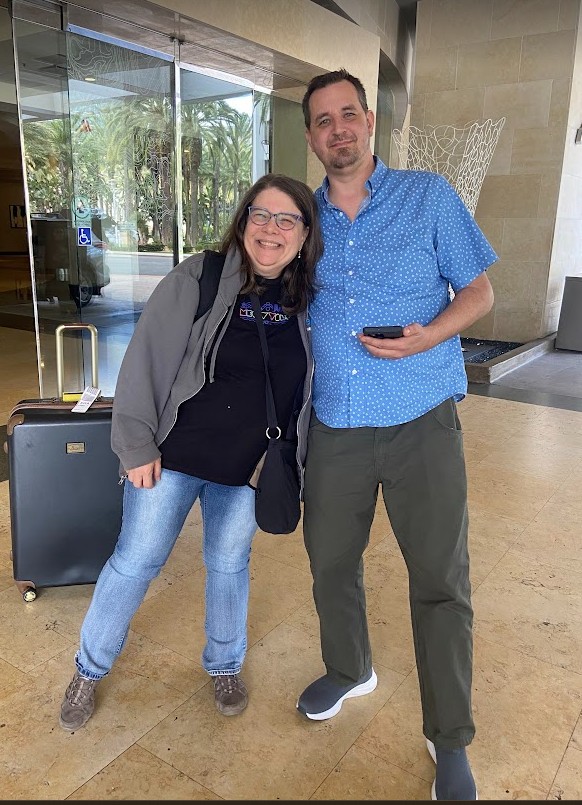
Being around for too long means I know, have met, or interacted online with many people. One of them being Glenda Sims AKA the GoodWitch. We have never really hung out or worked closely on anything, but we both have worked to make digital stuff more accessible, to people with disabilities, over the years and been regulars at CSUN.
Transcript
Steve:
Well, hello Glenda Sims, aka The Good Witch. The Good Witch, I mean, how did you get that name?

Glenda:
When I was little, The Wizard of Oz was a really big deal to sit and watch on regular television.

Steve:
Yeah.

Glenda:
And as I would introduce myself, if I just said, hi, my name's Glenda, Glenda's not a very common name, and people would think I said Linda, which is a perfectly good name, but it's not mine.

Steve:
Yeah. I thought you were Linda for years.

Glenda:
See? And so what I do is when I introduce myself for years, way before I got involved in tech, it was, hi, I'm Glenda, like The Good Witch and The Wizard of Oz. And it creates a mental picture and people catch my name much better that way.

Steve:
Yeah. Oh, that's, it's good. It's like, you may know, Dave Swallow, my friend, who I always talk about, and he's always on the Rogues Gallery, which will give you a hint.

Yes. He, he likes, he likes to be called Duke. Duke?

Yeah. It's, it's sort of, no, he doesn't actually, I'm just saying that because there's a, there's a TV show called Red Dwarf. I don't know if you've ever seen it, but there's this character in it called Arnold Rimmer, and Rimmer's a hologram.

And, well, he's a hologram. He was a person that had died. But anyway, it's well worth a watch if you've never seen it.

Glenda:
I will check that out.

Steve:
But there's this character that is like this, this sort of successful version of Arnold Rimmer. Rimmer's never successful. He's just, nobody likes him.

And he, he refers to him, like he says, my nickname is Duke, when nobody's ever called him that. But no, actually, Dave's actual nickname is the King of Driffield. And there's a reason for that, because he came from a place called Driffield in York.

He was born there. But anyway, enough about David. So tell me a little bit more about your, you know, your history, the arc of your, of your work life.

Glenda:
So I worked at the University of Texas at Austin for 25 years. And the first 10 of those, I was an HR professional. Maybe it was less than 10.

No, it was 10 for HR professional. And I got bored doing work that could have been digitized. And so I then became a developer at the University of Texas.

And this was the old days. Okay. This was before you had big, giant third party softwares that did all the things.

And so I became a developer. And I was the lead developer for all the HR applications for the University of Texas system. So that's all the universities, UT Austin, UT San Antonio, and they're like 17 of them.

Steve:
So what program language were you using?

Glenda:
 we wrote, originally, we were on mainframe. God, I'm old. We're on mainframe.

And we were writing in a German language called natural. It was very simple. And then we moved to the web.

And it was so early, so early, that it was pre JavaScript days. And Curtis Pugh at UT Austin wrote the scripting language for us to build our UI. And so I was on the web developing early, early, and I was coming at it from an HR angle.

All right. So literally, I program the employment application, the timesheet, I did insurance, all the all the things. And but I'm a people person first.

And one of my co workers in my early HR days, she was the specific interviewer for people with disabilities. Because there's an etiquette, and you have to understand reasonable accommodations. And you can say the wrong thing, if you don't know what you're doing and get in trouble.

And so she was just over the cube wall for me, and just listening and lunch talks with her. I know that that was the seed of my eventual move to digital accessibility. So at some point in my career, I moved from just writing the code for HR to, huh, I wonder if I can move from the business side of UT into the academic side.

And I had a sticky note on my computer for my wish to be a part of team web. That was my goal. And I got very lucky.

David Cook hired me onto that team. And we were the people that produced www.utexas.edu, the very first What years are we talking about?

Steve:
Is this the 80s? The 90s?

Glenda:
So I moved to team web in 1999. I want to say it's 1999. When I moved on to team web.

And I'd already been developing for probably eight years. But then I moved there and it was so much fun. Because every other gig I would get every other work assignment I would get would be mind blowingly awesome.

Now, every other one would be very pragmatic, like, help those students pay for their printing bills, like the system that would do that. But as I sat down on team web with the most amazing group of humans, UT was a fabulous place to work. I go in, I sit down, and I'm in a room with three other women.

And I turn and I say, I'm really interested in being a digital accessibility expert. Is that okay with y'all if I specialize in it? Or did one of you want to do it?

And they're like, no, no, no, you do it, you do it. And there's this guy on campus, faculty member, Dr. John Slayton, you need to go meet him. So PJ Abrams, I think, because she's the one that said, go meet John Slayton.

And I go over there, I'm like, faculty member, oh, no, like, is it all gonna be stiff and formal? I met that wonderful man. And he became my mentor.

And we worked closely. He, and I say I was on the academic side of the house, technically, yeah, I guess we were team web was more academic, but it still felt more like the business. And so he was faculty pushing for digital accessibility.

And I was more business pushing for accessibility. And we moved a bit of a mountain.

Steve:
Well, I can, if anybody could be the witch, that's for sure. Now, John. Yeah.

So, I mean, I honestly don't know a lot about John Slayton. I know his name, I know that he was on, but I've never encountered him. And when did he die?

Glenda:
He died in 2008.

Steve:
Oh, okay. So it was quite a long time ago.

Glenda:
Yeah, 2008. And his best friend was, one of his best friends was Jim Thatcher.

Steve:
Well, I know Jim Thatcher, yeah.

Glenda:
And so I was, I consider, like, my accessibility heritage, I call myself the accessibility love child of John Slayton and Sharon Rush.

Steve:
Oh, Sharon, I know as well. She's wonderful.

Glenda:
Yeah.

Steve:
And she's just retired, hasn't she, from, or she just stepped down from.

Glenda:
The party is this week. The party is this week.

Steve:
At AccessU.

Glenda:
At AccessU, there's going to be a beautiful event. I don't know if you've ever heard of it. It's Sight, Sound, Soul, I think.

And it is a completely accessible event with music and audio description and sign language interpretation. And then there's an artist painting to the music.

Steve:
Has this got to, ah, so, did I, I was reading something from, I'm hopeless with names or something. It's gone ahead. Crystal Preston Watson.

Glenda:
Oh.

Steve:
She, she was talking about some multi, you know, multi aspect.

Glenda:
It probably is. I remember the first time Sharon dreamed up the event. And I was just so blown away.

One year, it may have been the first year, we were in New Mexico at some fabulous event. I do a lot of work with Knowbility, volunteer work. And the artist, we had a blind jazz pianist.

Steve:
Cool.

Glenda:
And we had a blind painter. And the painter didn't just paint abstracts. He actually was painting the portrait of the blind pianist.

Steve:
Oh, wow.

Glenda:
And I believe the painter asked if he could touch the gentleman's face. He got permission so that he could have a better understanding of, of his face. And then the painter drew with puff paint, what he was going to paint and the puff paint becomes his outlines.

And I couldn't figure out how any of that was happening. But then he had an art class, a workshop for us later. And what he would do is he would add texture to each paint color so that he could feel when he put it on his palette, he could feel the difference in the paints.

Steve:
Right.

Glenda:
Oh, I mean, Sharon's events.

Steve:
While you were talking, this Crystal Preston Watson thing was a night of disability pride comedy. July 5th at the Rise Comedy in Denver.

Glenda:
Okay, that she's in Denver. All right.

Steve:
Yeah. But so that says it's.

Glenda:
This other one is called Sight, Sound, Soul. And it's also going to be a celebration for the amazing work that Sharon Rush has done. She hands the baton of executive director of nobility over to the amazing Jillian.

Steve:
Yeah, I haven't met Jillian. Is that Jillian? What's the second name?

Roar? No, that's Julie Roar.

Glenda:
No, no, no, no, no, no, no. Let me look her up real quick. What I'll say is when I first met Jillian, she was coming from Houston and she worked for Sharon and Jillian is the most perfect person for this role.

She if you look at the shoes she's stepping into, everyone's like, oh, my gosh. And Jillian's like, I can never fill Sharon's shoes. But I really think Jillian was born to take this moment and make sure that nobility continues to be the wonderful, wonderful learning and community space.

Steve:
Yeah, they do a lot of stuff. They do the air rally and they do. I remember many years ago now, it was probably about 2010 or 2012, that I got presented with a hero or something.

It was because of the work I was doing on H2O5 at the time. And it was it was it was instigated, I think, by Rich Schvertberger, who I work closely with. I've got it somewhere.

I don't know where it is because I but I just remember being in a room and though I'm never very good with with accolades or whatever, but it was a nice it was a nice thing. And I also remember that we TPG did some work. We contracted to get some work done with by nobility.

And at the time it was with Molly. This was like 15 years ago. So, yeah, I mean, it's always and I've always seen and said hi to Sharon whenever I've seen her at the various events, just like with you.

I mean, I always well, I didn't see you this year, but I usually see you at CSUN.

Glenda:
You were missed.

Steve:
Yeah, I mean, I had serious fun because I really enjoyed going to CSUN. Yeah, just because I had fun there, really.

Glenda:
It is a lot of fun. And I'm going to segue just for an interesting thing. And my dear friends will go, oh, here she goes again.

The next time you come out to California. If you're into interactive, immersive art, I would like to take you to my favorite place called Meow Wolf.

Steve:
Oh, well, if you're going to invite me tomorrow, definitely. I mean, I must admit, I usually don't go anywhere apart from the conference. So I'm quite happy to get to go on a journey.

Glenda:
Meow Wolf is the most mind blowing thing. And it makes me feel like I've become Alice in Wonderland and I've just fallen through the looking glass. It is so cool.

And what I love about going to places like that is how many times do you and I face things in our work that seem insurmountable or exhausting? And we look at how many years that we've been trying to make a dent, a positive dent in the space. And I go to a place like Meow Wolf and it helps me think inside, outside, upside down.

Steve:
Yeah, I mean, when you talk about something being insurmountable, people, I know people have been going on about the latest results of the WebAIM survey and how seemingly the accessibility of the code has gone backwards. But I think that's, you know, really that through the time that I've been working and you've been working on the web, things are just going to become a lot more complex. And so it's really sort of saying, 10 years or even one year ago, the complexity of what we're dealing with with web user interfaces and user interfaces in general, it's always changing.

Well, that's one of the things I really like about what I do and what we do is that there's always challenges. So yeah, it seems a bit like I never, I never wake up and think, oh, today's the day that everything's going to be accessible because it never is.

Glenda:
It's funny. One of the things that's driving me, I think we're about the same age.

Steve:
Well, I'm 62. I don't know.

Glenda:
I am too.

Steve:
Oh, well, there you go.

Glenda:
You were born in 64? 63.

Steve:
Oh, so you were a little bit older than me because I was born in January.

Glenda:
I was supposed to be born in January.

Steve:
All right. I was born on the 26th of January, which is Australia Day, which used to be a celebration. It was a public holiday.

But now as I've said before, it's reviled because of the politics of the way the Aboriginal people were treated and continue to be treated. But yes.

Glenda:
So one of the things that really drives me, it's interesting. It's like, why am I still working? I thought I'd be retired by now, for sure.

Steve:
I never thought that, but I've got young kids still, young, one 17 year old and one 21 who's, you know, both at college or my latter, my older girl is at university.

Glenda:
So, so my kids have both finished college. One of them's married. The other one's getting married in September.

So exciting. And, you know, it's like, why am I still working? Well, number one, I love what we do.

Yeah. We're not done yet. No.

Steve:
Just like Whitehang Street. I ain't done yet.

Glenda:
I ain't done yet. And what's, what's really important to me at this moment is, you know, I mentioned John Slayton and Jim Thatcher and both of those gentlemen have passed. And they and, and Sharon and Jim Allen are, are, are like so important to me.

And my career was created by some of these people, as in Jim created the first screen reader. And, you know, think about like Tim Berners-Lee created the web, our world. We know these people, like, how am I going to give back?

What am I going to do? And I do believe that there are other planes of awareness and that I want to take the vision that Jim Thatcher and John Slayton had. And I want to move the needle way more than it is so that the WebAIM survey, when I retire, will have moved so that, are we done?

No, we'll never be done. Will it be perfect? No, it won't be perfect.

But we made a leap forward.

Steve:
Yeah. Oh, yeah. It'd be nice.

It'd be nice to see some. But as I say, I mean, I think it's, it's, it's a combination of a, that, well, a combination. I just think that the complexity of the user interface and the complexity of the, of the technology that we use to create these user interfaces, it's just always moving.

So, like, recently there's been a, there's a, it's implemented behind a flag in Chrome, but it's HTML in Canvas. So, so you can, you can basically have interactive canvases.

Glenda:
Beautiful.

Steve:
Yeah. So it's interesting. And yeah, I could just have, like, I always thought it was going to happen because I remember I, I, I was arguing with Ian Hickson at the time, who's the editor of the HTML spec at that time, that he didn't want to, to allow any interaction to occur.

Because, you know, it's just basically a bitmap. That's what it is. That's on Canvas.

And he didn't want people to build stuff. And I was thinking, well, it doesn't really matter what we want. People are going to do it.

So this, this proposal, it's, it's worked while reading. But this proposal and this implementation does take into account accessibility and it does work. So it's, it's, but again, it's an additional complexity and you've got to really think about, well, you know, does it, does it, how does it support people with disabilities?

So that's an extra complexity. That's why I'm saying it's just an example of that. Now, let me pull up the Rose Gallery.

Glenda:
Okay, let's do it.

Steve:
Yeah. So I've reduced the numbers of people in the Rose Gallery from 12 to 8 purely because when Hayden was, was on eBroker, he only got through half. So I had to do, end up doing two, two, well, almost three hours of him and I, To make it through the rogues.

Yeah. Which is more than enough for anyone. But let me just share my screen.

Glenda:
I feel like I'm about to play a game.

Steve:
Yeah. Well, it's a game, but you don't have to, you don't lose or win or anything like that. it's just, Okay.

Glenda:
Okay. Okay. Let me, let me look.

Steve:
Okay. So top left. Sorry.

There's mostly blokes here. Well, it's, it's all.

Glenda:
Okay. That's fine. That's fine.

That's fine. That's fine. Wait, wait, wait, wait, wait.

Okay. Top left. Well, that I think might be the amazing Oh, sorry.

Steve:
Now, see this is what happens.

Glenda:
I just, That's fine. That's fine. is that David Swallow?

Steve:
It is. That is David. Sorry.

Glenda:
The amazing David Swallow.

Steve:
Yeah. He's there. He's at my house.

He came and stayed the night. He was doing a presentation in, in London at a university. He came and stayed the night and the next day he, he went and he likes doing park runs.

And so where the, the, I live in Bushy Park, which is where the original park run occurred and he wanted to go and make his pilgrimage. So there he is. And so you've got one of the few people that actually got his name right.

Uh, extra points for, for the name of my dog.

Glenda:
Oh, I have no clue.

Steve:
That's Lola. You can't just, I just like the look on her face there. She's sort of like, look, say, what the fuck is this guy doing?

But anyway, yeah, we've got that, that gate there because, uh, she's had some problems with, with her legs, her back legs. And so she's on, uh, steroids and unfortunately the steroids make her, wee uncontrollably at times. But when I take it, we live in a flat second floor and when I take it downstairs, we have to walk down like 47 steps, which are carpeted.

So I, I put a nappy on her. Yep. Yep.

That's so that's, yeah. And that's the reason why, because she seems to like going under the carpet and doing away. So too much information, but that's, that's David.

Glenda:
Well, I am happy to have met Lola virtually.

Steve:
Yeah. She's a lovely girl.

Glenda:
How old is she?

Steve:
She's seven now, but she's, she's been through the wars, you know, she had both, broke both her, uh, uh, front elbows. She had, yeah, she's the congenital defect. She's had like meningitis or the, you know, dog version of it.

And she lost control of the back legs and all these things. So, uh, but anyway, she's still with us, still causing havoc, still, still, uh, incredulous at, uh, the presence of Dave in the house.

Glenda:
So of course, of course. Oh, and this, this next one, you know, it's really weird because I'm, I'm, I initially thought it was Carl, but I think it's Patrick.

Steve:
It is Patrick.

Glenda:
Patrick's another woman.

Steve:
Yeah. Patrick Lauca. Yes.

And, uh, he's wearing a black helmet because he, he's recently got into riding bikes. so I just thought, I just got, don't ask me why, but I've got lots of pictures of both them all apart. Part of the reason is we meet up like they're good friends of mine and we meet up regularly, like once every couple of months somewhere, uh, you know, whether it be in our hometown or we go to the last time we were in Birmingham.

 I'm actually going to York next week for Tetralogical week, which is our face to face meet up and Dave lives in York. So I'll see him there. And obviously Patrick works with me.

So, uh, we'll be reunited and there'll be plenty of photos.

Glenda:
And there'll be more photos.

Steve:
Yeah. Well, it's really, I mean, I've got quite a few photos of you from when, you know, uh, obviously not like a creep shots, but I mean, when, when at CSUN, cause I always tell you, cause then without the photos, I just forget.

Glenda:
Yeah. Yeah.

Steve:
Yeah. You know, it's just, it, it really brings things back to me. So I appreciate that.

So yeah, that's Patrick and everybody knows Pat.

Glenda:
He's, he's such an important part of our community though. He does on, on WCAG.

Steve:
Yeah. He's the, yeah. I just, yeah.

I sit in awe of him. I mean, well, part of the fact that he's got a huge ego, but everything else, no, it doesn't.

Glenda:
Well, I was going to say, really? All I know is that he's usually right.

Steve:
Well, don't say that to him because that's what he, yeah. But, but I mean, it's, it's one of the things that I really like about working with people like Patrick and knowing people like Patrick and yourself and, and you know, others is that, and Mike as well. And is that even though, you know, I, I know stuff about accessibility, uh, I know my particular area, but it's such a broad subject that there's no way that, and I don't pretend to know everything because, and I think that's dangerous where people feel the need to, to think that they're experts in every aspect.

And there's no way, I mean, I'm not even an expert in the aspects of stuff that I know well. Yeah. There's always someone that you can call on.

And that's the part of the wonderful thing about the community that we work in is that people share knowledge freely. And that's an important thing. I've always kept that in, uh, in my head.

Glenda:
 I love it. I love it. Well, the next one is super simple.

That's Paciello. Of course, I have to say which one, because at least three of them work in the biz. So that's, how about Mike?

Steve:
Does Kyle, Kyle Paciello works at Deque? Does he?

Glenda:
Yes. He is wonderful.

Steve:
Yeah. I don't think I've ever met, like I've interacted with him, but, but I don't actually think I've ever met him in person. he's, uh, his brother and obviously one of other, Mike's other sons, Shane, I know really well.

And, uh, I really like, I mean, yeah, I mean, I'll, I like him, uh, Shane, uh, obviously I have a great affection for Mike. Mike's got good kids. Yeah.

He's yeah. I, I was pleased that I could get him onto the, uh, the fireside, which I did fairly recently. And we talked about stuff because, mainly because even though I don't agree with the, he's working at audio eye, I think it was a bad move, but I don't, I think he did it for the right reasons.

And I, I'd still believe that Mike, you know, if anybody can make a difference, Mike Paciello can.

Glenda:
I think so too. And it was curious when Mike went to audio eye, I'm like, what in the world? And I seriously thought a year would pass and he would, you know, run screaming from the building.

 and he hasn't, and he is there to try and fix it from the inside.

Steve:
Positive change within the, within the audio eye, at least they no longer claim they have an accessibility overlay.

Glenda:
So, so anyway, let me, let me ask you, do you know Chris Wilson by any chance?

Steve:
Yes. The, the, the guy from used to work at Microsoft then worked at Google and has recently retired. Yes.

Glenda:
 yes, he's, he's fun employed. and it's funny when I first met Chris Wilson, he was at Microsoft and I was subbing in on a South by Southwest panel because Aaron Gustafson, his flight didn't make it. So I'm having to pop onto this web standards panel and represent like the Zeldman, Molly Halshag web standards angle.

And Chris Wilson's there representing Microsoft and internet Explorer. And I'm like, and I seen discovered what a Prince of a man trying to fix things from the inside and forever changed my opinion. Like, don't assume that just because, a business is doing something you don't like that all its employees believe in.

Steve:
I mean, that, that, that is the thing that is, is that, you know, people in glass houses shouldn't throw stones and you know, everybody works somewhere and some of those places are more palatable than others. But I mean, you know, who, you know, Microsoft, Google, et cetera. I mean, they all do lots of things that nobody likes, but you don't look at the people that work there, you know, that are fighting the good fight within those organizations for accessibility, in particular, or whatever it may be.

 you don't look at them and say, you shouldn't work there because, well, I'm sure some, but some people do. It's like, you know, I mean, I, I, I joke around about, not, uh, wanting to work for any of the big three, because I did work for TPG, obviously, uh, accessible people, uh, accessible companies. Uh, but I started working there when, when it was run by Mike and Debs and Charlie, and it was a totally different organization.

Glenda:
Yeah.

Steve:
 it, so I can say, yes, I've worked for an American company for 17 years, but I don't think that I was lucky enough by the time that Mike left, though, I found somebody, I don't know, like had a child in existence there. So I wasn't, you know, so I was well paid and I got to do what I wanted to, which, is not mostly, it's not the case for, for people, you know?

Glenda:
Yeah.

Steve:
And people just, you know, graft, I mean, I've always grafted as well, but you know what I mean? But anyway, what I was, the point I was trying to make, I think was that I make, I poke fun at Deque and which is your employer and  level access or whatever. but you don't have to like a company, but you can, you know, you can support and like the work there.

Glenda:
And it's funny because no company is perfect. No. Humans are messy.

 but I continue to choose to work at Deque. I've been here since February 1st, 2011.

Steve:
So you've been there a fair amount of time.

Glenda:
I've been there a long time. And because I believe there's no place else on earth I can have the impact that I have. And it was, it was a hard switch for me because I worked a total of 25 years at UT Austin, working in an EDU on digital accessibility, the last X years, I was able to share, share, share, share, share, because I was at EDU.

Right. And then going into it's intellectual property. And I'm like, I don't know if I can do this.

I don't know if I can do this, but I learned, that I learned, I learned that I can do really good things and I can still find ways to give things away for free within this org, that are approved. and that it takes the whole village of different types.

Steve:
Yeah. Well, I always think about, I mean, like acts as a, uh, the, the, uh, rules engine that Deque had. I mean, it's everywhere.

It's everywhere. Yeah. I don't know.

I mean, I presume that the, uh, licensors is such that it could be used everywhere because that's what happens.

Glenda:
It can. Which is great. That in and of itself is one of the things that I'm like the gift of that, from AxeCore and then AxeCon, a free digital conference with no travel requirements that humans in this difficult economy can continue to learn how that makes sense.

Steve:
It's like ID24 that Pat runs.

Glenda:
Yep. Oh, I love ID24.

Steve:
Yeah. Well, he's doing a call for, uh, I think it's in September. So he's, he's doing a call for, uh, submissions.

So you should think about, tell your friends. He's always looking for interesting.

Glenda:
Oh, I know. And I love, you know, I admit I scan a11y Toronto, I scan ID24 and I'm looking who am I going to see if they'll come speak at AxeCon.

Steve:
Yeah. Yeah, no, it's understandable. I mean, yeah, it's, it's good.

 so yes, so, so that's Mike and they stand against obviously, uh, at AccessU. Yes.

Glenda:
Yes. In Austin. I'm headed there, in just a few hours.

Uh, Lucy Greco is the keynote tonight.

Steve:
Uh, say hi to Lucy for me. I've actually, I've been meaning to get in contact with her cause I, Lucy's another person I've met at various conferences over the years and we always have a chat. I wanted to get her on here to, uh, to have a chat with her, but I haven't been in contact with her yet.

I did. I recently snagged, uh, well yesterday, Janina.

Glenda:
Oh, awesome. She is, she is a force to be reckoned with.

Steve:
No, it was last Wednesday because I, she, she, uh, is co-chair of the, uh, platforms.

Glenda:
Yeah.

Steve:
Yeah. With, uh, uh, an old, uh, colleague of mine and friend, uh, Matthew Atkinson.

Glenda:
Matthew Atkinson. Yes.

Steve:
Yeah. So, yeah. So I, and so I asked her, she said she'd be delighted cause she, she's someone who's just been around for years and she's always been involved and active.

And apparently she plays the main piano too.

Glenda:
I did not know this.

Steve:
Yeah. This, this, I think there's recordings of it playing piano. Like she, she did something recently, did a recital recently and, uh, people invited.

But anyway, I'll, I'll see if I can find a recording and I'll put it on when I publish the, uh, this. Perfect. So, so yeah, so that's, accessU and Mike.

So let's move on.

Glenda:
Oh, wait, I think there's somebody to the right.

Steve:
Oh, there is. Oh, there's two more people.

Glenda:
Okay.

Steve:
You may not know this person.

Glenda:
Wait, wait, wait, wait, wait, wait, wait. Is he still with us?

Steve:
Yes.

Glenda:
Okay. I don't know him.

Steve:
His, his name is Jim O'Donnell. he goes and he's known as evil Jim O'Donnell. He's, he's, uh, involved with the State of the browser, but he's been someone that he's a local.

I think he worked at the, at the university of Greenwich for, he's like does some astrophysics or some mad hat, you know, sort of propeller head type stuff, but his partner or he's, he's married to a woman called Michaela Lewis. Who's a lecturer in, something lecturing something to do with what similar, what we do. I remember she always used to do, uh, do the, uh, the sort of visual notes like of, of, like if someone was doing a talk, she'd, you know, become out like a cartoon.

Yeah. But it was because I remember that I used to go, she did one of, one of my talks and I said, can I share it? She said, no.

So you've got to ask, uh, but yeah, but, but, uh, yeah, so that's Jim O'Donnell.

Glenda:
Okay.

Steve:
Well, I need to, there is no rhyme or reason how I choose these people sometimes.

Glenda:
Well, I think it's funny because you find it hard to remember names and then you make us do it.

Steve:
Yeah. I mean, I, I, I put the thing people want to hear and I can't even remember their name. Do you know the person that's standing next to him?

Glenda:
You know, it's funny. my vision's kind of trashy. but yeah, I, I, I first thought David Sloan and then I'm not sure.

And then I thought maybe it's Matt Ater. And then I'm like, yes, it is.

Steve:
It's Matt Ater. Yeah. Well, I don't know how to pronounce his name.

Glenda:
Oh, I don't know either. I've been on a panel with him, but I always call him Mater. He's, he is, we were on a panel at, at Fireside Chat at CSUN last year.

Yeah. And it, it was, and, uh, Rochelle Bradley Montgomery and there was one other person. It was wonderful.

Steve:
 that is, that is a picture of that. He came to visit me cause he used to be my boss. I was, and, uh, he went, fuck.

I don't know how I do this. so anyway, he used to be my boss and he came to visit me and that's the front door of my, the place where I live.

Glenda:
Oh, it's lovely. It looks like something, it looks like a really beautiful place.

Steve:
Yeah. Well, it, it, it used to be like, it's only really facade of the building, but it used to be, the Sopwith, uh, aircraft factory. And, and I don't know if you've heard of the Sopwith Camel, which was during World War I.

Yeah. Well, this is where they were built. And these are the off, this front part was the offices of the, of the factories where Sir Henry Sopwith used to have his office or whatever.

 yeah, but they knocked all the, the, the, the whole block used to be a huge factory and knocked all the factory down, put, put, flats up. And, uh, I live in the, in the old part.

Glenda:
I like it.

Steve:
And there's Matt. Yeah. There's Matt standing outside.

I always like I like to call this photo when a Mater calls. I don't know if you've seen that film, when a monster calls. It's about, it's about cancer coming, you know, affecting a child.

And he sort of said it's a monster. But anyway, Mater's not a monster. He's a nice guy.

And, uh, and we always got, I've always got on well with him. But as I say, it just, when I was looking for photos, it just came up and I thought, oh yeah, I like that photo.

Glenda:
Let's write that one. Well, the next one's super easy, but it's an old photo.

Steve:
Yes. Well, that's his photo. That's all that he uses for, uh, for, zoom.

Glenda:
So that's why is it, is it okay. Yeah. Yeah.

Alistair Campbell. He is he and Rochelle and I think it's Adam page now. They're herding the cats in the AG.

Steve:
Oh yeah. I mean, I was, I was a bit frustrated a couple of weeks ago that I, I, I made a comment on LinkedIn about, not about them, but about the thing. But then I came back straight afterwards, and made a comment to say that, you know, they do a great job because it's not a job that I would want to do.

Glenda:
Oh gosh, no.

Steve:
I just don't have the, the patience that I used to have.

Glenda:
It is incredibly political.

Steve:
Yeah. It's not, it's not, it is fluid. There's also, yeah.

Glenda:
And not, not like, not like government politics, but just, oh yeah. It's, it's incredibly hard work. And one of the things I try to do is I try to keep my energy spent on digital accessibility.

Steve:
Yeah. Well, I mean, I must've said, I don't talk a lot when I, I do it to the, like I said, I've just been to the last couple of hours, being in the conformance.

Glenda:
Oh conformance.

Steve:
Yeah. It's a special meeting, but I mean, I just had to do it sometimes because I want to say, oh, shut the fuck up, you know, but I don't because I'm a professional, of course, but also that, yeah. I just think that, that, that you can expend a lot of energy on, on things that aren't actually that productive.

Glenda:
And what I will say is that the work that Alistair and Rochelle and Adam are doing, it's really important because the consensus method and, and letting everybody voice their opinion. And so I'm grateful for them doing it. I'm also, when I think about Andrew Kirkpatrick, wow, I worked on WCAG 2.1 when he was Agwag lead. Yeah. Deller.

Steve:
Yeah, no, no. Andrew's, Andrew's a good person and a thoughtful person as well. The, the only issue I have with that group is that, yeah, there should be, there's lots of people on there, but mostly people don't actually get word in edgeways because there's certain people within the group that just dominate.

Glenda:
I've been thinking that too, and I'm gonna maybe brainstorm about that, but not on video.

Steve:
Yeah, yeah, no, no, of course, of course. I mean, I'm not, yeah, it's, we're not here to put people down.

Glenda:
So this next person, this next person, is that Christopher from Google?

Steve:
Yeah, Patno.

Glenda:
Yeah, yeah, yeah, yeah, yeah.

Steve:
I just, just remembered his name.

Glenda:
You put people up here.

Steve:
Yeah, well, no, I did, I knew him, but then, but, you know, like I just, in the moment, I'd suddenly forget things. But I just like that because he looked like, he looks like.

Glenda:
Oh, I think it's fabulous. And, and, and, you know, like I went to the University of Texas at Austin as a college student and then worked there for 25 years, and he's doing this, right? But this is Longhorn.

So I'm like loving the whole vibe.

Steve:
What, what does that mean?

Glenda:
So our mascot for our football team is a Longhorn cow, and they have like big, giant horns. And this is when you're standing up and you're cheering. It's like, that's the hand symbol for Longhorns.

Steve:
Gotcha.

Glenda:
Yeah. Yeah.

Steve:
I think he's based in London.

Glenda:
I do too. Yeah. Yeah.

I don't know that I've met him. I have other people. Now, this next person, I am gonna make a wild guess.

Steve:
You've only got half his face. So.

Glenda:
I know. I know. And it's Ian Lloyd.

Steve:
Exactly. See, you know everyone. That is a colloquially known as Lloydi.

Everybody calls him Lloydi. He even calls himself Lloydi. And he's, you know, he's, he's handled some various things as Lloydi.

Yeah. But this is someone again, who I work with now.

Glenda:
I love Ian.

Steve:
Yeah, he's good value. And he knows his stuff. And he's, I like working with people that, that have, you know, their heart is in the right place.

And Ian's heart is in the right place as well. He does lots of really interesting things, makes lots of, of interesting, uh, tools.

Glenda:
BW buses.

Steve:
Yeah, he loves, yeah. He's got a motorbike as well. He was, yeah, he's, and he's, do you know that he, uh, that he was a, uh, he makes, makes a, you know, music.

Glenda:
No.

Steve:
Yeah. He's into house. Yeah.

He's got records that were put out.

Glenda:
I had no idea.

Steve:
Well, there you go.

Glenda:
I had no idea. And I don't, you may not know this, but the first panel that I was on at South by Southwest, it was Ian and James Craig and Derek Featherstone and myself.

Steve:
Wow. That was sick.

Glenda:
So, and I was so mad because Eric Meyer's session was at the same time, right next door. And I thought nobody would come to my session, but I was wrong. We had it.

We had it. We had a full house. Yep.

Steve:
I think that that was because Pat was sharing a room with Lloydi at South by Southwest. This was like two, this was in the early 2000s.

Glenda:
2005, if I recall correctly.

Steve:
Yeah. Yeah. It's sort of a legendary, uh, uh, time that, but some, it was fabulous.

I've never been. That's another thing. I've never been to South by Southwest.

Glenda:
I have to tell you, I think it was that same South by I'm at a party. It's like one o'clock in the morning and we're out in a beer garden outside in the back. And you know how you're standing in a circle and the circle starts to grow.

And then all of a sudden you might bump into somebody behind you in another circle that started to grow. And so that happened. I, I moved back and I, and I just lightly bumped someone.

And then I looked over, it was Jeffrey Zeldman and I hadn't met him yet. And so I like realized who it is. And I'm like, and then, and then I got, that was when I got to meet Jeffrey for the first time.

Steve:
I, I met him, like I was, presenting at a conference in somewhere in the Nordic regions were like Sweden or, or somewhere like that. And I met him, I remember cause he said that I was giving him the stink eye. Yeah, of course.

Glenda:
That's just resting Faulkner face.

Steve:
Yeah, exactly. Yeah. I mean, I just, it was happy to be, I think, yeah, it's got something to do with why I look, but yes, of course, you know, the incredible you Nina of accessibility goodness.

 yeah, she's, she's a force to be reckoned with and I look forward to this because I'm sure she's got lots of stories and, uh, but yeah, I mean, I'm glad that I've, I've worked with and known her for, for many years and she's still full of life.

Glenda:
John Foliot introduced me to her.

Steve:
John Foliot. I haven't seen, have you seen him?

Glenda:
Yes. I, I keep in very close touch with John.

Steve:
I remember you and I were discussing. Yeah. And, I, I did reach out to him, uh, a couple of past six months ago and we had a conversation, but I haven't seen him like, do you know what he's doing?

Glenda:
 he is officially retired and having a blast. He's opened, a little antique shop. He does a lot of collections.

Steve:
All right. Yeah. Yeah.

Glenda:
He and his wife, Vicky, get together and ticking. Yeah. And, the other thing that he's doing, we're like brother and sister, so I do stay in close touch with him.

he is digitizing or he's organizing his digital collection of music and creating a very accessible interface for it.

Steve:
Oh, nice. Well, give him, give him my love. yeah, he's someone that I've spent time with over the years. I've got lots of lovely pictures of it, surprisingly.

 and yeah, he and I like, yeah, I remember I was at see someone that was in San Diego. Yeah. And he got, he shared a joint with me or something.

And it just knocked my head off. I remember it was good times.

Glenda:
Do you know the joke he pulled on me? No, I had never had an edible.

Steve:
Oh, really?

Glenda:
And I didn't know how strong they were and I didn't know how long it took. And so he gave me a quarter of a bonbon and it was, it was legal, you know, he gotten it legally. He gives me a quarter of a bonbon.

And so I think he's like giving me a quarter of what a normal person would have. And so like 15 minutes later, he says, do you want another quarter? I was so out that Elle Waters had to babysit me.

Steve:
That's somebody else I was going to ask her about. Cause I hadn't seen anything about, I know you and you and her were inseparable.

Glenda:
Yeah. She's one of my muses. She and Denis Boudreau have always been my muses.

They're the ones that like poke, poke, poke, poke, poke, poke. That's not enough. Like they think really big.

 and I love how they push me. So Elle is at work day.

Steve:
Ah, that's right. Yeah. So what about Denis?

Glenda:
Uh, Denis is independent and he's, uh, published two books now and he does accessibility in speaking. He's like, professional speakers learning how important it is to think about accessibility in, as a presenter.

Steve:
Well, that's cool. Very cool. I hadn't, yeah, I hadn't seen the last, well, last I remember seeing him, he was working in Houston and he came up to me at CSUN and was asking me, you know, at the time, how, what would I do?

What would I have to do? What would they have to do for me to come and work with them? but, uh, yeah, I was, unfortunately I was a little bit stoned at the time.

Glenda:
We'll blame that on foliot.

Steve:
Yeah, yeah. Well, yeah, of course. But, uh, I just remember, yeah, I remember him sort of coming and talking to me and I was thinking, yeah, yeah.

Glenda:
Denis, Denis is such a craftsman that he does best when an organization isn't too big. And so, I am, I'm just grateful. Like I, I do it this way.

If we're working on accessibility, we're family. I don't care where you work.

Steve:
I don't care. So how many people work at DQ now? Is it DQ or is it DECU?

Glenda:
I really am just a manager at Dairy Queen. It's DQ. Would you like some ice cream with your accessibility?

Steve:
So it's DQ.

Glenda:
It is DQ. I am actually gonna look something up real quick because I, it's hard for me to keep track of the number, but you've got like offices in India now. We have offices in India.

We have offices in Europe.

Steve:
Europe. Yeah.

Glenda:
Yeah. Yeah. so we're, we've, and when I started, like, I swear there were just four experts.

It was, uh, Salish Panchang.

Steve:
Yeah.

Glenda:
Karl Groves. and a guy named Don, I'm forgetting his last name. I can't believe I'm forgetting his last name.

And myself, there might've been one other, there were four of us. and we could, I think the, the majority of the company sit at a big long table. and now I, I know we're over 300.

I'm looking to see if we've, passed, a higher number than that. Cause we probably have.

Steve:
So a lot of people, I mean, that's that, that was one of the things that I found difficult when, because I always felt as if I could, you know, sort of put my arms around the, the people at work, you know, not physically, but you know, it's all like, I had that in, you know, the, the, I understood the organization, but then once it started to grow and grow and grow.

Glenda:
Yeah.

Steve:
I just lost, lost touch or lost sight of what, what the organization was. And also the, the more you grow, the, the more specialized, the people that you've got, your marketers, you've got this, you've got that different, you know, different. And so you become siloed and things like that.

So I thought, how was the communications across DQ?

Glenda:
 actually pretty good. My favorite part is, so I grew up in a really big city. I grew up in Houston and I'm used to big.

And then I worked at the university of Texas, 50,000.

Steve:
I mean, everything's bigger in America.

Glenda:
Everything's big. I'm from Texas. Bigger is better.

Right now. I totally agree with you that as you grow, the communications can be more problematic, but so I work with, I don't know if you know, Matthew Lukin, but he's my best friend at work.

Steve:
 and yeah.

Glenda:
And I just moved into a new house. So that's why things are empty behind me. So I work from home, but, Matthew has this, I think he calls it a hive, a communication pattern.

And it's like, communicate, share, communicate, share, communicate, share. And he is on us if we are not communicating. And so he's like, efficiently.

And it's not his job to do that, but he's one of those people that he understands that we can't be as effective if we don't have the conversations that we need to have or share the information. So for the size that we are, we communicate well. And one of my favorite things that I set up years ago is, the accessibility Jedi council within Deque.

Steve:
Yeah. I remember you talking about this previously.

Glenda:
Yeah. And so I've got Wilco on it, you know, the heartbeat of AxeCore, right. I've got Paul Bowman on it and he's the heartbeat of Deque University.

Right.

Steve:
Yeah. Just to know, I always, it just grates on me that you call it university because university is like a reserved word for me. You know what I mean?

Glenda:
So it's already, I know, you know, you know why I know that? AccessU used to be called Access University and we had to change it. Sharon and I dreamed up the name for AccessU and we had to change it because it's a reserved word.

So you're right. You're right.

Steve:
And then I, you know, I just think it means that, that you, you know, you, you provide real qualifications that, that, uh, you know, degrees.

Glenda:
So, yeah, I, I, I respect that having worked at a university, I do respect that, but I've got, I've got Wilco and Paul. And the reason I'm saying this is it helps you see how we have these connections. So, and then I've got two people that are running our, our manual test method that we have very detailed GitHub, so that we can have consistency.

And that's a Parna Pasi who's in our India office and Jeremy Catherman, who we got from USAA. He's fantastic. And, oh yeah, some girl named Goodwitch that thinks she's Yoda or something.

 and the five of us meet weekly because if the five of us can come to consensus on, does this pass or fail WCAG normative with the idea that we have to go defend that in a courtroom and be right. Like, like Andrew Kirkpatrick's at the other table. I better get it right.

Or Faulkner or Patrick Lauke. and that it's really crucial that we be pragmatic because as much as I want you to build better than WCAG minim it's not my place to pretend like this other thing is that's a best practice is a normative requirement.

Steve:
Yeah. Yeah. That's yeah.

Pat's very, I mean, very, insist upon that. I mean, so, so like, cause being, you know, that there's lots of things that we'd like WCAG to do, but, or, you know, but it just, if you, you, you've got to look at the normative, uh, content and say, okay, this is, it doesn't say this, it says this.

Glenda:
It says this. And that's a hole and that's a hole we need to fill in the next iteration or down the road. And so we actually have a list of all these things that people thought were failures when they came to work for us.

And we've added, you can't call it a failure. You can't call it a failure. So it's a wonderful list to help realize these are all the gaps.

Steve:
Yeah. We, I mean, when we, we do, when we do our, we call them successful snob audits, but it's all about the word, isn't it? But, uh, we, uh, we have best practices that we have what fails, you know, so yeah.

Glenda:
Yeah.

Steve:
There's plenty of that. It doesn't stop us, you know, having hundreds of issues that we file.

Glenda:
So yeah, there's a lot to find out there. It's very easy, to make a mistake. It is to make it, it's too easy to make it inaccessible today, but I have hope for our future.

Steve:
Yeah. So do I. I'm always, I'm always hopeful.

That's why I continue to do what I do, but it's also because it's, it continues to be challenging, you know, every day there's, there's something new to look at, you know, and something exciting.

Glenda:
Oh my gosh. I, I have had some amazing ones recently where like, I need to have a beverage and, and think about it. I have to dream about it to eat it.

I love this challenge. They feel like puzzles to me.

Steve:
Yeah, exactly. That's yeah. Much the same.

So we've done the, uh, the rogues, the rogues gallery. So we can, uh, put that to bed, so to speak, you know, just now I've got to work out how to, uh, oh, I do. That's all right.

I mean, things have got a lot better in, in my, uh, the, the, uh, my presentations of, of, you know, during this, but still is it stopped? Yeah. Yeah, it has.

It's all right. Oh, no. Stop screen share.

That's it. I never know. I never know where to, uh, okay.

So I wanted to ask you because I, people you work with Dylan Barrel. Yeah. Barrel, Barrel, like, like a barrel of, yeah, like a barrel because I, I have heard other people refer to it as Darryl Barrel.

Now Darryl's not his name, is it? No, it's Dylan. Yeah.

That's what I thought. And also somebody, somebody said Dwayne. I don't see.

Glenda:
Yeah, no.

Steve:
No, it's definitely, he's always been Dylan, hasn't he?

Glenda:
Yes.

Steve:
I thought so. He's another interesting character who I, uh, run into, at various CSUNs now. Uh, so what is your actual job at Deque?

Glenda:
 the cool thing was I got to create my title. I'm the chief information accessibility officer. And I put the I in there instead of just chief accessibility officer, because as I was designing the job description and discussing it with Preeti, I also shared it with all my strategic consultants and said, is this job description what you think Deque should have?

And is this job description something that you would want to be able to share with clients to go, this is what our CIAO looks like. And before I put the I in, they started asking me questions like, well, what about starting an employee resource group for people with disabilities? And what about, ergonomic chairs?

And what about, and I'm like, I care about those things, but I'm pretty sure Preeti is going to want me to focus on digital. And my strength is digital. And so that's why I put the I in there.

It's not that I don't care about those things, but we put those responsibilities primary as HR responsibilities. And then I come in and assist if they're like, how do I do this? I'm like, oh, I can, I can advise you.

Steve:
Oh, that's cool. so you're roughly similar to what David Sloan? Yes.

Yeah.

Glenda:
Yeah. David Sloan, uh, John Avila, that.

Steve:
Yeah. I was actually the CAO, Chief Accessibility Officer at TPGI before when, when I left, that's when David Sloan took over, but it was never a role for me. It just, it's not me.

Glenda:
I love it.

Steve:
Yeah. I mean, I didn't know what it did really mean either. I mean, I, I, I enjoyed it because part of my job was, I was, the W3C rep for TPGI and also managed a small group of people, which was the knowledge center.

And that was James Edwards, Ricky Onsman and Hans Hillen. So yeah, I mean, Hans and I, we started on the same day back in 2006. So he's put up with me, put up with me for many years.

 but yeah, it was a nice little group and it was like managing four people. I could handle managing three people. I could handle, but, uh, cause at times there at TPGI I had 20 people I was managing, which was mad.

Glenda:
That's too many to effectively manage. I mean, I actually have a degree in HR and worked in HR for 10 years, so I'm really comfortable doing that, but I want to nurture people. And, and I was trained that you want to help people reach their full potential.

Steve:
Yeah.

Glenda:
And that may not be within your organization. And so I'm, I'm people first and right now I don't have anyone that reports to me directly. And at this stage in my career, I don't mind because what I really want to do is I don't want them to be overly dependent on me.

At some point I am going to retire. maybe if there are grandchildren, but it's, as, as I was putting together the job description, it was, it was really fun because when Preeti agreed to name me chief and we started to work on the job description together, I thought I had already been doing it. And then she officially, you know, the title was announced and everything.

I didn't realize that it would really mean a lot to me. Uh, I thought, Oh, this is just formality. But then like the heart emotion, I was like, this is really, and taking it so seriously, like, how can I be the best chief information accessibility officer at a company that does digital accessibility?

And so part of my work is to work with strategic clients. Occasionally, I'm not the only one. We have a house of strategic consultants.

 thought leadership is really important. And part of that is W3C work, innovation and community engagement. So I get to be very involved with Axe-Con and creating a caring community.

 and here's the part that I actually, this is as my nerd geek enjoys, perhaps a lot more than I just do governance and monitoring of accessibility within my own org for every breathing human. Yeah. I don't, I don't care if you're the accountant, I don't care if you're the IT security guy, you have to understand accessibility etiquette and how to communicate.

And that includes email and Slack and PowerPoint and word and all the things. And you need to understand that's your responsibility. And if you don't know how to do it, that's fine.

Go ask someone for help, supervisor. And so of course I've got the whole developer arm under Dylan. And so agreeing to required training, uh, service level agreement for these issues shouldn't happen at all.

And if they do, when are you going to get them fixed by?

Steve:
Sure. I love that part.

Glenda:
Crack the whip.

Steve:
Yeah. I am.

Glenda:
And, and it's really, it's so important that we live it and you cannot take it for granted. No. Even in an accessibility company where we have all the training and all the tools that we could possibly need without somebody watching it and reporting on it, it will slip.

Steve:
Well, yeah, that's the thing. One of the things about me, like, as you know, I'm quarter owner of a smaller company now, only 17 people, but, as always, as, as we punch above our weight.

Glenda:
You do.

Steve:
But, it, it's good having such a small group, but still, you know, just all the, the tools that we use, we really need to think about are they accessible? You know, do they work for the people that, that, that we have employed? Will they work for future employees?

All of those things. And you're, you're up against it because most of the stuff is not that accessible or is not that good. So it's always a, an uphill battle to find the things that work.

Glenda:
And what I will say, you know, we talked earlier about, you know, WebAIM million, the results lately weren't what we wanted to see and, and it's so hard to buy accessible software, but I have felt a positive shift. it, there has been progress and I want to call out, I want to call out a specific company. ADP is who I use for HR stuff for our employees.

And it's not perfect because it's big, right? So there's going to be bugs, but that team, I don't know if you know, Kelsey Hall at ADP. Kelsey Hall.

She's amazing. She's, she's amazing. The team she's built there.

 and I had a brand new employee come in, report a problem as he was filling out some paperwork. It was a low vision problem. It had to do with increasing font and, and things no longer fit were cropped.

I asked him to report it just to see what would happen. It was fixed in two weeks in production. I almost fell over.

And when I say I almost fell over, I know ADP cares. I don't expect you to fix an issue in two weeks in production and get it rolled all the way out to my employee. Wow.

Steve:
It's nice when they do. That's for sure.

Glenda:
I, yeah, I think I had a little tear in my eye and it seems so simple, but the being able to be independent with your personal information is crucial.

Steve:
Yes. Yeah, definitely. You don't want to have to rely upon other people all the time to, to import stuff and to, yeah, to interact for you.

You want to be able to do it yourself. Of course. okay.

So sorry, it's my brain. It's, it's, it's, it's coming on for a nap time. Yeah.

It's coming off the half past six. So we've, we've done it. I know it always seems to go so fast.

Glenda:
I am loving it.

Steve:
Yeah. And well, I'll get you on again. I, yeah.

I mean, when I started doing this, I didn't expect it to, to go on as long as it has. And, uh, but I just keep getting more people that I've got Aaron Gustafson coming on and got Brian Cardell who's on the tag. Yeah.

I've got, Doug Shepers.

Glenda:
Oh, Dougie.

Steve:
Yeah.

Glenda:
I'm the only one that calls him that.

Steve:
He's a funny guy. I love Doug.

Glenda:
I adore him.

Steve:
And, uh, well, are you planning on going to a11yTO, uh, in, uh, October?

Glenda:
So I haven't been yet because I try not to hog all the conferences. I know, I know it's fantastic. and I almost went one year and then I can't remember what happened.

So I, I can't promise because I'll see you there.

Steve:
It's only because I was, I usually see you at CSUN, but I didn't go this year and I, I won't plan. I don't plan on going to, going to America, going to where you live until there's regime change.

Glenda:
And I don't blame you.

Steve:
Yeah.

Glenda:
I don't blame you.

Steve:
Yeah. That's the only reason. Well, yeah, I was concerned, you know, and I'm just, I'm a, you know, a white middle-class guy from the UK.

So, well, actually I'm from Australia, but I live in the UK, but, you know, I, yeah, but I generally would, I'm concerned about, what would happen if I just got, you just have to look at someone the wrong way and, and, and you, yeah.

Glenda:
But anyway, I understand.

Steve:
I, uh, it's, it, it's, what can, what can I say? It's, it's horrific what, just watching from the outside. I can't imagine what it's like living, living through.

Glenda:
It, it has been so heartbreaking. and I don't know if you've paid attention to what's happened in the last couple of weeks, but the Americans with Disability Act Title 2 update and the HHS 504 deadline were both just moved out of here. Yeah.

And, it's, it's heartbreaking, to see these things happening. but I always remind myself, don't give up. What is it that Lainey says?

 she says something about if you do, if you comply with what they wish you would do before you have to, in other words, somebody's asking you to do something wrong. They're, they're asking you to stop caring about accessibility. And so you give up caring about accessibility.

You just let them win.

Steve:
Yeah.

Glenda:
Don't do it. Don't do it. And so I was like, it's always darkest before the dawn.

Many times in my life, I've been at a point where it's like, this isn't ever going to change or this isn't ever going to get better. And then if you just hang on your, your moments, your months, your, you know, from the breakthrough. And so I'm just going to keep hanging, hanging on.

Steve:
Optimism. I'm going to keep hanging on. Nice to see.

 okay. So before I forget, part of, part of the enjoyment of being on the, is you get a free item from, yeah. Well, you, so choose whatever you like and I'll send you it, but I'll email you about that and I'll send you through the, uh, the recording so you can, I'm pretty sure that nothing was, was that we, nothing controversial.

Glenda:
I don't think we said anything.

Steve:
Apart from me, I'm questioning, uh, Dylan's name, which is not controversial. But no, but thank you, Glenda. It's been wonderful to speak to you.

As I said, I always say this, that I always like, this is probably the longest we've ever actually talked. I mean, I was sitting across from you at dinner, but usually these things I'm quite antisocial. I just get overwhelmed by, because, you know, but I live in this box and this is where I am most of the time.

So it works for me from, from that side, but it's just nice to talk to you and I appreciate you doing this.

Glenda:
I think it's wonderful. I so enjoyed this. and you may not know this.

 I appear as an extrovert. I'm actually an introvert.

Steve:
Yeah. Well, I'm much the same. I don't know why I am these days, but I feel much more comfortable in my skin as I've got older.

I think that's one of the nice things about age.

Glenda:
I agree. I agree.

Steve:
Well, you have a wonderful rest of your day.

Glenda:
And I will, I'll go say hi to Lucy for you.

Steve:
Say hi to everyone else, to all the people.

Glenda:
And happy almost GAAD.

Steve:
Oh, yes, yes. Well, next week's Tetralogical week, and we'll all be together in York, which is, I don't know if you've ever been to York, but it's a great city.

Glenda:
Give everyone a hug for me.

Steve:
I will. You work with an amazing group. Next week, I'm presenting in, the Netherlands.

So I'll be hanging out with Hiddy de Vries, who I co-edit the WCAG-EM with, and somebody he works with, a guy called Jeroen Hulscher. So yeah, be an interesting time. And I made a shirt that says, uh, that says excessively political in, but it's in Dutch.

So I'll be sporting that while I'm there.

Glenda:
They'll love it.

Steve:
Yeah. All right. Thank you again.

See you later.

Glenda:
All right.

Steve:
Take care. Bye.
some stuff mentioned
- Glenda Sims – Chief Information Accessibility Officer, Deque
- John Slatin AccessU 2026
- Inside No. 9
Crazy Horses – the Osmands
Lyrics
[Verse 1]
There's a message floating in the air
Comes from crazy horses riding everywhere
It's a warning, it's in every tongue
Gotta stop them crazy horses on the run

[Pre-Chorus]
What a show, there they go
Smoking up the sky, yeah
Crazy horses all got riders
And they're you and I

[Chorus]
Crazy horses
Crazy horses

[Verse 2]
Never stop and they never die
They just keep on puffin'
How they multiply
Crazy horses
Will they never halt
If they keep on moving
Then it's all our fault

[Pre-Chorus]
What a show, there they go
Smoking up the sky, yeah
Crazy horses all got riders
And they're you and I

[Instrumental Break]

[Bridge]
So take a good look around
See what they've done, what they've done
They've done, they've done
They've done, they've done
They've done, they've done

[Chorus]
Crazy horses
Crazy horses
Crazy horses
Crazy horses
Crazy horses
3 replies on “here comes the GoodWitch”
[…] here comes the GoodWitch […]
[…] Fireside: Glenda Sims AKA the GoodWitch Steve Faulkner: we both have worked to make digital stuff more accessible to people with disabilities over the years. […]
[…] Fireside: Glenda Sims AKA the GoodWitch Steve Faulkner: we both have worked to make digital stuff more accessible to people with disabilities over the years. […]