I mistakenly thought that Wendy Reid was on the W3C TAG, I thought this, as each time I have encountered her (including now by the fire), she has struck me as brainiac. Wendy worked accessibility at Kobo, and now at eBay. I hope you enjoy listening to Wendy speak as much as I have.
Transcript
Steve:
Well, hello, Wendy Reid. Welcome to the resurrection of the fireside chat. That is not any other type of resurrection.

We don't touch religious subjects much, unless you want to bring it up. That's fine. But yeah, it's the reason why I call it the resurrection, because I was watching what the who's the guy, Dexter.

And the last year was called the resurrection. So I thought, oh yeah, I'll resurrect the fireside chat from what I used to do back in the day. Anyway, let's just tell me about what you've been doing, what you're doing now.

Who are you working for now?

Wendy:
eBay.

Steve:
And what are you doing at eBay?

Wendy:
On paper, I am a senior product manager. Which means that in theory, I'm a product manager. I think the better way to describe it is that I'm an accessibility subject matter expert that works with everyone and occasionally has a project or two.

Steve:
Oh, it sounds okay. So you're a lone wolf, so to speak.

Wendy:
Not a lone wolf. We're a team of four.

Steve:
Oh, that's okay. And just who are the other people working? Anybody that I know?

Wendy:
Aidan Tierney, who also is in Toronto with me. Martin Pohl and Gautam Panetta.

Steve:
Yeah, I don't know the last 2 I've heard of Aidan. I think I've met Aidan. I'm sure I've met Aidan, actually.

But I'm really bad at remembering people and names. I know I've met you before. The last time we...

I can't remember if I talked to you at the TPAC in Anaheim. Were you there in the TPAC in Anaheim?

Wendy:
I was at the TPAC in Anaheim. Last time I saw you in person was at A11yTO last year.

Steve:
Oh, yes, yes, of course. But the time that I remember was the TPAC in South Spain, wherever it was.

Wendy:
Oh, Seville.

Steve:
Seville, yes. Yeah, I've got those people going in the pool and I've got pictures of various people. I should have.

I actually had a picture of Charles on previously when I talked to Mike Smith, who you may also know. Now, can you tell me, were you a member of the TAG at one point?

Wendy:
I was not a member of the TAG. I was a member of the advisory board.

Steve:
Ah, OK. Because I think for some reason I thought you were a member and it's just stuck in my head. That was me.

So the W3C advisory board, what does that mean to be a member of that?

Wendy:
It's a great question. So the advisory board is an elected body from W3C. It's elected by the advisory committee, so all the representatives of the individual companies that are members or groups that are members.

The advisory board, I would say, is similar to the TAG in that they oversee and manage processes within W3C. The advisory board is the governance process, occasionally squishy parts of W3C, whereas the TAG gets to do the nice technical, difficult work. And yeah, the advisory board, they oversee the process, they oversee the vision, the code of conduct, stuff like that.

Steve:
The important stuff, but the more administrative aspects. Yeah, yeah. Yeah.

I totally get that. Did you have fun when you were doing that? Was it a time of your life you would look back and say, hey, I really enjoyed being on the advisory board?

Wendy:
I'm glad I did it. It definitely was a lot harder than I expected it to be. I was chair for some reason at the same, like of the advisory board as well.

Steve:
Everyone else stepped backwards and, yeah.

Wendy:
Kind of, that's maybe a really good way to describe it. And I think like that added extra challenges that I didn't even think about because you, it's not, I think, intended this way, but when you become the chair, you also end up accidentally kind of becoming the face of the group. You're like the first line of contact.

And in some ways that's fine. And in other ways, like it's not. Cause then you're, you become accountable for things.

I was saying like, it was an interesting, it's an amazing group of people, but it's always managing personalities. And, and, you know, that comes with its own challenges.

Steve:
Yeah. I mean, I, I was, I let off a bit of steam after a recent, accessibility guidelines working group meeting, just because I get frustrated because I, I I've gone back to, to the working group after sitting out for an extended period. But, and we're now working on WCAG 3 mainly, as well as, as up doing the WCAG 2 stuff, which is updating all the thousands of documents and Pat's doing it as you may know, Pat, Patrick is the lord of the backlog.

I don't know what they call him, but anyway, he does lord it over people. That's for sure. But, yeah, he's, he's doing that.

But yeah. So anyway, I, I,  I sort of sounded off, but I just said, I'm frustrated essentially on, on LinkedIn and,  the, but then I came back straight after and said, I didn't say anything nasty. I just said, it was annoying me that, you know, cause I sit there for two hours a week, just like a bit like sitting there, you know, listening to me.

Yeah, sorry. I'll, I'll get back to, to,  what was I trying to say? So anyway, yeah.

But then I, what I, what I, you know, I made most of the afterwards said the chairs, which are Alistair, Campbell,  Adam page now and,  Rachel Bradbury. That's, that's a name, Brad. So maybe she's got a double barrel name.

Wendy:
Bradley Montgomery. I think she has an intensely impressive name. I love it.

Steve:
Yeah. I was calling her Rachel Bradbury, which is sounds like some mixed between Ray Bradbury, the older, sorry. I'm really bad.

I'm really bad with names anyway. so yeah, so it can be frustrating when I'm, I'm hearing what you're saying and it's damn hard work. And it's not something I would do.

Cause I'd just be telling people fuck off. And that really doesn't go down well. And it's, it wouldn't be appropriate.

Wendy:
I have a, I have immense respect for the chairs. Someone who goes to attempts to go to meetings. I have been a bit absent lately just because of scheduling, but also I think some, maybe some similar frustration, that others experience with being in the meetings too frequently.

and, but I have like immense respect for the chairs because it is not an easy group to manage. And I chair other working groups. And like, I, it, it is a lot of work to, I think, manage personalities, make sure everyone feels heard and respected, but also like manage sometimes people who maybe have a slightly inflated view of their own,  other, like their own, yeah.

And you don't want them to feel disrespected, but you also want to make sure that other people,  get a chance to present themselves. And don't feel overwhelmed.

Steve:
Is that backhanded me being someone who thinks that I'm more important than I am? Is that what you're saying? No, no, no.

I, I mean, I, I just tend to listen a lot. Well, yeah. But on the other occasion, I, I, when I wanted to say something, the, the,  oxygen in the room was taken up by others.

So, so that I, I became frustrated with that because, you know, you sit on, you sit in one of these meetings for hours and you think, finally, if, if I don't have anything to say, I won't say it. But lots of people seem to, well, some people seem to,  have, you know, a comment about every single thing, which,  anyway, yeah, it's really, it can be frustrating.

Wendy:
I think an essential thing about, and this is like standards in general, not just accessibility, but like literally any standard is having the self-awareness to know whether you have an opinion on something or you have a contribution to it.

Steve:
Yes, yes.

Wendy:
It's like, it's so easy to have opinions.

Steve:
Yeah.

Wendy:
And we're all like, I don't think we would be in standards if we weren't opinionated and like thoughtful about what we do.

Steve:
Yeah.

Wendy:
But it is like sometimes telling the difference between like, wait, am I, am I having an, do I have an opinion about this or do I actually have something to say that is going to like further the conversation?

Steve:
Yeah, that's, yeah. I think a lot of people forget that that's the aim is to get things done rather than, yeah, to, you know, anyway. But yeah, people could be really, come across really aggressively in standards discussions as well.

I, I, I'm one of the editors of the WCAG-EM, which is the Evaluation Methodology. It's not a specification as such, it's a no-trade document. But,  on that, somebody became quite adamant and overly aggressive in one of the comments,  in one of the issues and,  I didn't deal with it.

I shied away. I looked away, but no, but that was, yeah, unfortunately that, that, you know, caused, caused upset. So it's, you know, I try to avoid doing that these days.

Wendy:
I mean, it's, it's really hard in this world, because even that, like, desire to make people feel that they're respected and listened to. Sometimes it still means that you have to say, hey, thank you for your comments, but we're not going to be doing anything with this, with this, or, you know, thank you for that contribution, but we're not going to be adding it. And, or like, that's a really great feature suggestion.

We don't have space in our, in this version or this iteration to include that.

Steve:
That's okay. People understand that. But then at some point in this case, the person just, yeah, yeah, wanted the change.

And, and even though we agreed with it, we said, well, they're going to have to take some time, but no, but anyway, that's the, you know, yeah, I'm sure I was like that at some point.

Wendy:
I think we probably have all been like that.

Steve:
Yeah.

Wendy:
There's definitely been, that's the thing. It's like, we all care so much. We're all, like, I say, like, as much as I want everyone to be participating in standards and for everyone to have a seat at the table, I do think there is like a particular personality or,  like neurotype that is drawn to standards.

Steve:
Yeah, there's lots of weirdos at TPAC. I can say that much. I mean, myself, myself included, but both of us included.

Wendy:
Exactly.

Steve:
So it's sort of like, and it can be, the, what can I say? It, it can be,  not anti-social, but it's difficult to socialize. I, I find it difficult to socialize with people at,  a TPAC in particular, because yeah, there's lots of people that are just, yeah.

And, and also I must admit that if it's based in somewhere in the States, I'm usually smoking some weed.

Wendy:
So whatever gets you through. I mean, yeah,  you know, I think the next AC meeting is going to be in Halifax, which I think is,  I'm not on the AC, so, you know, jealous of everyone else who gets to go to Halifax.

Steve:
So are you still, you, you are still involved in W3C working groups? Is eBay a member of the W3C?

Wendy:
Not yet. I'm working on it. I'm hoping, but right now I'm an invited expert.

Steve:
Oh yeah, that's, that's fine. I mean, I can say I did most of my good best work when I was an invited expert. So, you know, simply because at the time TPG didn't have the money to, to become a member.

They, they did eventually, but yeah, I was an invited expert. Didn't really clip my wings, so to speak. Yeah.

So eBay, I think somebody else, he used to work at eBay. Did Dennis Lembree, do you know Dennis?

Wendy:
I don't, cause I'm relatively new.

Steve:
I've only been here a year and he works at GitHub now. But,  yeah, I just remember, I thought that Dennis was, there were a few people that worked at eBay through the years. And so how do you find the, the culture at eBay?

Wendy:
It's really good. I was kind of surprised. So I came from like a much smaller company where I spent like my, basically my whole career.

and I was used to working with like 400 people knowing most everyone's names and, you know, kind of being able to be on top of everything that was going on. and to like, obviously a much bigger organization with a lot more people in a lot more places.

Steve:
yeah. And yeah, like eBay must be tens of thousands worldwide.

Wendy:
Yeah. I was trying to look up this number cause I was curious. I think there's like, but it's like, there's like, I think something like 12,000, like full-time employees.

But then we also have like contractors and people around the world and like various other capacities. So yeah, it's probably tens of thousands. but yeah, just like going to that change in scale, not having, like not knowing everyone,  not knowing anyone except for really my own team.

that was a big adjustment, but people are friendly. I really like the, there's a lot of, good value, like especially around giving back to the community. Oh, that's good.

You know, community participation.

Steve:
I love it. I'm not losing interest. It's just that my daughter's asking me to get food for her.

So I'm just telling you that I won't be,  yeah, just give me a sec.

Wendy:
No worries. Don't worry.

Steve:
Yeah. My daughter's upstairs gaming. And,  is she?

Yeah. Anyway, I'd go down the road and get a chicken katsu. That's, that's one of my, my.

Wendy:
So it's pretty good.

Steve:
Yeah. so, so when you said you used to work at a smaller place, so 400 people is still big to me. I know it's not big in terms of, you know, of companies in, you know, large companies.

but yeah, I, I found when,  TPG started to grow and then got merged with Vispero and then suddenly it grew, you know, there was hundreds of people instead of 15 of us, that that was a big shock. so I could imagine that going into a situation where you're essentially, you know, not a cog in the machine, but you're a much smaller fish in a bigger pond.

Wendy:
Yeah, it was definitely,  I think the biggest change was just like, I mean, it's also the part of being in a new company, not knowing who to talk to about like, Oh, I have a question about this. but then it was like this. I think I was joking with a friend that like one of the scale problems was that like when I was at, Kobo, my previous employer, there were like less than 10 product managers.

And so if I had, I had a question about something I knew, Oh, I just got to go talk to this person. But now it's like, Oh, I have a question about this page. I got to find out who to talk to.

And they're like, Oh, there's like five or six different product managers because there's someone for this section and there's someone for that section. And the pop-up that appears here, that's someone else.

Steve:
And it's like, wait, what?

Wendy:
So this is complicated.

Steve:
Do you work on a particular part of the eBay site or do you just get drawn?

Wendy:
Everything, everything worldwide. We consult on everything. We work on the site.

We work on the apps. we try our best to, you know, be as available as possible for teams to help them, you know, make good decisions about accessibility.

Steve:
So what's the state of eBay accessibility across the various platforms?

Wendy:
It's good. It, you know, I mean, like, like anyone knows, like there's always room for improvement. but the program has been around for a long time and there are like something I think that really impressed me when I arrived was just how many, like the team is small, but we have a lot of champions.

And there's a lot of people that are like embedded in teams that are really passionate about accessibility. And so they, you know, they advocate for us and they help. and they ask the right questions and it helps a lot.

Like there's still things that happen. There's still, you know, of course, big company, new people join all the time. And, you know, they don't know about accessibility.

And so you have to kind of build that knowledge up as you find it. But, like it's like one of the best integrations I found was like eBay has a fairly centralized design system and the design system. People are very interested in accessibility.

And so every team inevitably goes to them to be like, Hey, I need to do this. How do I do it? And they're like, that's great.

Here's, here's how to do it. Design wise, you should be talking to the accessibility team, to find out if like there's any usability issues or pitfalls that you are unknowingly walking into.

Steve:
Oh, that's cool. And do you have, people with disabilities on staff who test stuff?

Wendy:
 we have a couple of different ways to do it. So there are like people internally, but they get, they're just doing their regular day jobs. We don't rely on them for testing.

we have a vendor that we use that does our auditing and,  like does testing called applause. they coordinate like,  usability studies and fast feedback and things like that, where they talk to people with disabilities and get their feedback. we're also, I think,  I don't know.


Steve:
All I know is you don't use us.

Wendy:
So I wish, I wish I'm tetralogical's biggest fan.

Steve:
I know you supported us over, over many years and we appreciate that. and we enjoyed working with you in your former role. Oh, what I will do now to,  Oh yeah.

This is where things started becoming complicated. no, I'm going to share the,  the place, your, your Rogues gallery. So, and I'm hoping you can see it.

Wendy:
Oh yeah.

Steve:
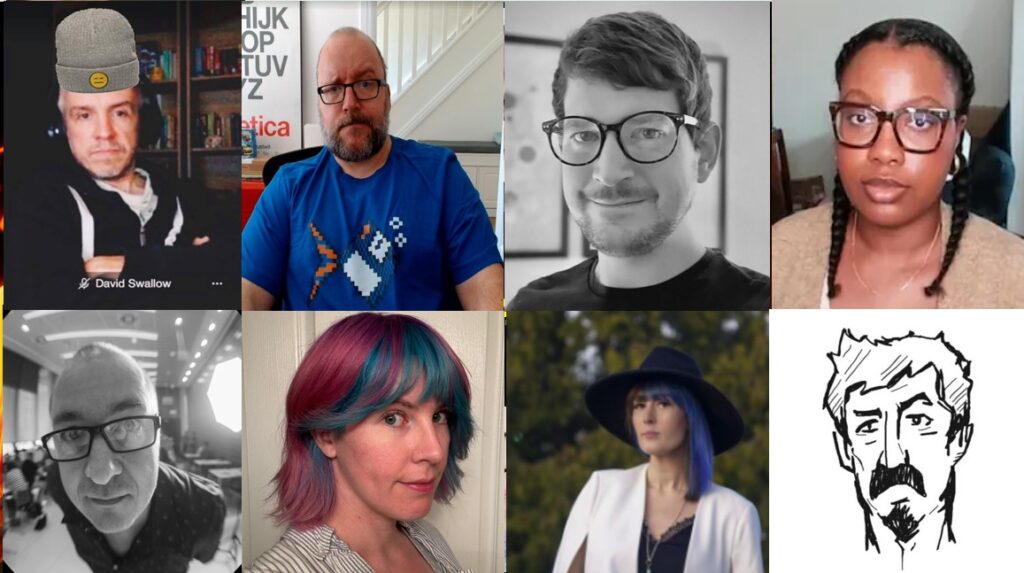
Yeah, I can see it. Excellent. So first on the left, if you can work out who this person is, I'll,  he's, he's, I'll explain why I've got these.

Cause I was trying to get, you know, I do T-shirts and things like that. And then other web accessibility is standard stuff. This is the,  this is the, the mascot of,  HTMLZ, who also happens to be a friend of mine and,  well, he's had at least, can you work out who that is?

Remember what I told you?

Wendy:
I know. And I, my brain immediately was like, Oh, he told me. And then like, whatever that sound is, Mac OS makes me send an email.

Steve:
That's Doc Swallow.

Wendy:
And it's also like, all I see is like sunglasses and hair.

Steve:
Yeah. Yeah. That's actually, yeah.

A picture of me is like, he was, he's got a bike on mine. I've actually got a picture of him standing with the, wearing the T-shirt with this coming from and standing exactly the same pose. So I should have showed you that, but, it's very good.

Yeah. But what, what I was thinking was that a way to sort of like bring in the sponsorship that, that,  the HTMLZ provides to,  the fireside chat into the actual thing. So that's why I'm using pictures from,  so you can buy that T-shirt.

but also whenever you buy something, you get a picture of that,  in black and white. So, next time. So that's Doc Swallow.

He's a very good friend of mine. He works at TPGI, highly respected, more UX than, than, but he did his PhD, he did a PhD on web accessibility at the university of York. So, I'm looking forward to seeing him next month along with,  everybody else.

Next up, do you, can you, is that too small for you? A little bit, but I'm like, oh gosh, this head, he, he, he thinks he's better than he is. He's heavily involved in, in,  well, he's involved in the WCAG 2 backlog.

He's also pointer events, editor and chair of the pointer events working group. man about town, you will know him. I'm sure you met him.

Wendy:
I probably have, it's not Patrick.

Steve:
I was like, it looks like Patrick, but then it also doesn't, but it also might just be this is another t-shirt that I made. It's called WCAG 2.2 party people. And that is Patrick in the middle of his party people.

Wendy:
I was so relaxed, you know?

Steve:
Yeah, yeah. That's, that's, we, we call it. Yeah, I won't call it there, but yeah, he does.

It's got a particular look at his face. So that's Patrick. and,  oh, what I will say is Doc Swallow.

One of the things I'm doing when I'm up in York is, getting him on the,  fireside chat. So I'm looking forward to that. Patrick was the first person to, I, I did it on the fireside chat.

Next up.

Wendy:
That's Adrian.

Steve:
Yeah. Everybody knows Adrian. I, people call him a mug.

I don't know why. Sorry. That was a bad joke.

Cause he's on a mug. The mug you can buy from,  from HMLZ.  next up.

Wendy:
It'd be embarrassing if I didn't know Leonie.

Steve:
Yes. Well, this is actually a, there was a picture from last time when I was talking with Mike Paciello, there was, it was a picture of Leone with,  with Debora Rapsis, who was one of our bosses at TPG and her daughter who did the HR, Kate. but I've just cropped them out because I thought we, you know, it would, it, you would,  not know them.

So there's Leonie. He was just a really nice photo of the three of them smiling. It was in Orlando.

I used to go,  bottom left. Yeah.

Wendy:
I mean, he's a legend.

Steve:
I was, I was, I was surprised that, when I was talking to Mike,  cause my, well, I was surprised that Mike came up with the name where it exists. Which sounded like, you know, some, some of the BS when he said it, but then,  there's a,  there's a history of WAI or early history of WAI, written by,  Danielle Dardier, who was, I don't know if he still works at W3C, but he was there for years. And,  there's a document that talks about the history of the way and,  includes, the,  the fact that, that, that, that,  the way name came from, from,  him, he discussing it with Mike.

So it's, it's amazing what you learn. Oh yeah. and yeah, so what, sorry, what I was going to say was, was that Shadi, I didn't realise that Shadi was there so early on as well, but he was powerful.

Wendy:
Oh yeah. He's,  he's one of the originals.

Steve:
One of the originals. He's still, yes, still very original. I'm looking forward to chatting to him in the coming months.

 next person.

Wendy:
That's Matthew Atkinson.

Steve:
Oh, everybody knows Matthew, don't they?

Wendy:
Cause he's the best. I love Matthew as well. I mean, everyone here is, is amazing.

 but Matthew, like,  was so happy when he got elected or selected for the tech or elected to the TAG because finally we had like a strong accessibility voice.

Steve:
Yeah. I mean, you probably know, I've worked with him for, for years and,  I don't think I even managed him at one point. Not, yeah, mismanaged.

That's my modus operandi. But, I think that since he's got involved with the W3C and, you know, he's chair of the APA accessible platform architectures co-chair with Janina and now he's here, he's on the TAG as well. He's just found his element.

He's found his people. He just, yeah. Every time I see like a TPAC or whatever, he's,  beaming.

Just like, I mean, he's a very smiley person anyway. He's a really nice guy.  next person.

Billy. Yeah. I thought you might know Billy because you, well, I wasn't sure.

Do you know a woman by the name of, or person by the name of, Shell Little? Yes. Yes.

Now I, I, for some reason, because I'd only ever seen her in, in A11YTO and when I went to Canada, I presumed that she was Canadian, but she's not apparently.

Wendy:
No, but I mean, the a11yTO community is small, but active.

Steve:
Yeah. Yeah.

Wendy:
Billy's at the center of it.

Steve:
Yeah. Billy's the, the, the black hole at the center of the,  a11yTO community. I, I'm actually, cause I love going to a11yTO and I do plan on going this year.

If the,  airfare prices aren't too, too high, but, I've been,  working well. Billy and I try to cook up some sort of form of,  fireside,  shorts where that we have, you know, like a, an event, you know, how they have event nights where people come along and just talk about stuff. So we'll, we'll see how far that goes, but, hopefully give me a good excuse to attend.

Yeah, yeah, I'll definitely, I mean, I'll come along regardless, but,  it's just nice to have something to do as well. I attended the,  meet the TAG session in London,  a couple, a month or two ago. Yeah.

Yeah. You see, because I was going to say, oh, you were on the TAG, but you obviously weren't. You're on the.

Wendy:
I was not. Yeah.

Steve:
It's probably, it's, I mean, I have this,  well not inflated, but I mean, I have this opinion of you as being a real,  brainiac. So that's probably why I thought you were part of the TAG, but.

Wendy:
I mean, it's the most flattering assumptions anyone has ever made because everyone on the TAG is so smart to be, to be, to be associated with them is a, is an honor.

Steve:
Yes. Yeah, it is. I mean, I, that I,  caught up with Brian Kardell, you know, Brian Kardell, I was really surprised.

Well, wasn't really surprised, but I was surprised that he, that he was on the TAG. I'm glad he was on the TAG. He's made it onto the TAG, but I always like I've said it before.

I always say, cause I always saw him at TPACs over the years and he was like, he's like a real political operator. he's the thinker as well. I recently,  was reading his thoughts on, the priority of constituencies, which is an interesting, yeah, interesting type.

He's coming on, in the, over the next month or two. So I'll be talking to him, but it was really nice to say, cause I know, know Brian for, for quite a few years and always seen him at TPACs and things like that. So, but I'm really glad that he's landed at Igalia, Igalia?

Yeah. Yeah. So,  cause he's like a perfect place for him.

so yeah, so that's, well, I won't go through cause I don't know most of them, but I do know, well, I do know Lola, Odolola, who,  is on the TAG and part of the, we help support her, as in Tetralogical supports her on the TAG. So, you know, doing our bit as well as Leonie being everywhere at the W3C. Oh yeah.

Yeah. Which is, which is great. but, you know, the people I've been in,  associated with the work with have always been involved in stuff at the W3C always, as you know, which I think is, is really,  which is really positive because it's always about thinking about what's coming next.

Yeah. In, in standards, in web standards in particular. So question for you,  I'll get rid of this now.

I'll stop the share. There we go.

Wendy:
I'm glad I wasn't asked to try and name everyone on the TAG currently, because I don't.

Steve:
Well, I thought that if, if you had been on the TAG that you may know some of them, but also, yeah, the pictures released, the photos are really small. And while I was there, I didn't stay for the whole period, for the whole, for the whole thing. Took some pictures and buggered off home because it was late.

Yeah. Well, it was in London. It took me an hour and a half to get what not an hour and a half took me an hour.

anyway, so question for you in regards to the,  WCAG 3 or just the WCAG in general, what is it? What, what are your thoughts about how it's used to test, native applications and e-readers and things like that, as well as,  web interfaces?

Wendy:
Oh,  it makes me wish that the user agent accessibility guidelines took off. because I think, I mean, credit to the, like everyone who worked on WCAG 2 and everyone like working on WCAG 3, that it is even possible that we're able to extend a lot of the success criteria to things like,  mobile apps and, like hardware devices, like e-readers. But there are definitely some, like huge challenges with, like, you're, you're doing a lot of reading in between the lines.

You're doing a lot of like, well, I'm going to extrapolate out of this, the like desired end goal and fill the blanks in for that. Because some things, some things are easy to like, to map and other things it's like, okay, this software behaves completely differently than, or this hardware behaves completely differently from, from the, like from the web or from, you know,  your kind of standard web browser interface. I think it's easier for things like mobile apps because the, the, you know, patterns of interaction are very similar and, you know, there's a lot of like through carryover.

It was definitely like before I, before I left KOBO, it was one of my last projects was trying to like test EN 301549 against an e-reader device and trying to think of like, okay, well, like how do we take this requirement and apply it to this device? What is it, what does it mean for a screen reader to work on a device that does not have a keyboard? You know, these very,  you know, how do we, how do we build a touch interface?

Like it's like most e-readers are touch interfaces. It's like, okay, do we use kind of the same affordances that a mobile device use? Do we need new ones?

Do we, you know, how do we, how do we do this? How does this make sense?

Steve:
It's always a challenge. So did you leave before you finished completing the project?

Wendy:
 yes, I left. So they were in the midst of a lot of the work when I was leaving was we had kind of nailed down how we were going to test. It was actually building the features and actually getting them in a place that they were functional.

And I hadn't, I haven't actually seen them functional.

Steve:
Well, it's always something to look forward to. So can I ask you this? So did you leave,  Kobo because you wanted to expect, I mean, what was the motivation for leaving?

It's okay. You don't need to say, oh, well, you know, or whatever, but I don't know. So.

Wendy:
Yeah. I mean, I think it was,  I didn't get sacked. I'll say that.

 I left in my own volition. I, one of the things that I really want is to like, I started and led the program at Kobo, which was an incredible opportunity and incredible experience. But the entire time I, you know, you have imposter syndrome.

Cause you're like trying to learn everything. And luckily I had amazing people in my circle that like made that a lot easier. at the same time, like I had to teach myself how to run an accessibility program for a software company that had multiple products in multiple countries and had to become that expert.

And it was a lot of pressure. And I really, the entire time I really wanted to be able to learn from someone else. And I had even at one point proposed to my bosses to say, Hey, what if we hired a boss for me?

Like, what if we had higher, higher, like a manager of accessibility or a director of accessibility, someone who has much more experience than I do and can like take this to the next level. And they were like, that did not fly. Cause it was like, well, you want how much money to, you know, to do this?

and so like eventually it just kind of reached a point where I was like, I really wanted to learn and build my career.

Steve:
And that's what you're finding at eBay.

Wendy:
Yeah. I'm actually the most junior person in my team at eBay and it's really nice. I'm really enjoying it.

There was also definitely like friction around, you know, what I wanted from the program and what the company wanted from the program. Or like what we were willing to do. Like, I really wanted us to be like a leader in reading accessibility.

I thought it was an opportunity for us to really stand out even more against our big competitors. Yeah. And some people agreed and other people were like, you know, but these things are hard to implement.

Can we just do, you know?

Steve:
Yeah. The min. Yeah.

Oh God. So,  that was Kobo and then now eBay and you're involved at the W3C. So what, I mean, what do you do, you know, when you're not doing this stuff?

I mean, what would you have hobbies? You do you have a lot?

Wendy:
What are those? I, I, I even have less of a life than usual because I'm also actually literally this week. I am wrapping up my final project for my master's degree.

I'm doing the master's of inclusive design at OCAD university here in Toronto. so on Wednesday I have to submit my, my final project. so even less time.

Steve:
Yeah.

Wendy:
Yeah. Even less time than usual.

Steve:
Is that the university that's downtown? Yes. Yeah.

Because usually I, I stay at least part of the time at the,  the Rex, which is on Queen street. And then you walk up from there and there's, yeah, I've got some nice pictures of interesting architecture that I have there.

Wendy:
Yeah. The OCAD building is that very odd building on stilts.

Steve:
Yeah.

Wendy:
It's actually quite close to the Rex. Yeah. The OCAD campus.

Steve:
Yeah. I know. It's got those.

Yeah. Yeah. Oh, cool.

so have, so you, you doing your master's, so you'll get, you'll graduate.

Wendy:
In June, hopefully.

Steve:
Yeah. It's like my oldest daughter is, just is graduating in June from university, from a local university here. So good times.

Wendy:
Yeah. And I mean, if I'm not doing that,  in my like incredibly limited other time, I am probably reading, playing video games or going to sporting events.

Steve:
What sort of sporting events do you like?

Wendy:
I am a huge hockey fan. in true Canadian fashion, I'm a huge fan of the,  Toronto scepters, which is our like professional women's team.  I like going to, I can't afford to go to Toronto Maple Leafs games cause they're too expensive.

I'm also not that big a fan. I'm a bigger fan of another team in the NHL. but sometimes I'll go to like the lower league games cause they're cheaper and they're more fun.

huge baseball fan Toronto Blue Jays, of course.  so I like to go to their games in the summertime and then, I mean, otherwise, like I love going to, like, if there's like an event in town, that's,  you know, like when we had a couple of years ago, we had like the Pan Am games, went to a bunch of those events. it's like sports.

It's like, I like watching people be really good at their thing.

Steve:
Of standards and work, which is an important, important thing. I'm just, I was just taken by that.  what's that little figure you've got to on your, in your bookcase?

it's, it's like a,  Funko pop looking thing. No, no.

Wendy:
Oh, this?

Steve:
Yeah.

Wendy:
This is a Charlie Brown,  themed Blue Jays bobblehead.

Steve:
Uh-huh.

Wendy:
Yes. Well, I have, I have a lot of Blue Jays merchandise as you can imagine.

Steve:
Yeah. My, my youngest daughter's got like, I don't know, more than a hundred, Funko pops of, of she's like every, every Funko pop associated with the game of thrones, that sort of thing.

Wendy:
So that is impressive. Yeah.

Steve:
I do not have that many. Yeah, it used to be my, in, in, in this room, but then we swapped rooms, but, she also loves,  building,  Lego as well. So our whole house is a mausoleor musefilled with Lego.

 well, it's, it's good because I, I didn't actually know whether that was, was a real background, but indeed it is.

Wendy:
It is a real background is my real collection of both junk and books.

Steve:
And do you live in, well, you don't have to say, you know, where exactly where you live, but you live in Toronto.

Wendy:
I live in Toronto. I live in the city.

Steve:
Oh, nice.

Wendy:
Not just in a suburb and just tell people that I live in Toronto.

Steve:
Yeah. But it must be expensive though. I mean, it's expensive to live there.

Wendy:
It is expensive to live here. I don't, I don't know how we manage it, but it also is like, it makes the most sense. we both, like both my partner and I live and work downtown.

So I also, I grew up, I grew up in the suburbs of a city called Mississauga, which is just outside of Toronto and spent every free minute going into the city that I could as a teenager.

Steve:
Yeah.

Wendy:
And so I knew like, as soon as I had like adult money that it did not matter, I was going to, I was going to move downtown. I couldn't stay in the suburbs a minute longer.

Steve:
Yeah. I mean, I, you know, as I say, when I come over, I generally stay in the, in the city around the belts. I love walking around Toronto.

It's a great, great town.

Wendy:
I'm obsessed. I I've, you know, standards results in us traveling to a lot of very exotic and beautiful cities around the world, which sounds very romantic, I think to people when you tell them about it until you tell them that I've just seen like the most,  most interesting hotel conference rooms in a variety of very cool cities. but I always get excited to come home to Toronto because as much as I've loved every place I've been home is, home is my favorite.

Steve:
Home is where the heart is, so they say. are you planning on going to,  TPAC in,  November this year in Dublin?

Wendy:
I'm hoping, I'm not sure if I will be able to, but I'm hoping to, because I mean, I haven't been to Dublin since my first year of university and,  I was there for like, I think 48 hours and wasn't sober for most of those. So I'd like to actually see the city this time.

Steve:
Well, if you go to TPAC, you'll just be in the hotel. You know, you're not allowed to go out.

Wendy:
Yeah. We're not allowed in TPAC. They lock the doors when we get in there.

Steve:
So I would,  hopefully I'm going to go, because also,  one of the people that I used to work with a guy called Charlie Pike, who was part owner of TPG at the time, he lives in County Wicklow, which is just South of Dublin. Beautiful area. I'd like to, to visit him, but we'll see because, because a11yTO and, TPAC very close together, I think in time.

Wendy:
I think so.

Steve:
They're like a week apart from each other. Yeah. We'll wait and see.

So in regards to your work at the, at, in eBay, do you get, do you get to, to do presentations and things like you go, do you get encouraged to, to talk about what you do?

Wendy:
Yes. that's another reason I think I've, I've been enjoying my time there is that like encouragement and,  kind of push for us to, I think, present externally. So I was at CSUN, presented with my colleagues at CSUN, which was really fun.

I'd never been to CSUN.

Steve:
Well, you picked the badge here, but you know, it's still a good conference.

Wendy:
It was a good time. I had a good time.  it was an amazing experience.

I, so we gave a talk about AI, and our experience using it for a specific project. And I leading up to it, my colleague and I were writing it and we're like, oh my gosh, are people going to think we're like really negative about this? Cause we know we, we added a lot of caveats and we didn't realize that by doing that we would,  write one of the like more honest talks about AI that was given at the conference.

And we got a lot of great feedback about people really appreciating, like us being realistic about our experience and talking about the pitfalls. It is available. I don't have a recording of it, but our slides are online.

So you can, you can get it from our slides.

Steve:
Yeah. I'll get you to just send me the slides or send me, yeah, for sure. Because I, yeah, I'd like to collect a few, few things to put on the post when I publish.

oh, that's, that's really good because I mean, it's always been a thing with me that, that, sharing the knowledge and, and, you know, getting, and, you know, being collegiate about is cause the aim, I think the aim is, is to make things more accessible and you make things more accessible by holding knowledge back from people.

Wendy:
Yeah. This is, this is a big thing that I am really concerned about with, like in our industry is I think when, like, when we get together interpersonally, like if you're just like, you see someone and you're chatting with someone, I've had like just amazing conversations where we're talking about our programs or we're talking about like the challenges we're having, but we can't seem to do that at like a, in a more organized fashion.

And I think a lot of like, it is very strange. I find like how secretive some companies can be about their accessibility programs or like even sometimes getting an answer about like, Hey, how many people do you have employed who do accessibility? And it's like, oh, well, you know, it's,  it's distributed and you're like, okay, well then how many full time and part time?

Like, you know, how many people have any percentage of like their job description? You know? And it's like, no, like it's helpful information because I think like, it is really hard to say, like, is your team the right size?

Because you have no way to compare, you know, is my team structured the right way? Do I have the right people in the right places? Because it's near impossible unless you work at another company to know like, oh, well, this team is structured like this.

This team is structured like this. And I don't get why we have to be so secretive about these things. Because it only helps each other.

Steve:
Do you find that is a general thing? Like many companies are secretive or, I mean, because when you started talking, I immediately thought of Apple because Apple doesn't allow people to say anything.

Wendy:
Yeah. I think it's especially true I find about accessibility for some reason. And I think it's because of like the legal landscape.

And especially in the US, like not as much in Canada, the Canadian legal landscape is very different. And obviously we have Europe now too. But because of that, like risk around litigation, people are incredibly, you know, tight lipped about anything that could invite like a lawsuit.

Like if you're too public about like the gaps in your program or, you know, areas that you would wish you were doing better in, I think there's like this impression that, oh, if I say that in a public forsomeone's going to jump up, run out of the room and call their lawyer and be like, let's, you know, we're suing for, you know, they said they have problems with their menus, like, you know. And it's like, for one thing, that's not really the case. And it's also like, hey, there's ways to have these conversations without that risk.

Steve:
Yeah, I mean, it's, you know, if you're talking about problems that you're encountering in the process of fixing stuff or create, I mean, how can you be not knocked around for that? But yeah, I mean, Apple are just weird, as far as I'm concerned. But yeah, but I do, I have, yeah, depending on, I think you're probably right, it's got something to do with the culture of the culture of the legalistic culture of American companies in particular.

Wendy:
Yeah, it's hard to in like accessibility world, because lawmakers make these legal frameworks and people who work in accessibility, actually use these frameworks. And we have two very different opinions on how these things work. And, you know, but of course, the lawmakers write the laws.

And so you end up in these awful situations where it's like, well, we have to be 100% conformant. It'd be 100% compliant. And meanwhile, every professional is like, there is no such thing as 100%.

Steve:
Well, I mean, that's part of the fault of that is down to the way WCAG has been structured that you either, you know, any issue that's found, you either fix or you fail. It just, yeah, it's not realistic. And I think part of WCAG 3 will be, you know, that the conformance model will be tweaked.

So, I mean, I'm not trying to say that people shouldn't fix everything. But there's some things that, you know, people prioritize anyway. I mean, when we do our assessments, we provide our ideas about the prioritization.

You know, it's like there being a typo in a document and there being a mistruth. You get rid of the mistruth before you tackle the typo. I mean, it just makes sense.

Wendy:
But no, it's a really weird, like, environment we kind of find ourselves in where everything is treated like an emergency, which is like, oh, you have to fix this, like, bit of link text that is, like, at the very bottom of the page that, you know, it's not perfect. It says learn more or something. And that's like, you're not conformant because of that.

It's like, I would much rather focus on the fact that, like, the usability of our, like, top navigation is conformant but sucks. Like, you know, I'd rather deal with these bigger problems that actually impact the day-to-day function of my site or my product than chasing after, like, oh, the, I don't know, like, images and text.

Steve:
That is part of the issue with getting third party to assess and using automated tools and all these things is you get a slew of information but you don't, you've got so much that it's overload. So, you don't really know what to do with it. So, you need to be able to sort it into priorities and all those things.

And you need to be able to sort, you know, get rid of the false positives, which always creep into things. I mean, I know I'm speaking to the choir here, but as you realise that we pride ourselves on not using automated tools in order to do site-wide stuff and the issues that we raise are pretty strictly based upon the interpretation of WCAG. But based on a strict interpretation, not that, oh, I wish that it would be.

Because, especially, you know, in the legal framework, that if you have, if you're saying it fails X but in fact it doesn't fail X or, you know, success crierion X, it's just your interpretation of it, which is not grounded in the reality of it, you're going to end up screwing around, you know, screwing over the people that you're doing the work for.

Wendy:
Yeah, I think the biggest thing that I, I was fighting for it for a while and kind of got tired, but I know other people are still fighting for it in WCAG 3, is like a much more flexible and context-appropriate conformance model that reflects the fact that, like, and I think we can go even further with this, but I don't think, I don't know how far I'll get with this, where, like, every website is different, different business areas have different needs and different priorities.

There are things that have a much higher impact on usability than others. And I would much rather be able to put my time and energy into the things that most impact the usability of my site for people with disabilities than getting lost in a lot of really small details that you're chasing after me to be like, but you have to be 100%, and to be 100% compliant, you must do all this, like, not, not inconsequential stuff, but not nearly as important stuff. Yeah.

And of course, the problem is, is like, having those conversations about flexibility and introducing, like, opportunities for people to, like, be more in one, focus on one thing than another, like, almost inevitably results in someone accusing you of not caring, caring about, insert disability group here. And it's like, that's not what I'm saying. Yeah.

Steve:
Yeah, it is a practice, it's space to be in, but it's still worthwhile trying to, you know, to improve, because what I hear from Andrew Kirkpatrick, who you know, and Shadi, who are also members of the working group, what I hear from them when they is talking about the, the practicalities of, of basically no, no site passes.

Wendy:
So, yeah, yeah, we need, I think we need a lot more representation from people that are like, and representation, not only just like, in, like, that they're there in the meeting, or that they're like, on on the participants list, but like active participation. And I'm guilty of this myself, of like people who are doing this every day, and saying like, hey, I have to deal with 100 bugs. And it's driving my developers insane, because a bunch of them are, you know, P4 trivial things, and I'm demanding that they have to do this when I could be like using their time to, you know, address these usability issues that are not technically WCAG failures.

Yeah. But, and it's like, I want a system like that. But I think we also like, there needs to be a bunch of us who are in that world, probably screaming, screaming from the rooftops for it.

And it's hard, it gets exhausting.

Steve:
There's a fair way to go on that. I think there was, there's going to be some virtual meeting of, for the conformance subgroup and over a couple of days. So yeah, I put my hand up for it, because I was interested.

But at the same time, yeah, it's, I find it hard slogging that with certain people in that group. So yeah, so it'll be fun. I'll be there.

Wendy:
It'd be fun. We'll be, yeah, I gotta check my emails. And maybe I'll be there too.

I said I was going to do it the last time. And then I was, I preserved my mental health.

Steve:
Yeah. Well, I'll just, yeah. I mean, I'll just sit in the cheap seats and listen to other people.

Okay. What's the time? How are we going?

Wendy:
I have to run actually, yeah.

Steve:
Oh, well, no, no, no, you have to stay here for at least another hour and a half. No, it's just a bypass. Thank you, Wendy.

It's been really nice to speak to you. I don't think, what I was going to say is that I've met you various times, but I don't actually had a conversation with you, which is my fault, not yours. It's really nice to converse with you.

And when I, hopefully I'll see you in AccessibilityTO.

Wendy:
Hopefully. It was great talking to you.

Steve:
Yeah. Thanks, Wendy. I'll say, oh, I was going to, I almost forgot.

Choose something from HTMLZ and tell me what it is. Give me your mailing address and it'll be on its way.

Wendy:
Okay.

Steve:
All right. Yeah. And yeah, it's lovely to talk to you.

Wendy:
All right. It was great talking to you too. I'll have a great rest of your evening, I guess.

Steve:
Yeah, yeah. It's six o'clock here.

Wendy:
All right.

Steve:
Bye.
Some stuff mentioned
- Wendy Reid
- WCAG 3 Conformance (exploratory)
- accessibility at ebay
- Sports in Canada
- Doctor S the UX nightmare slayer Short Sleeve T-Shirt
TAD – Jack Pepsi
Lyrics
One night me and my friend
Jack Helton from Nampa, Idaho
Decided we were gonna take his dads
Brand new 4 x 4 pick up
Out for a ride on Lake Lowell
Well we had a belly full of Jack Daniels
And some Pepsi, too,
And we decided
We going for a ride!

Well we got out on that ice and started
Spinning around doing
360s and 180s all over the place
Suckin down Jack Daniels
As fast as we could
That's when I heard the most horrible sound
I ever heard in my life!
And I knew we
Going through the ice!

Help me Jack Pepsi!

Well we broke through the ice
Sunk down to the bottom
The water starts rushing in
Through the doors
And the windows.
I started freaking out
And Jack says Hey man,
If we're gonna make it
Through this alive
You are gonna have to settle down
And breathe the air off the roof
While the water rushed in!

Help me Jack Pepsi!
Help me Jack Pepsi!
3 replies on “WENDY FIRESIDE”
[…] Video: Wendy Fireside Steve Faulkner: each time I have encountered her (including now by the fire), she has struck me as brainiac. […]
[…] Video: Wendy Fireside Steve Faulkner: each time I have encountered her (including now by the fire), she has struck me as brainiac. […]
[…] WENDY FIRESIDE […]